Studies: Using social networking at work

We all use them, we all use them on a daily basis and who has had success getting engaged loves them: social networks. Now, Deloitte comes up with some interesting insight in the view CEO’s use social networking for their companies reputation. According to the third annual Deloitte LLP Ethics & Workplace survey, 60% of business executives believe they have a right to know how employees portray themselves and their organizations in online social networks. Yes, a lot of us know the importance of social networks on our business, … and for our personal branding today. But not all…

What strikes about the results is that only 17% of executives surveyed say they have programs in place to monitor. 55% of executives admitted that their companies do not have an official policy for social networks. 22% would like to use social networks, but don’t know how. Seems unbelievable but we all have to understand that the use and benefit of social networks might differ from industry sector to industry sector.

Having heard this in some conversations with companies in the last months, I tweeted the Intel social media guidelines for companies that have not yet seen an example of how to handle employees that engage in social media or social networking. It’s for those who ‘participate in social media on behalf of Intel to be trained, to understand and to follow these guidelines.’ And yes, this is a short and easy to read and understand version. The IBM guidelines read a bit more complex but should be understandable for every executive.

On the other hand the study shows that nearly half of the surveyed employees (49%) indicate concrete guidelines will not have any influence on their behavior online. And they disagree that the company should be looking in their social networking activities intensely (53%). Especially the young employees in companies between 18–34 years think employers should not be monitoring their online activity (63%).

Deloitte’s Sharon Allen, chairman of the board, makes clear that using social networks bears also a risk for employees and employers.

“While the decision to post videos, pictures, thoughts, experiences and observations is personal, a single act can create far reaching ethical consequences for individuals as well as employers. Therefore, it is important for executives to be mindful of the implications of this connected world and to elevate the discussion about the risks associated with it to the highest levels of leadership.”

Spot On!
Personal branding becomes more important for employees and goes hand-in-hand with companies having a close eye on it in the future. Especially from an human resources perspective as we could see this week in the research results by Jobvite. So, employees should be aware of the point that employers will be monitoring social networking activities in the future more than in the past. It seems that there is some valid reason for my personal web manager vision.

“One-third of employees surveyed never consider what their boss or customers might think before posting material online,” states Sharon Allen, chairman of the board, Deloitte LLP. “This fact alone reinforces how vulnerable brands are as a result of the increased use of social networks. As business leaders, it is critical that we continue to foster solid values-based cultures that encourage employees to behave ethically regardless of the venue.”

The US telephone survey was conducted by Opinion Research on behalf of Deloitte LLP among 2,008 employed adults (1,000 men and 1,008 women 18 years of age and older).

News Update – Best of the Day

29.05.2009 von Martin Meyer-Gossner  
Kategorie: Daily Top 3

Gamers like ads according to a study in the UK. BizReport states that “many (65%) believe in-game ads add to the realism of a gaming environment and 55% go so far as to say ads “look cool”". And the study finds brands advertising in-game are reaching affluent, brand-literate young men. But also that around 40% of gamers are women…

When we think of case studies for social media, there is the mentioning of Dell, Zappos and Starbucks. In terms of retailers, there is another one that is not so famous in Europe compared to the other examples but it might change with the acquisition of 50% of Carphone Warehouse’s European stores. Yes, we are talking of Best Buy. Robin Grant summarizes insights of their success in the social media arena.

One of the most amazing virals comes from Mayo Clinic. Scott Meis explains the whole story of the main actors, the reasons for the success of this video and … this is why I have chosen to integrate this into today’s news… pics my favorite topic as the last successful argument: bridging online with offline. Yes, this is what makes the business of the web world a winner.

News Update – Best of the Day

The difference between Facebook pages and Facebook groups is…? Well, if you still don’t have the proper answer… OK, here is one of the finest explanations by Howard Greenstein that I found on the web for those companies that evaluate on smaller or bigger interaction on Facebook.

Companies still ask what the return for investing in social media is. Beth Perdue summarizes some great suggestions from experts at the New England Xpo for Business at Boston in terms of how marketing mentality is shifting. Definitely an interesting read…

Finding good case studies for social media marketing is not easy. Del Monte Foods has created a great example in just six weeks. Adage focuses a speech by Forrester Research’s Josh Bernoff. Watch it and learn from it…

Werbewirkung von Werbeformaten im Web: Es zählt, was unterhält…

Der Onlinevermarkter Tomorrow Focus hat die Ergebnisse der ‘AdEffects 2009′ veröffentlicht, welche die unterschiedlichen Werbewirkungsindikatoren für sechs verschiedene Werbeformate aus 13 Kampagnen zeigen.

Basis der Studie unter knapp 4.500 Nutzern ist eine Onsite-Befragung im Netzwerk der Tomorrow Focus. Etwas wenig aussagekräftig kommt das Ergebnis daher, welches besagt, daß alle Formate je nach Dimensionen ihre Stärken haben. Keines der Werbemittel wird durchgängig gut oder durchgängig schlecht beurteilt, so dass für jeden Anspruch, egal ob Performance oder Branding, das entsprechende Format auf die passende Weise wirkt.

Dennoch stellt die Studie mit einem Ranking der effizientesten Onlinewerbe-Banner auf, welches als Indikator bei der Planung von Mediakampagnen hilfreich sein kann. In sechs unterschiedlichen Kategorien konnten bis zu fünf Punkte gegeben werden, so dass ein Bannerformat unter dem Strich maximal 30 Punkte erreichen konnte:

1. Banderole Ad – 27 Punkte
2. Video Ad – 21 Punkte
3. Medium Rectangle – 15 Punkte
4. Skyscraper – 14 Punkte
5. Wallpaper – 14 Punkte
6. Super Banner – 11 Punkte

Das Banderole Ad gewann in fünf von sechs Kategorien mit der höchsten Punktzahl. Dennoch scheint es für Awareness nicht geeignet, wo es gerade mal mit dem Skyscraper auf einer Ebene liegt mit zwei erzielten Punkten. Es verwundert auch nicht, daß das Video Ad im Kommen ist und mit hohen Klickraten und guter Awareness hoch punktet.

Das Medium Rectangle erscheint neben der Banderole als das reponseträchtigste Format. Die Autoren der Studie bezeichnen das Banner als den ‘Allrounder’ bezeichnen – vielleicht wäre das ‘Aktivierende’ eine treffendere Bezeichnung gewesen. Auch wenn die Werte durchschnittlich positiv sind.

Spot On!
Generell gilt: Was unterhält, hat Aussicht auf Erfolg. Da unterscheidet sich die Internetwerbung nicht von der TV- oder Radiowerbung.

Dennoch ist die Begeisterung und Akzeptanz für Banner in der Nutzerschaft weiterhin nicht überwältigend (alle analysierten Banner-Formate erreichen gerade mal einen Akzeptanzwert von 3,36). Der Nutzer empfindet Banner immernoch als störend, akzeptiert aber inzwischen die Massnahme als Refinanzierungsmittel wie im Print, TV oder Radio auch.

Das Web ist eben nicht kostenlos und Banner sind immer noch die Monetarisierungsform Nummer 1. Ohne Werbung kann kein Medium langfristig existieren und dann bleibt dem Mediengeschäft wohl nur eine Zukunft mit Paid Content – und die werden dem User wohl auch nicht gefallen. Wer glaubt, daß Web 2.0 könne sich als werbefreie Zone etablieren, dem sei die Illusion hiermit genommen.

Die Ergebnisse sind aus B2B Sicht mit Vorsicht zu genießen, denn eine Unterscheidung zwischen B2B und B2C Zielgruppe muss bei der Auswahl der Bannerformate auf jeden Fall bei Kampagenplanungen berücksichtigt werden – und in der B2B Zielgruppe wage ich mal zu sagen, daß die Banerdole nicht angesagt ist.

Grundsätzlich decken sich einige Aussagen der Studie mit Ergebnissen einer weiteren Studie von AdTech.

Der gesamte Ergebnisband der Tomorrow Focus Studie ist hier einsehbar…

News Update – Best of the Day

Procter and Gamble just released an interesting case study, saying that community building is four times more effective than advertising.

Stereotyping is not a good deal in terms of getting attention through social media. Viewing the case study of the Langham Hotels in Hong Kong, it shows that companies have to be careful dealing with social media in a correct and cosmopolitan way.

Sometimes it is just great fun to see banned adverts – Coca Cola at it’s best.

Panel: Diese Web 2.0 Dienste nutzen deutsche Web-Profis

Das Marktforschungsinsitut Innofact AG ist der Frage nachgegangen, welche Web 2.0 Dienste wie Twitter, Youtube, Flickr, Facebook, etc. von den deutschen Web-Professionals genutzt werden.

Darauf basierend hat Innofact ein Ranking erstellt.
Web-Experten nutzen folgende Web 2.0-Services…

1. XING 85%
2. Facebook 59%
3. Twitter 50%
4. StudiVZ 32%
5. LinkedIN 28%
6. De.licio.us 23%
7. MySpace 22%
8. MrWong 19%
9. MeinVZ 16%
10. Wer-kennt-wen 16%
11. Stayfriends 12%
12. Lokalisten 12%
13. lifestream.fm 5%
14. Friendfeed 4%

Auch wenn Facebook die Nummer 1 unter den Social Networks weltweit ist, setzen die deutschen Interactive-Cracks noch vermehrt auf XING, und Facebook muss sich mit Platz 2 begnügen.

85% der Web-Experten nutzen XING – so kann das Business-Netzwerk die stärkste Verwendung vorweisen. Und wenn 44% davon es hauptsächlich beruflich sowie 35% beruflich und privat nutzen, dann zeigt das Panelergebnis klar, daß der avisierte Fokus der Betreiber sich durchgesetzt hat. Zur privaten Nutzung kommt Facebook zum Einsatz (35%). Aber Facebook ist im Kommen auf der beruflichen Ebene: 21% nutzen das Netzwerk geschäftlich und persönlich.

Und Twitter?
Der Microbloggingdienst Twitter liegt derzeit an dritter Stelle. Gerade bei den Trendsettern und Bloggern hat sich Twitter als neuer Kommunikationskanal durchgesetzt und jeder zweite Web-Profi setzt inzwischen auf den Informationsgehalt und die Distributionsstärke des Micro-Blogging Dienstes (50% schreiben mehrmals pro Woche eigene Tweets und 64% lesen genauso häufig die der anderen Nutzer). Die berufliche und private Präferenz ist schwer zu definieren, wobei die gleichzeitige Nutzung beruflich und privat leicht führend ist.

Spot On!
Die Zukunft gehört offensichtlich dennoch Twitter. 63% der befragten Experten sehen eine steigende Bedeutung von Twitter voraus. Daß fast jedes größere Unternehmen Twitter-Account haben wird, sehen 56% der Befragten. Ob Twitter Facebook oder XING als ‘the next big thing’ zukünftig überholen wird, hängt sicherlich von der Refinanzierbarkeit des Business-Modells ab, die derzeit noch schwer unklar ist und heiß diskutiert wird.

Im Rahmen der Panelstudie von Innofact in Kooperation mit deutsche-startups.de wurden 941 Internetnutzer aus Deutschland sowie 301 Internet-Nutzer aus der Schweiz zu den Schwerpunktthemen Kommunikation im Web 2.0, Tendenzen im Online-Shopping, Mobiles Internet sowie Gaming befragt.

Candidate 2.0: Did you find a new job using social media?

This week, there has been the Careerbuilder example on how using social media might effect your career in a negative way, and also on how to restore it. This post is meant to turn this topic into a positive point of view scenario.

Isn’t it a better idea to look for positive examples on how candidates 2.0 were successful finding a new job with their social media activities? And how they did it, or what they actually did?

We all love success stories, don’t we? That is the reason why this post was created…

So, if you were interested in online reputation this week…, you could come across another two interesting posts concerning how to influence your career with social media. Both were meant as a positive advice, although one had a negative connotation. One, on how to promote your personal brand via social media, and another one on 30 examples how Twitter can ruin your career.

Some examples of the second post definitely show a quite amateur behavior and these people probably got themselves into serious trouble. Still, the question remains if those people really need to be fired immediately, or just criticized, or are we not all becoming cooler with the future use of social media world in terms of career aspects… and don’t take every word with a pinch of salt.

Having written that, I am still waiting for the first relevant study on how many recruiters use social media as a pre-selection tool for potential candidates. We probably all agree that recruiters and hr managers use social media in an intense way, and increasingly for their research – but we do not know how or in which way.

A friend of mine, who is a recruiter for one of the big worldwide recruitment agencies told me that there was not one job applicant that has not been screened via social media tools or platforms in 2009. So, there is a need for people to know what is happening and a study could do people some good.

Today, I have even seen that we already have a Social Recruiting Summit. If this topic is evolving in the recruitment arena, then it definitely makes sense to ask some questions. So, coming back to my headline…

Who can say he/she has found a job using social media?

And to give this topic more relevance and transparency for the future, I would appreciate if you could take part in our following poll …

Candidate 2.0 – Online Reputation: In the eyes of recruiters and hr managers, will (micro-)blogging pay out when applying for a new job?

Spot On!
Now, one thing is for sure: If you are applying for a new job (or even evaluate doing it), there are definitely some reasons to choose your words wisely in communities, social networks or (micro-)blogs.
But isn’t this what we all knew before? Was this not written in our employment contracts? Don’t talk about internal stuff… Your voice becomes public in communities, once it goes live on the web – and the push factor in communities might be massive. Not only because people like to ‘tweet’ and ‘re-tweet’ things. This is not a Twitter phenomenon – status updates are also on Facebook, Friendfeed, XING, etc…

News Update – Best of the Day

In recession times people think about improvement, re-structuring and effective changes in companies. Definitely one option is turning the business into an enterprise 2.0 business. And here are some links that explain the benefits of enterprise 2.0…

Newsgator shares insights in seven ways to cut costs with enterprise 2.0. A valuable post on how to save money and get the ROI thoughts on integrating social software tools.

Ross Dawson presented to a group of CEOs of large organizations how to prepare for an organizational change with enterprise 2.0 – and writes ten ‘dos and donts’.

Madan Sheina writes on the basis of web 2.0 in an enterprise 2.0 company and aks if it works.

PS: Forrester just launched a report which states that nearly one in two businesses will make use of enterprise 2.0 software.

Study: How women use blogs and social networking…

A recent study Women in Social Media from BlogHer, iVillage and Compass Partners, shows that the motivation of women using blogs and social networking differs. Blogs for women follow the purpose to find the right information while social networking platforms have the ‘mere’ sense to connect.

The results state that US women are nearly twice as likely to use blogs than social networking sites. Blogs are seen especially valuable as a source of information (64%), advice and recommendations (43%), and opinion-sharing (55%). Social networking sites are more used to share their strong affinity to connect and to entertain themselves.

Women show much more interest and increase their activity in social media. So, women are turning to blogs (55%), social networks (75%) and online status updating (20%) to satisfy their interest.

The new study found that women spend less and less time engaging in traditional media activities like watching TV, listening to the radio, or reading magazines or newspapers.
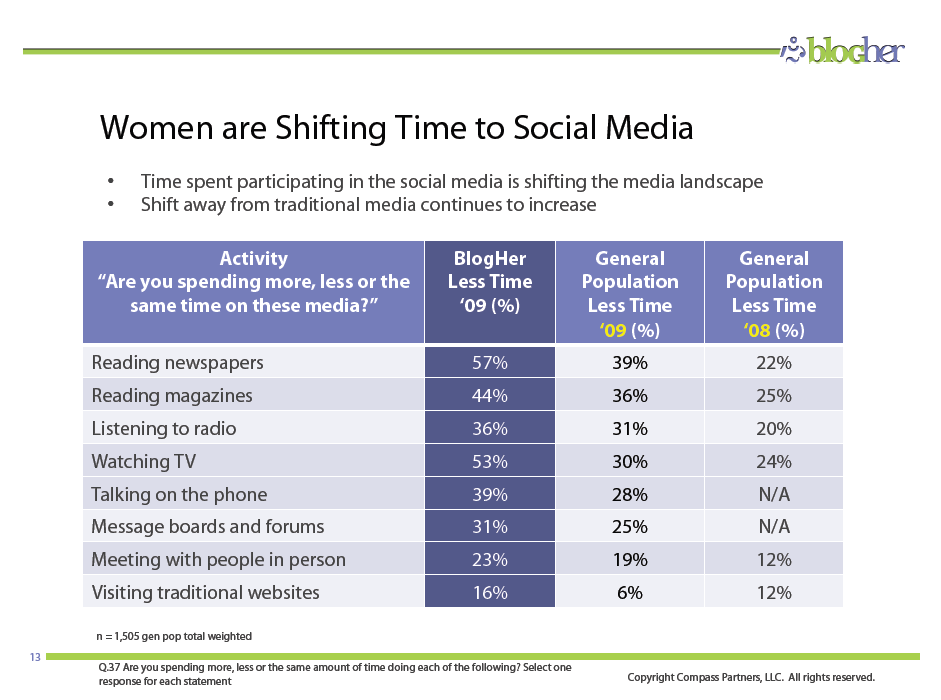
And for women blogs are becoming more and more important as a trendsetting and purchase sources of information. Seeing the influence of blogs on purchase decisions, the study makes clear that women are more likely to buy a product after reading a customer post or reports about the item. 45% of survey respondents bought a product after reading about it on a blog.

“The scale of social media usage among US women continues to grow, and blogs remain the go-to resource for those who want to gather information, share ideas and get reliable advice,” said Elisa Camahort Page, BlogHer co-founder and COO. “At a time when the economy is top-of-mind for more than 70% of these active social media participants, women who blog are turning to online resources, including blogs, to help them make their day-to-day purchasing decisions.”

Spot On!
The influence of blogs on purchase decisions shows the importance for companies to evaluate blogs as a new important part for their media plans. Reading about the habits and attitudes, the study revealed that half of the survey respondents participate in social media activity daily and weekly or more often. When we think of the 42 million women participating in social media weekly, 55% of women do some form of blogging activity; 75% participate in social networks (i.e. Facebook or MySpace) and 20% are using Twitter. The data provided shows the change in the media landscape. While traditional platform face a decrease of importance, social media is on an all time high. The time seems right to rethink traditional and digital media planning.


News Update – Best of the Day

Three examples how to use social media for medical needs and purposes…

UNICEF – The association are running a campaign to raise money to eliminate a preventable disease that kills a child every three minutes: newborn tetanus.

Physicians – See this presentation on how physicians use social media in medicine (US example).

Medicine 3.0 25 Excellent Social Media Sites for Your Health

Nächste Seite »

Get Adobe Flash playerPlugin by wpburn.com wordpress themes