Infographic: Why mobile will fuel the future of business…

31.05.2011 von  
Kategorie: English Content, Mobile

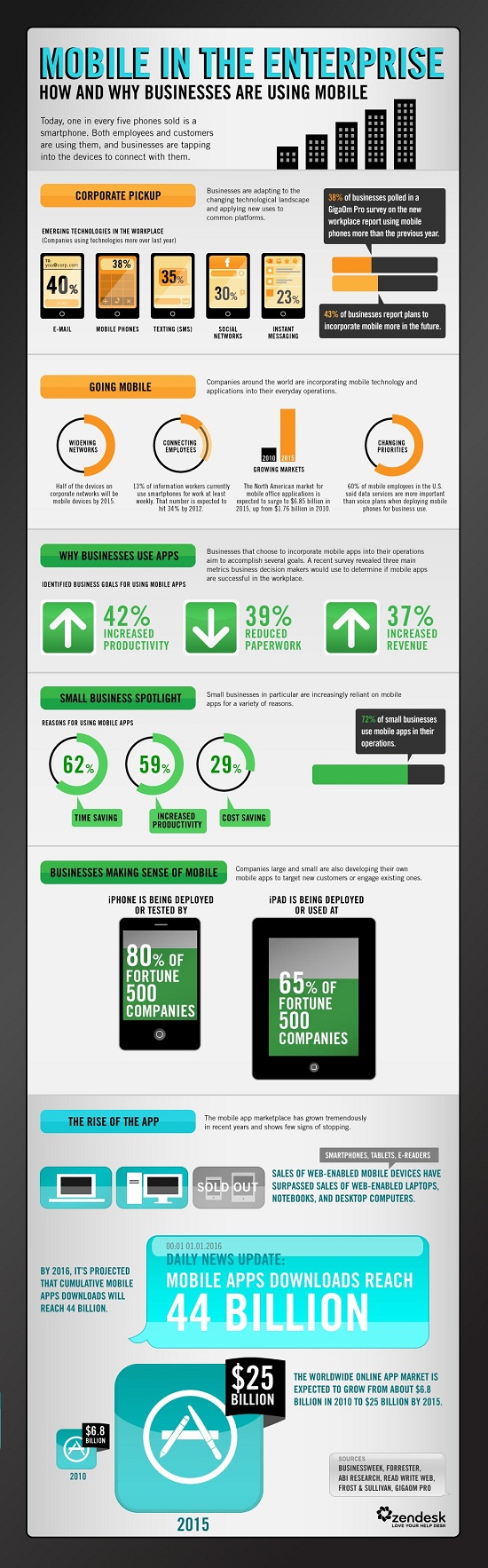
Mobile apps and technology is becoming increasingly important for companies in order to increase productivity, generate revenue, approach a new client generation and to get rid of paper. Thsi states a study by Zendesk which highlights the results in a nice infographic… and it reminds me of some research data of a Microsoft study.

The Zendesk research found out that 43% of businesses are planning to increase mobile technology for business purposes by 2015. Corporate networks will see half of all devices being mobile devices until that date. The business use of mobile apps is expected to grow on a worldwide basis up to of $25 billion by 2015 (approx. $6.8 billion in 2010).

Study: Understanding the value of brand advocates…

Recommendation marketing is one of the most compelling ways to approach buyers. If these recommendations are coming from the social graph, people tend to trust them even more. If those recommendations are coming from brand advocates who love to talk about brands and their activities connect to them persuade the opinions and purchase decisions of many others, the value for sales and marketing from a word-of mouth point of view cannot be underestimated any longer, concludes a study by BzzAgent (recently acquired by dunnhumby Ltd.).

Study definition of brand advocates: “Brand advocates are people who habitually review products and share their opinions with others around them.”

The study on brand advocates by social media marketing agency BzzAgent concludes that these “heavy users” of social media were 83% more likely to review products and share their opinions than the control group of Internet users. The BzzAgent research makes clear that brand advocates share their experience on the brands they like offline and online: at the water cooler, in (online) shopping areas, or on social networks. Brand advocates are, according to the study, two and a half times more likely than other Web users to use social media to expand their social ecosystem.

A lot has been said about the motivation of brand advocates. This report suggests that while the people are altruistic as well as selfish in their responses, they are also brand advocates just to be social from a conversational perspective. Maybe you find some more helpful information in the BzzAgent infographic on brands advocates…

“They use these conversations as icebreakers to connect with people (…) which runs word-of-mouth marketing campaigns through its 800,000-member advocate network for clients such as Procter & Gamble, L’Oréal, and Welch’s. They meet new people there. This is recreation for them. They like to brag about positive experiences.” Malcolm Faulds, SVP of Marketing, BzzAgent

Spot On!
The emerging field of brand advocacy and its challenge remains first of all in the identification of brand advocates, and to understand the difference in male and female brand advocates, and counting in how volatile brand loyalty could be. Although products like Klout, Radian6 and SM2 are useful tools in this process, for me those tools often don’t really reflect the intensity of “brand love” and the trustworthy reliance on the real engagement and output for a brand. The real marketing impact and sales value of brand advocates can only be measured and forecasted in a real lively exchange with brand advocates. However this engagement needs to be online and offline. And companies need to create programms showing that brands understand the distinction between reach and relevance.

A great Twitter campaign or just a brand campaign?

Some Twitter campaigns from companies and brands are outstanding and become brilliant case studies. This one from a Turkish telecoms company keeps users engaged on the micro-blogging platform by using most common Twitter features. Just by removing post-it’s for a chance to win the phone, Twitter users spread the word around the new technology with 56,000 Tweets around the competition over the 3 days that the activity was run. The “crossword puzzle like” competition ended with users trying to get a celebrity to Retweet them to win the phone. Nice idea…!

However, there are some questions that arise from this Twitter campaign case study for me…
Are such campaigns only possible with heavy Twitter and mobile users?
Is this campaign buzz getting out of the inner circle of the heavy social web users?
What is the long lasting ROI effect this creates (if at all it does)?
Are such campaigns more efficient from a branding perspective than using PR briefings?
I am sure you can think of many more questions…, right?

If this is an outstanding social media case study, then it would be good to hear what makes this campigns so compelling? Wanna watch the video and give me your views? Really looking forward to it…

News Update – Best of the Day

All entrepreneuers and business managers try to create best possible brand awareness these days. Mashable author Benjamin Lang has some great 10 tips for entrepreneuers (and business decision) makers how to socialize their business and get more “free” brand awareness. It reminds me that I still haven’t got the customized URL shortener up and running. Project for next week…

Mobile is the extension of print in the future, I wrote some weeks ago. Aurasma, a new app by Autonomy, gives again a proof for this thesis which I found on the IBM A Smarter Planet blog. It enables media companies to use it to relate to printed matter (i.e. print ads, posters, newspapers articles, etc.) to compelling video and online content.

The music industry, especially young bands and singers, are said to put their bets still on Myspace for the promotion of their new tapes. Interesting to see that MTV, the most popular music channel, and Corona Extra are using Facebook (and not Myspace) for the revival of their campaign in Germany. The contest “Experience The Extraordinary – The Challenge” is for users that can describe and share the dream experience – and Corona and MTV will make it happen, they say. The proof from last year is in the video promotion. And I am still thinking what I am dreaming of but we will hand something in – be sure…

Corona Experience the Extraordinary – English from Corona Extra on Vimeo.

Study: Yes, consumers trust the Internet. Can someone ask HOW please…!

Old studies come to your mind when new studies are being published. This week, Yahoo released their study “The Long and Winding Road: Gamesmanship of Shopping” which talks about how much people trust the internet these days. And in some way it reminded me of a Nielsen study from 2009 and which was referenced so often in my trainings. The outcome of the Nielsen study was: “Personal recommendations and consumer opinions posted online are the most trusted forms of advertising globally”. Remember this chart…?

Well, the Yahoo study now states when people are searching for information about products they’d like to purchase, 69% of the study respondents said they trusted the internet. The selling item of the study is obvious from Yahoo’s point of view. By using search engines and finding online content to evaluate their purchase options, every deal is much more a win than it was.

We all know, that consumers do a lot more research today, in the era of Social Media, without knowing how much their Social graph influences their buying behavior. People receive more and more input through the conversations in their social networks. Thus, they are getting permanent recommendations from friends. The result is that buyers are deciding less impulsive, says the study. Marketers can draw their own conclusion whether this is bad or good for their business opportunities…

Some further key findings of the survey that asked 2,485 purchasers or intenders…
82% of surveyed people are finding a great deal on a product contributed most to the feeling of winning
69% are now seeking more deals and coupons online
60% said, getting a better price than other people made them feel like a winner.
49% of respondents are using more coupons now because of the Internet.

In some way, the findings are persuasive, in some way those studies should dive much deeper into the modern shopping influence, and maybe ask… How much do you rely on recommendations? Do you check age, interest and preferences of the person that gave the recommendation? A shame that it is difficult to find these insights… Maybe Yahoo will include these and more questions next year?!

And I am asking this as according to a Netpop Research, most of our friends don’t trust Facebook for example. But then again, they shall be believing in what the users of Facebook are saying and recommending. Sunds a bit bizarr to me…

Spot On!
The Yahoo study concludes that shopping is a collaborative effort. People take their time to evaluate and seek information, and listen to what their social graphs are advising and telling them. If we take the Nielsen study into account, then it becomes apparent that marketers have to face a much broader challenge scope than in the past. Finding and supporting the right brandvangelists in order to spread the message through trusted sources and make information easy accessible will be changing the shopping landscape in the future. More importantly, marketers need to rethink their funnel management in order to create a modern network of shopping enablement which reaches out to the social ecosystem.

Ok, this is my view. Very much interested in yours…

The Social Society – Social Networking

Gerd Altmann/AllSilhouettes.com

The Social Society…?! What is it? We are all social, aren’t we? We have always been. Long before the Social Web, Social Media and Social Networking ruled our daily lives.

This post will be the start of a new series of thought-provoking posts which will be grouped together under the category “The Social Society” (I was actually surprised nobody has used the term yet for posts if you check Google). The idea of this series of posts is to make us all think about our daily behavior, our habits, our attitudes in how we engage in the Social Web. How we share our Social Graphs. How we connect and leverage our Social Media affinity in the digital future.

The topic of the first post: Social Networking.

I came across the whole idea of the series when I read the following tweet

Although I have not checked how often this quote has been shared in the last five days, I can assure you it was very often. I am asking myself if this is a clever quote?! Does it still have value in the era of globalization networking? Do we even have a chance to leave people behind in the future?

Just numbers…
How many contacts do we have? Come on, be honest and tell me. Can you…? You cannot, right? Or do you still count them…? Does it give you some kind of satisfaction, a good feeling when you can add someone? Or when someone gives you a like on your Facebook fanpage? Do you even still check your newbies on Twitter following you? Wouldn’t you add those people if they have some value for you?

Just content…
In a seminar some weeks ago, I have heard that “Sharing is the catalyst of social networking”. Is this still true in a world of information overload? And if so, think about the following… Do you credit people according to what information somebody shares, how important this person is, or what the value of the content creator is?

Just quality…
How do you rate your contacts? How often do we add contacts that we don’t really know? How often do we add some we have never had any conversations with in the offline world? Come on, let’s be honest! How seldom do we stick to our personal social networking tactics? How easily do we forget our unique strategy why we connect with others, exchange our visions and hold the contact to people we have or had long forgotten?

Just a reminder…
By dropping a contact always bear in mind…
… how you might shift your open-minded nature and how this changes your interest and social graph
… how you might lose out on job opportunities (Social HR)
… how you might let go a social customer in the future… (SocialCRM)
… how you might affect your Personal Scoring Index

Many questions, many thoughts, many suggestions…

Spot On!
The Social Society and social networking will be changing the way we are thinking about relationships, about face-to-face recognition and about the way we define ourselves. However, isn’t it time and a chance, as well as a challenge, to rethink our social networking strategy? In order not to loose humanity with all the social networking madness? Is it “uber-social” when we logon to Facebook first thing in the morning? Or does every contact in our social networks have their special places in our lives? If only to use them to boost our social graphs…? All of us have such contacts I would assume. Is social networking today an ode to joy?

How much truth lies in the above comic today if you think about your own social network? How far have we gone with social networking today? How much social are we? Let me know your thoughts…

News Update – Best of the Day

About one year ago Twitter started introducing their new monetization model: Promoted Tweets. Twitter expects 150 Mio. USD revenue this year with the program. Now, one year later the first “success story” have been published, and Gordon Mc Millan writes a nice summary “Do Twitter ads work?“. Not really, it seems…

Is tablet computing changing the future of the whole computer industry? Who can say that today? However, since tablets are equipped with advanced sensors like high-resolution cameras, augmented reality has become an interesting opportunity to facilitate help for customers, i.e. in the form of manuals. Metaio explains in their latest video how this works…

Have you ever wondered why Microsoft bought Skype? This infographic by Jess3 might have an answer for you. The infographic highlights the dynamic of geosocial networking, and the relative size of social networks, like Skype, Twitter or Foursquare among others.

Customer Service through apps is like a mobile promise…

Over one year ago, when I realized how blind brands and companies started creating apps for their business, I wrote my 5 strategic reasons why brands need an app. Although this was written with some twinkle of my left eye, I am 100% sure of what I stated in my 5 arguments (and many people shared these thoughts around the world).

Apparently, a study proves more or less what I sent out as an advice to brands those days: Have a valid business reason, and more importantly, have the right back-end support, when you start building an app… especially when using it for customer service reasons.

When your strategic reason of your app is meant to become a “Servicesetter”, a promise from brands to help and be there when people are out in the streets, companies want to make sure that there is sufficient service behind their mobile technology: people, products, processes. A recent study conducted by Constellation Research now finds that most companies have not really established service and support for those modern mobile customer service touchpoints.

Obviously, it has taken many companies years to establish some kind of customer service via digital media which makes customers want to use it, email and online chat amongst others. According to the study, it will be similar with mobile. Companies create mobile apps (and open up social channels on Twitter or Facebook) but are not set to handle the business coming through to them. Although it might be a marketing advantage for them, companies tend to forget the customer, and don’t think about what it means to deliver 24/7 support via social or mobile platforms.

“Customers are taking it to the streets. They’re going to go out and complain about your company on Twitter or Facebook or whatever–and their expectation is that companies will respond.” Elizabeth Herrell, Global Communication Analyst and Strategist, Constellation Research

The report also finds that companies use different teams for mail or phone customer service versus mobile and social. These later teams then have no information on the quality of the customer. The customer then don’t get feedback, stop using the app, writing bad reviews. Thus, nobody is going to use the app in the future. Money is wasted if nobody understands the strategic and tactical importance of an app.

Spot On!
Apps are 6 times more popular than web browsing these days, states a study that Zokem just recently released. And apps create smartphone loyalty, says Gartner. If companies bear in mind that web-centric people are not as loyal to brands as they have been, the importance of having the right strategy for the app and the correct processes in place that deliver the mobile promise becomes apparent. Herrell’s conclusion is that customers need to take customer service via mobile and social more serious, and dedicate teams to it which have the same capabilities as their counterparts on i.e. the phone. The customer service teams will not only have to be able to write a 140 characters tweet but also to understand the urgency of reponse, the importance of the client from a buzz point of view, as well as giving some feedback in “real-time”… and that can be via phone or the mobile app then.

My advice would be: “Think why your brand wants to offer a mobile promise to your customers. Then start building an app…!”

How displays will organize our day and influence purchase…

We have seen different versions of the future of digital displays. They tell us how all these displays will organize and manage our daily business and lifes. Remember the TAT and their Open Innovation project? A nice idea…

Today I came across another display vision looking into the future called “A Day Made of Glass” was made by Corning. You should watch it…

Just imagine what it means if other technologies like Immersive’s software will be combined with these displays of the future. The Immersive software is built on artificial intelligence software. It calculates the probability of success for each impression and serves the most appropriate ad. It learns how people give feedback and improves response targeting over time.

The software works with existing digital signs, uses anonymous facial recognition and takes advantage of given data through APIs, i.e. from social networks like Twitter or Foursquare, weather data and time of day. Thus it determines the age, gender and attention time of people passing by. No matter if you are in busy atmosphere or at home…

Immersive Labs – Wiji Software Demo from Immersive Labs on Vimeo.

If these technologies would be combined in the future, and I am sure we will see derivates some time soon, then it could well be that you don’t even have to look at ads again. Ads will catch your attention in your house whilst you are cleaning your teeth, taking a bath, via head-up display while driving, or when you are passing by a billboard. And you will touch the screen and just purchase the offered product by wiping your mobile (see latest study by VISA) over the screen, or simply by the fingerprint. Just imagine…

Study: Succession planning – HR Execs don’t give best grades for leadership roles…

According to an online study conducted by Right Management, HR and talent management executives give not the best grades for the quality of their own organizations’ leadership pipelines. The poll by Right Management surveyed the 1,262 executives. It found that there are gaps in the leadership areas of most companies in North America. Just 6% of organizations were reported to have future leaders identified for all critical roles.

The Poll Question…
Do you have future leaders identified for critical roles in your organization?
6%: Yes, for all critical roles
17%: Yes, for most but not all critical roles
55%: Yes, for some critical roles
22%: No, not for any critical roles

“We learned that organizations are all over the map when it comes to implementing a coherent leadership development program. (…) A majority of organizations seem to have ‘some’ critical roles covered, but that’s barely reassuring. What’s really striking is that fewer than one in five has no one slated to take over any key positions. And we’re not talking about small companies.” Michael Haid, Senior Vice President, Right Management

Succession planning seems to be growing when executives rated their leadership pipelines, and were asked if there had been any recent change in their organizations’ approach. 57% stated that succession planning had become a higher priority in the past year. 17% replied it was made a lower priority.

“There’s a growing recognition that management succession is no luxury. Board members, executives and business leaders are now openly acknowledging that talent management plans —which include succession management — are absolutely essential for sustained performance in today’s organizations, as talent is now seen as one of the only competitive differentiators left,” (…) “The world is chaotic and unforeseen events can change a company’s situation overnight, so having a depth of leadership talent as well as a genuine plan for all eventualities are more important than ever. In fact, weak bench strength throughout the company can erode employee engagement and reduce overall performance.”

Spot On!
It is reported by Haid that the study shows how the need for succession planning is becoming more evident, but actual succession management strategies and implementation plans are lagging behind. The question stays whether succession planning is not been overseen by “replacement planning” for key roles very often. Scotiabank offers some education with four videos in their Get Growing for Business blog. For me succession planning is all about the challenge of businesses to continously evaluate the USP of their valid business reason to find evidence for their employees. It is the basis to be able to handle the daily business challenges. It is vital for the long term health of your business, brand and product strategy.

Nächste Seite »