LinkedIn, Twitter or Facebook? Study finds leading social network from journalists…
26.08.2011 von Martin Meyer-Gossner
Kategorie: English Content, Web Marketing
What’s your guess? What is the leading social network for journalists? And what does this mean to business decision makers, managers and PR professionals?
The answer by far is LinkedIn with 92% – with a remarkable increase of 7% compared to 2009. However, this does not mean that it is their main source of information. At least, this is what the latest study tells us which is called 2011 Arketi Web Watch Survey: Inside BtoB Media Usage of Social Media.
For me it was a bit of an eye-opener as I thought journalists might prefer to use Twitter to monitor sources for trending topics and breaking news. Probably, the statement has some value still. For Mike Neumeier, Pricipal, Arketi Group was not surprised…
“It comes as no surprise more BtoB journalists are participating in social media sites, especially LinkedIn. (…) LinkedIn provides an online outlet for them to connect with industry sources, find story leads and build their professional networks.”
The second largest still is not Twitter. It is Facebook. 85% of journalists are on Facebook (increase by 30% to 2009). However, Twitter comes in nearly at the same result (84%) and with the highest growth of 60% to 2009. And nearly half of the responding journalists (49%) say they blog or read blogs regularly.
“When compared to the 2009 Arketi Web Watch Survey, this year’s results show significantly more journalists are using social media tools (…) This means companies have more online channels through which they can reach media targets. This is both a blessing and curse for today’s PR professionals.” Dr. Kaye Sweetser, associate professor of PR, University of Georgia’s Grady College

Findings where journalists have their news sources…
- 80% via public relations contacts
- 77% rely on news releases
- 74% turn to newswires (i.e. BusinessWire or PRNewswire)
- 71% get from email pitches
- 56% from blogs
- 44% from micro-blogs (such as Twitter), and
- 39% from social networking sites (such as Facebook, LinkedIn and Myspace).
More than nine out of ten journalists responding (96 percent) say they prefer to receive news releases via email from companies they know, and 95 percent of business journalists say they prefer to receive news releases via email from companies they don’t know but are in industries they cover.
Journalists get crucial information regarding breaking news from the following sources…
- 85% Industry experts
- 81% Company website
- 80% Industry website
- 80% Other interested parties
- 57% Industry blog
- 53% Company blog
- 41% Industry Twitter feed
- 33% Company Twitter feed
Spot On!
Although LinkedIn is very popular among journalists, it does not seem to be the centre of attention to get a big story. Still, the direct contact and company websites have massive power and as they are probably the most trusted sources, they still lead. Still, social networks make it easy for journalists to get in touch with relevant people for good quotes. It should assume that investigative journalism is on the rise. Reading newspapers and websites today, I personally get the feeling that blogs have far more to offer.
What is your view?
3 Tips for Anyone Interested in Maintaining their Reputation
23.08.2011 von Martin Meyer-Gossner
Kategorie: Daily Top 3
Nearly every type of business today has some tie to the web. Even traditional storefront businesses need to have a highly functional website to remain competitive. However, the greater connectivity that being online allows for also comes with greater responsibility.
If you are interested in keeping your name and brand viable on the web, you need to be concerned with online reputation management. What is Reputation Management you ask? Online reputation management is when you remain proactive about how your business looks to the average consumer online. Although many large companies will employ firms to personally manage their online reputations, there are a few basic steps any entrepreneur can take to properly perform Online Reputation Management:
Obsess Over Social Media
Any business interested in remaining competitive needs to be on various social media sites. Not only do businesses need to be on sites like Facebook, Twitter, and LinkedIn, but they need to be actively participating on these sites on a day-to-day basis. Owning a Facebook account that you log in to once a month can be disastrous for your online reputation. Not only will posting frequently keep your customers engaged, but it will also help keep your name high on the search engine results pages.
Maintain Consistent
All of your websites, blogs, and social networking accounts need to convey the same message about you and your business. If your blog conveys one message about your business, and your social networking accounts convey another, your customers and potential customers will notice the incongruity and be less likely to trust your company. If they don’t trust you or your company, they won’t be likely to trust your products and services and business will suffer.
Quick Damage Control
To remain highly visible online, you need to promote yourself through every online avenue possible. However, while promoting your company, you also need to be highly aware online image at all times – and this includes anything that is ever said about you. Online forums and social networking sites can become a hotbed of negative press if not closely monitored. When negative press does arise on these sites, you need to be able to quickly respond politely to deter any more negative comments from being made.
As more and more businesses move online, online reputation management has never been more important. It takes years to build a brand and only a few seconds to completely tear it down with a neglected Facebook page or poor Tweet. To effectively stay ahead of the competition, you need to properly employ online reputation management on a day-to-day basis.
This post is a guest post from Online Reputation Management which is a partner of Growth Partner Company.
Marketing automation – A sleeping lead generation star…?
23.08.2011 von Martin Meyer-Gossner
Kategorie: English Content, Web Marketing
Although companies get flooded with information concerning the benefits of marketing automation, the topic is still “not self-explanatory” to most marketers. The majority of B2B companies understand the general benefit in principle. Nevertheless, only a few are using marketing automation yet (7-10%). It seems that marketing automation is a sleeping star…
Still, the market for marketing automation is growing as you can figure out from the numbers below. Not surprising. The solution providersfor marketing automation proclaim an increase in lead generation and explain companies how easy it is to manage the sales lead funnel. And generating leads is what drives the B2B world around…
The annuitas Group just recently published some statistics from numerous sources that summarize the marketing automation market and published an interesting infographic.
- 110 vendors are seeling products and solutions in the marketing automation space
- 81% of best-in-class companies see the benefit in closing deals faster
- 76% of marketing decision makers see generation of high-qualified leads as the biggest challenge
- 64% of them have neither an internal nor external process to manage marketing automation
- 36% use marketing automation for lead nurturing
- 451% increase in qualified leads get businesses that use marketing automation for lead nurturing
- 47% more closed werde generated via lead nurturing generiert
- 10% use marketing automation to follow up later in the buying cycle
Spot On!
The statistics illustrate the power of marketing automation and what it could do to lead generation. However, when companies use marketing automation, only 25% use the full potential of marketing automation. It has become a “must have” in the marketing departments, at least of enterprises. If small and medium-sized companies use marketing automation or their a pre-sales/telemarketing to leverage their marketing and thus sales potential would be an eye-opening statistic in these terms. In many cases, time and resources hinder most companies from diving deeper into the potential of marketing automation and thus their brand content, the context in which it appears, and the community that talks about their business, products and services. The approach that I came across the last three years was an outsourced solution to service providers like agencies, publishers or software providers. And the main challenge of lead generation and nurturing is to align marketing, sales and customer service for a more efficient web strategy.
Would you agree that marketing automation is still a sleeping marketing star for lead generation…?
LinkedIn – The future of career advertising goes social…
20.08.2011 von Martin Meyer-Gossner
Kategorie: English Content, Web Marketing
About one and a half years ago, the guys from Mediamind asked me if I want to write a guest post on the future of banner creatives on their blog. Well, I flashed back to find the future – the old strategic approach… What came out was a headline called “Engagement creatives reloading the future”. Seeing what was happening on LinkedIn in the last months, it seems I had quite a good feeling on what the future might look like.
In the Mediamind post, I focussed on the response banner functionality of Facebook creatives and how the referential potential of social graph marketing intelligence let the personal network get engaged. One individual creates buzz just by being integrated with a linked name in one line of the graphic. So, people know your name and get dragged into campaign activity, just by curiosity, just by wanting to know why, what and how. Just by … you name it.

In the last weeks, LinkedIn came from being just another platform selling space to opening the potential for intelligent career online advertising, and leveraging the network potential with clever display advertising. Companies were focussing on personalization, the social targeting opportunities and the API potential to enable innovative campaigns creatives on the business network.
While some social media marketing companies (funny right…?! see picture above) use the traditional way of banner creatives, Volkswagen identified the evolution of the pick-a-boo effect and the competitive aspect of having more contacts, more recommendations and better education. Just the things that make up a career…
Another example is AMEX. They took their social advertising career campaign even a step further by not spoting you, but the person next to us that helps successful managers, the teams and you: the administrators. People could nominate their business supporters, and by voting promote these “second liners” to have a chance to win a gift card courtesy of 2.500 USD.

In the end, the most convincing career social display campaign is when you find yourself in the middle of a personalized creative. When I checked one of my contacts from SAP today, a rectangle banner appeared next to the SAP contact profile of the person I am linked with. Now, guess what happened? I got offered a job from SAP. Well, maybe not the job I wanted but still a great approach.
The banner was personalized using my LinkedIn picture and my name. It was really somehow talking to me. It detected I could be in the software industry, I could be a consulting sales person, and yes, the creation is clever in terms of straight interaction and sharing. Don’t you think…?

Spot On!
We are still early stages with these new (career) display advertising opportunities. Still, the advertising evolution is happening, and publishers need to have a close look at the opportunities if they don’t want to loose the battle to social networks. These examples might be geeky – however, they are engaging, personalized and conversational. Just what traditional banner cannot offer far too often…
Web or App? Nielsen study knows usage time of Android smartphone users
19.08.2011 von Martin Meyer-Gossner
Kategorie: English Content, Featured Stories, Mobile
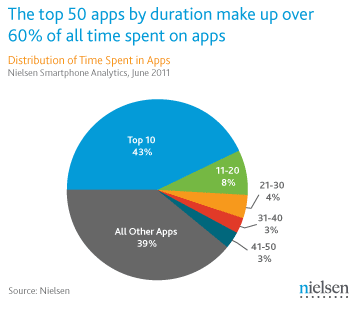
According to the latest findings of research firm Nielsen that tracks and analyses iOS and Android data, smartphone users spend twice as much time on applications than on mobile version of these websites. The study reveals also that –although there are millions of apps in the world- only “a very small proportion of apps make up the vast majority of time spent”.
The average Android smartphone user spends 56 minutes a day using apps and browsing the internet. Two-thirds of that time is usage of apps, the rest goes to mobile websites and 39% acccount for consumer app consumption. The study illustration below shows that mobile device owners spent almost half of their usage time on their top 10 favorite apps and 51% on their favorite 20 apps.

Let’s give it a guess… Probably most of the app usage of mobile device owners accounts for the following usage time: Checking email apps, Facebook, Foursquare or Gowalla, Twitter, and some of their favorite and coolest news or geeky gaming apps (very often used by their kids). And if you look at the top (free) list of apps you find Angry Birds, Angry Birds Rio, Google Maps, YouTube, Facebook Mobile, Skype, Tiny Flashlight, Viber and Drag Racing amoungst others.
The study supports my own feeling that although we continue to download apps and spend (2010 per user: Android 1,97 USD, iPhone 21,22 USD), we only use most of them them periodically, and only a few continously if the give us permanent benefit in networking or staying up-to-date on news.
Well, the time will come when HTML5 might change the market situation and developers will have an easy time working with apps. Amazon’s Kindle Cloud Reader gives insights in what is possible with HTML5 for the mobile web.
Spot On!
The study does not really give an answer to the question yet, or can give a recommendation to management. Still, Seeing these numbers, just imagine the chances companies and brands have when launching a new app to get under the hiflyer apps in the smartphone user market. Ideally, think about the five strategic reason that could make your app successful and be aware of the fact that most brand apps fail.
Will Millenials cause a headache for IT in the future?
18.08.2011 von Martin Meyer-Gossner
Kategorie: English Content, Featured Stories, Web Strategy

Credits: Gerd Altmann / pixelio.de
An online study along with in-depth interviews of 400 “Millennials”, ages between 20 through 29, and 200 IT managers the U.S. from mid-sized to large corporations gives some interesting insights in the expectations of the Millenials when it comes to IT. The study was conducted by Isurus Market Research and Consulting with analysis by GigaOM Pro, and underwritten by Bomgar.
Millenials are growing up in an “instantaneous world” of social web conversations, mobile phones, and almost permanent WiFi access. This brings new challenges for IT departments in the future as expectations are these young people are high. Millennials expect more or less immediate answers on IT support questions and all options of multi-channel communication. However, the worst is: Ideally, they could solve their technology issues themselves.
Some key findings what Millenials do…
- 71% state to have done a Google search for a solution finding at least once.
- 61% don’t turn to company support first to solve problems, while 71% say they have done a Google search for a solution at least once.
- 58% prefer to communicate in chat or text messaging, not the phone.
- 40% use a mobile device for work “on a weekly basis.”
So, if Millenials are responsible for their own technology, as it is their private device, IT could get away from the omnipresent IT support issue as they will have less responsibility, costs will decrease for IT, and it is a sustainable Green IT approach. Or who wants to carry around two mobile phones, two tablets, two notebooks, and so on?
The challenge for company bosses? Millennials say that their job satisfaction is “strongly affected” by the type of mobile device their employers provided. Isn’t this great? Just ask them what they want and you can increase personal productivity and work efficiency. Correct?
“Our research highlights the biggest challenges for IT departments: Millennials expect immediate responses, prefer a wider variety of communication channels and, when it comes to problem solving, often turn to Google and outside resources before contacting support,” David Card, Research Director, GigaOM Pro.
Millenials will become difficult to handle though. 60% think that good support time for a technical problem to be solved is less than 10 minutes. Compared to IT managers who think that a reasonable time frame for solving tech problems was an hour or more, this calls for problems between the work forces in the future. No wonder, 80% of IT managers see Millennials as “different or very different than their older peers in terms of technology expectations”.
Spot On!
However, these two studies might sound like a massive IT change process for companies in the future. It has to said that 75% of Millennials rate their IT departments a six or seven on a seven-point scale. Maybe IT should think about setting up IT knowledge wikis instead of letting their employees loose time surfing on Google for a solution. Millenials are not expecting something outrageous, they might just be brighter in terms of technology handling, and show us that collaboration on social networks and in communities works when they are solving their issues without the IT department. They are just another generation. The transition managers need to rate that aspect, too…
What is your view on these new challenges for it?
News Update – Best of the Day
17.08.2011 von Martin Meyer-Gossner
Kategorie: Daily Top 3
Loss in productivity is the fear that all bosses of companies have since the beginning of the web surfing era. Two studies by the National University of Singapore now found that web surfing is more productive than monitoring or banning web access. The first study stated that bosses who monitor an employees Internet surfing time may be wasting more time than their employees. The test showed significantly “lower levels of mental exhaustion and boredom”. The second study found that “rather than reducing cyber-loafing, excessive monitoring increases its frequency, as employees invariably view such policies as a form of mistrust that the company has in them”. Blocking Web usage in office hours proves ineffective as it prevents the “restorative function” that web surfing offers.
Many companies think about using Groupon to boost their marketing efforts or to upsale their revenues figures, or just to get some (often old-fashioned or outdated) in stock products out of their halls. To be honest, I found it quite amazing how much loss the company made last quarter, and I was asking myself why to spend money on a company that cuts their own marketing budgets. However, these are just superficial thoughts, Jeff Gibbard explains in three steps why Groupon does not make sense for companies: no financial uplift, no brand loyalty but many bargain hunters.
The Facebook “Like” button offers many opportunities to promote, push and place notion of your products on the Social Web. More importantly, it offers the chance to be creative around its intelligence. Two advertising students Jeena and John from the Willem de Kooning Academy in Rotterdam created a virtual showroom where IKEA highlights the most liked items.
IKEA “The world’s most liked showroom” from Jeena van der Heul on Vimeo.
Majority of Irish students favor use of private devices and Facebook…
15.08.2011 von Martin Meyer-Gossner
Kategorie: English Content, Social Media
What will companies say if employees want to bring their own devices to work? How about security issues and support opportunities for companies? A real challenge for the future when we look at an Irish study that interviewed 164 students in secondary school and at third level in order to understand how this generation is communicating these days.
The study by IT distributor Data Solutions on behalf of Blue Coat Systems shows that more than 60% of young people expect their employers to allow them to use their own personal devices (i.e. smartphone, laptop, etc.) for work purposes in the future.
The argumentation behind their expectations are obvious: They know how to use our private devices, so they don’t need to learn new technology which saves the company time and money. The challenge for companies will be to establish a set of new policy and security guidelines, as well as data safety and storing options.
“More than 85% of the students surveyed own or have access to a laptop, and almost 40% own a smartphone. This facilitates the trend towards ‘bringing your own device’, and every business is going to have to learn to accommodate this trend while ensuring security (…) When today’s students enter the workforce they will be completely in tune with the new ways of communicating and collaborating online, as most are already using social networking sites, blogs, Skype or instant messaging. Employers now need to look at new ways to facilitate their needs and expectations.” Michael O’Hara, Managing Director, Data Solutions
The study also shows the bluring use of email comunication. 75% of Irish students favor social networking sites like Facebook as their main channel for communicating online these days. Just 6% prefer to use email.
Spot On!
The study findings illustrate that social media sites continue to be on the rise in popularity, and it indicates how older traditional online communication tools like email become less attractive. When 88% have a Facebook account, it is not surprising that they are not swappping to Outlook anymore when communicating with each other, not matter if business or private. And it seems that this will have the same effect on the hardware and devices they want to use. Maybe we just need a separate login on our computers in the future? What is your view on this development…?
Still smoking? I bet you can quit…
15.08.2011 von Martin Meyer-Gossner
Kategorie: Daily Top 3
About 5 years ago, I quit smoking. In those days, I stopped from enjoying one package a day to none – in only one day. Just by having a strong will and an appropriate reason, I was able to get away from it. We are responsible for our own health. We know it is not good for us with the risk of getting cancer but still we do what we do. If we can explain it or not…
So, sometimes it is better if your friends look after you. And maybe they give you a reason to stop smoking. The American Cancer Society created a Social Media approach that brings the power of friend crowdsourcing and Facebook straight to those of you who still cannot resist. I like the idea as we sometimes need to get the right push from those we trust most. Those who believe in us. Our friends…!
Hey smokers, would you not be proud of you if you could get away from the fags? Get your friends to bet on you…
QR Codes: A trend already gone, or still on the rise…?
12.08.2011 von Martin Meyer-Gossner
Kategorie: English Content, Mobile
In the last weeks, I have spoken with many clients and interesting people in the industry, whether QR codes are still an emerging topic for marketers, or if the trend goes thanks to the latest innovation from Layar. The new Layar technology let’s the importance of QR codes in some way vanish…
So, the question is: Are the QR codes an over rated technology? Let’s bear in mind how many people know how to use QR code technology, and how often those who know really use the QR code reader? Now, the team from Lab42 comes up with as great infographic on the use of QR codes.
And guess what, 60% of the respondents say they are not familiar with QR codes in general. Most of the people using QR codes (46%) scan them for discounts. interestingly enough, for 42% of the people these codes serve as a ticket (for a concert (62%). And 67% see the QR codes in print magazines. So, my assumption that QR code technology could become the access point for the extension of print (Augmented Reality) seems to proof correct.
Check out the rest of the data yourself…

I am interested to get your view on the future of QR codes. Is this a remaining access hub for companies, brands and services, or will it end when Augmented Reality evolving, and finally detecting 3D objectives…? Let us know your thoughts…