Study: Three mindsets of search categorize peoples’ seach mode
28.09.2011 von Martin Meyer-Gossner
Kategorie: English Content, Featured Stories, SEO
According to a new study conducted by the New York Times Co.’s About.com in collaboration with Latitude there are three kinds of search behavior: “answer me,” “educate me” and “inspire me”. Thus, the study identifies some distinct human behavior search patterns which will help marketers connect and understand the target groups they are heading for.
So, how do these three search pattern types differentiate in the study that surveyed 928 Americans, age 21 to 54 with household incomes of $50,000 or higher?
“Answer me” searches accounted for 46% of all searches, the study found. People searching in this mode simply just want exactly what they ask for. They don’t want any value add. Their typical search is looking for beauty, fashion and entertainment.
Advice for marketers: The option to capitalize on an “Answer me” moment by featuring product benefits front and center, in addition to aligning content that presents quick, easy-to-find answers, offers a massive opportunity to marketers to generate leads.
“Inspire me” searches accounted for 28% of all searches. This is the typical browsing mode. Usually, people in this mode look for travel as well as home and garden.
Advice for marketers: For those consumers in the “Inspire me” mindset, creativity and different inspirational information sources will be wanted by consumers.
“Educate me” searches accounted for 26% of all searches. People searching in this mode expect to find multiple perspectives on a topic. The top categories of most interest are health and finance.
Advice for marketers: In the “Educate me” the contextual search mode marketers offer might help consumers with creating informative, multiple messages.
From a brand marketer’s point of view, the study explains that ads can be relevant to search. When nearly 90% of respondents “enjoy when brands stop trying to sell you something and focus on teaching you something,” this tells them that putting your bets on search is defenitely not the worst tactic.
Furthermore, most respondents agreed on search advertising terms…
- the best ads are the ones that work with the information source to help you get what you need (88%)
- that ads can be useful when they are very relevant to their search (77%)
- that ads have helped them find great options, deals or discounts (64%)
Spot On!
However, marketers can take their advantage from this study, being successful with the findings is still a challenge. What is the best way to identify in which mode a user is? The easiest option will probably be to have some ads for each of the categories. Still, this means to have the right content when consumers are clicking through to the landing page. If you think about it, you will understand why content marketing is seen as a major trend from CMO’s.
Studies: The internet is more important than water…?!
26.09.2011 von Martin Meyer-Gossner
Kategorie: English Content, Offlinewelt 1.0
Can we access the internet if we have nothing to drink anymore, if our water is poluted? No, we can not! Sometimes, adults should ask themselves about, and quickly start to re-think, the values that they hand over to our kids. I am happy to have spoken with mine about this topic last year around the Blog Action Day 2010…
Some weeks ago, I have written about a UK study from the London Science Museum made clear that UK people rather prefer to have sunshine and internet connection than clean water. Now, Cisco comes up with a similar study.
The Cisco study states that one in three college students and young professionals consider the Internet to be as important as fundamental human resources such as air, water, food and shelter. The study is based on the second annual Cisco Connected World Technology Report. It examines the relationship between human behaviour, the Internet and networking’s pervasiveness across 14 countries in the world (United States, Canada Mexico, Brazil, United Kingdom, France, Spain, Germany, Italy, Russia, India, China, Japan, Australia).
Mahesh Gupta, Vice-President, Business-Borderless Networks, Cisco (India and SAARC), said in a teleconference on Thursday that about 33% across the globe and 95% Indian college students and young employees admitted that Internet was as important in their lives as water, food, air and shelter. The internet has become a crucial important thing in peoples’ lives. More than half of the respondents (62% of employees and 55% of college students) said they could not live without the Internet. They see it as an “integral part of their lives”.
From a face-to-face social perspective, it is also quite amazing to see that people had indicated that Internet was more important to them than meeting with friends, dating, or listening to music. Like in the UK study, updating Facebook seems to be of the highest priority – higher than socializing. Gupta stated that within certain countries 91% of college students and 88% of employees globally had Facebook account and check it on a daily basis at least once. Furthermore, seven of 10 employees have “friended” their managers and coworkers on Facebook, and 68% follow their manager or their work colleagues on Twitter.
From a hardware point of view, mobiles rank highest as their important technology device, as high as being “the most important technology”. Two-thirds of students and 58% of employees felt that a mobile device (laptop, smartphone or tablets) was the most important technology hardware in their lives. Young employees in the UK (74%), India (71%) and Australia (66%) ranked highest when it comes to the importance of mobiles devices.
Spot On!
The study also shows some trends that other industries should watch out for. When two of five students have not bought a physical book (except textbooks) in two years, this is a clear message to the print industry. And when 2 out of 3 choose Internet connection over cars, the it becomes clear why concepts like BMW Drive Now and Smart Car2Go become popular. However, the new trends also need to be watched from a distraction point of view when being online.

Let’s hope they don’t forget to drink some water…
The world is mobile social networking
24.09.2011 von Martin Meyer-Gossner
Kategorie: English Content, Featured Stories, Mobile
From a new study by Insites Consulting, we can learn that Europeans connect more to social networks via their phone than surfing the web with them.
47% of smartphone-connected-Europeans will surf the mobile internet every day. However, this might sound like massive traffic load, it is probably more remarkable that 66% of connected smartphone users log on to their social media profiles daily. At the dmexco all experts agreed that the mobile phone is and will remina the leading communication device.
Obviously, it makes a change if you have your smartphone with you whereever you go – at least from a social network point of voiew. It is a difference in terms of frequency and intensity of use of social media platforms. It comes as no surprise that Facebook confirms “People that use Facebook on their mobile devices are twice as active on Facebook than non-mobile users”. Smartphones are the emerging access point for Social Media.
And we will say… These were my Facebook days!
23.09.2011 von Martin Meyer-Gossner
Kategorie: English Content, Featured Stories, Social Media
Facebook is not new? Well, correct… Facebook is complete new! It writes our lives…
I just realized how Facebook ruled my last three days offline and online…
On Tuesday, I was shaking hands with Carolyn Everson, (Vice President, Global Marketing Solutions) after her presentation on stage at the dmexco Conference 2011. Yesterday morning, I enjoyed an espresso with Scott Woods, Commercial Director DACH at Facebook. In the afternoon, I was moderating a panel on engaged consumer advertising strategies. Topic: Facebook. Obviously, Facebook was one of the main topics we discussed…
And then, the evening came with the big announcements. I was on the train watching the announcement of the new Facebook features at the f8 conference. Techcrunch told us how to get into the new Facebook in minutes. However, only the owner can see it until the 30th of September.
And what can I say… Welcome to my Facebook life!

The main three changes for me…
- the massive lead picture – reminded me of a former Myspace design.
- the two frame structure – offers a quicker overview on personal infos, updates, activities.
- the missing picture gallery – enables people to do some personal or company branding with these pictures. Cool!
The main three “Likes” from me…
- The coolest feature is the Timeline. If Google is changing our brain, then Facebook is pre-writing our autobiography.
- People can be creative in terms of the mixture of their conversational ingredients – text, video, audio. This makes a profile colorful and lively, apart from finally understanding that we do not “LIKE” everything – we shop, we act and we like!
- It is much easier to see which updates were uncool and not engaging. Kill them to make your profile look conversational. Aren’t we kind of authentic…?
Facebook wants to get away from throwing sparks in our days – it aims for long-term relevancy. It wants to be the ever-lasting spark. Our memory…?! And when we are old, we won’t tell our grandchildren stories of the past. We will say… Just read my Facebook days!
First Facts and Stats on Google+ (Infographic)
20.09.2011 von Martin Meyer-Gossner
Kategorie: English Content, Social Media
We were all challenging Google and our friends some weeks ago to get the popular Google+ invite. Today, I wonder how popular it still is, and well… Here you go! The first facts and stats about Google+ were put into an infographic by IdentyMe. There are 26 million users on Google+ and 72% of those are male, US and India rock the platform from a number of users perspective, most of them are techies and creatives, and it cost half a billion USD to make it. The scary thing? It seems that we users don’t leverage the platform into other markets…

So, what’s your view on Google+ these days…?
Incentivized ads boost brand perception, study finds
20.09.2011 von Martin Meyer-Gossner
Kategorie: Brand, English Content, Featured Stories
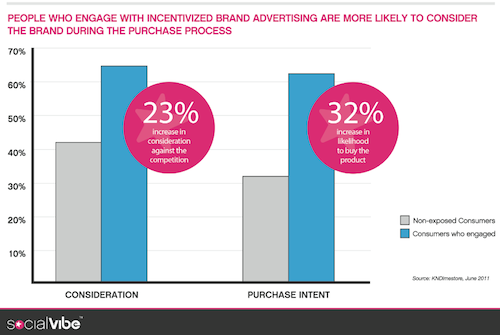
According to a recent study by KN Dimestore and SocialVibe brand messages and incentives influences most consumers to pay more attention to ads. In fact, if companies combine these two advertising and brand strategies, the interaction of consumers with brands increases by 91% and brand perception by 38%.
The study -which gathers data from more than 30,000 survey respondents- reported that when 48% of survey participants initially opt-in to engage with a brand for the incentive, they stay and pay attention to the brand message.
The aim of the study was to find out if and why incentives prompt people to engage with the advertisements, how they affect consumer perception of the brands, and if they influence people to visit the company’s website or „buzz“ their friends about the offer. Respondents gave feedback on ads from U.S. brands across financial services, CPG, entertainment, e-commerce and technology categories between June and July of 2011.
Some key findings of the study…
48% of those interact because of the incentive but pay attention to brand
12% interact purely based on brand
31% interact for brand and incentive
9% interact purely for the incentive

The results summary makes clear that engaging with the ad increased the odds that the consumers would purchase the product. Above that, incentives through ads drive website and in-store traffic, as well as purchases – and also conversions. Happy customers are coming back more often to the website when initially satisfied with an incentive through incentives. 36% of respondents were more likely to purchase brand-related products at physical store after interacting with the ad.
SocialVibe names the strategy “value-exchange brand advertising”. The company defines it as ads that ask for a consumer’s attention in exchange for something they want, such as virtual currency for social games or making a donation to charity. There is a clear differentiation from sign-up and straight purchase intended offers like cost-per-action (CPA) advertising.
Spot On!
The study is an interesting step in indicating the value of ads for branding. Generating consumer interest and awareness get’s more and more challenging these days with the masses of advertising we are faced with on a daily basis. Mobile advertising shows some similar development in terms of incentivization and engagement. Often companies said that the value of ads is getting lower as they just value it from a conversion-based ROI perspective. However, the study now shows that earning points, virtual currency or some other rewards finds the atention of customers. That’s when conversion comes into play, and that’s where brands need to foster engagement to a purchase via the right communication tactics.
Criminology and Law Enforcement Officials Using Social Media To Fight Crime
20.09.2011 von Martin Meyer-Gossner
Kategorie: Daily Top 3
For years now, the world has become a very high-tech place, and just like with everyone else, criminals are also becoming more astute and coming up with more technological ways to break the law. Ever since the Internet started seeing widespread use, Criminology and law enforcement officials have been playing catch-up to try and monitor all of the offenders that are currently on the web. Now, as social media has taken hold, it seems that officials now have a new tool in fighting crime.
Social media has allowed the world to become interconnected and interface with one another through the digital format of social media. More and more of our connections are going through online forums, but it’s also having the side-effect of keeping track of everything we say. Law enforcement agencies around the country are beginning to realize the power of social media for their own purposes.
Police blogging has become relatively popular lately, and it’s beginning to allow police stations across the country to keep up on the events of the day. Many people are already familiar with the police sergeant sitting at the registry desk, but now a station can keep track of Twitter feeds, blogs, and updates. It offers officials and the public a real-time way to see the crimes that are being committed in their area. These blogs are publishing crimes and arrests and keeping track of the real-world activity through online avenues. This is becoming a very useful tool to keep an open dialogue and exchange of information between citizens and police. Average citizens can also post on these blogs to let police know about what’s going on and it’s quicker than a phone call.
There have been sites where people could go online and see the latest wanted criminals, but now different law agencies are beginning to use Facebook, Twitter, and other social media platforms to update and keep people aware of local criminals that are at large in their area. The great thing about social media is that it’s instantaneous, and officers can keep the public aware of what’s going on up to the minute. This has been done through fan pages as well as local and district specific pages. Their usage has become more fine-tuned over time, and it’s increasing in regularity. It’s another example of how much social media is changing our everyday lives.
Many aren’t aware of the term, but social media stakeouts are becoming a popular tool to find criminals in every background. Some social media advocates argue that this has become a sort of invasion of privacy but police and law enforcement officials aren’t hacking into anything, they’re merely listening in. Whether you agree with it or not, it’s given police the ability to track important information and search real-time for offenders and key words and phrases that are of particular interest. This social media monitoring is a preemptive measure that’s getting a lot of attention. There exists the possibility that these social forums could be abused by officials but there’s no doubt that it has helped them to keep up with the times.
It’s not clear as to how much control different offices of enforcement really have over our personal and social media accounts. There’s been a lot of speculation over Facebook’s complicity in working with companies and governments and sharing personal information. Currently, it’s only through accusations. People are worried about “big-brother,” but it’s essential that we give our law enforcement officials the tools they need, within reason, to combat crime in an evolving society. Otherwise, we could run the risk of giving criminals a better ability to curtail the law and hurt others.
This post is a guest post from the Davenport Institute.
Mobile Study: Retailers focus consumer mobile efforts on stores
16.09.2011 von Martin Meyer-Gossner
Kategorie: English Content, Featured Stories, Mobile
One of the latest research projects “Keeping Up with the Mobile Consumer” by Retail Systems Research (RSR) which was sponsored by Google and SAP Research, states that retailers are eager to engage with consumers via their personal mobile devices, but focus their efforts on driving customers to stores, rather than on mobile commerce. The study offers some orientation and recommendations for successful mobile strategies for retailers (and brands).
The research studied of 83 qualified retailers in the summer of 2011 and divideds the respondents in best performers – Retail Winners – and other performers. It states that 79% ackowledge that a cut and paste version of a full eCommerce site is simply not a viable mobile strategy. It also shows that the “Winners” are somewhat ahead of the market, however it is early days in mobile ecommerce.
For Retail Winners the future of mobile ecommerce is not only an extension of their website to the mobile channel (77% vs. 88% of all others). Most retailers look to outside advertising agencies with mobile experience – 31% to 18% of the Winners.

The best performers take a broader view of what mobile really looks like as it relates to how consumers use mobility, the study suggests. Winners focuse much more on the ability to write once and deploy across multiple mobile platforms than are average and underperformers (73% vs. 35%).
“Overall, 51% of respondents say that their mobile sales will grow significantly in the next 3 years, and another 42% expect at least some growth, if not a significant amount. And while the top mobile channel capabilities for our retail survey respondents include search for merchandise and receive coupons/offers, Retail Winners tell us they are laser-focused on using mobile to help the purchase process,” Nikki Baird, Managing Partner, RSR Research

According to the study for the Winner retailers the main challenge is that consumers are using mobile as part of their shopping experience and that they need to be there and they see (92 vs 81 of others). 42% (versus 29%) see significant online traffic from mobile sources which they need to respond to. Even the Winners (38%) admit that mobile technology is evolving too quickly and they cannot keep up with the pace of innovation (48% of others).
“There’s going to be a lot of trial and error, and even though not all new endeavors will be successful, it’s important to remember that the consumer already wants to use the device she has in her purse; even if a new tactic falls short, she’ll be eager to try it, and she’ll likely reward you for trying,” Steve Rowen, co-author of the report.
Spot On!
Generally speaking, the study shows all retailers are aware of the common and future status of mobile. They recognize the opportunities that mobile devices offer to them, their capabilities, and the shoppers’ willingness to use them. However, it is still difficult for them to predict the best retailers understand that “the next big thing”.
Social Media around the word (study presentation)
14.09.2011 von Martin Meyer-Gossner
Kategorie: English Content, Social Media
Steven van Belleghem from Insites Consulting is presnting findings from a global social media study with 9.027 consumers (age 15+) across 35 countries, representative for the online population for their counties on age, gender and e-commerce in Europe, the US, Australia and some of the biggest Asian countries like China and Japan.
Study: Mobile ads increase user engagement… these days
14.09.2011 von Martin Meyer-Gossner
Kategorie: English Content, Mobile
Mobile advertising seems to be the rock-star among banners these days. For marketers it is becoming an essential digital marketing tool for the future due to its ability to achieve an essential audience reach everytime and everywhere.
The latest global MediaMind study “The Comprehensive Guide on How to Leave an Effective Message” suggests to increase engagement levels and pay-per-click rates through the location where the advertisement is displayed, the time when users see it, and the size of the banner seem to be crucial. For the study MediaMind surveyed about 21 billion impressions, from the second quarter of 2010 to the first quarter of 2011.
The study finds that telecom advertising is the second highest vertical for user engagement. It is just surpassed by sports, still ahead of electronics, travel and retail though. This comes as no surprise as the telco spendings are increasing as of the high competition in the market place. In 2011, US Telecom advertisers are expected to spend over $4 billion on online advertising.

However, awareness is high, click activity still lacks engagement. From one million impressions web users would “dwell” on 70,000 adverts but only click on 1,800. The old question reamins: If we could only measure the final impact of banner awareness before people click banners.

The success factors in a telco advertising campaign: timing and location. Seen from a conversion point of view, telco ads achieved the highest conversion rate after the first impression, generating about 5000 conversions every one million impressions. Users were most likely to convert within the first three exposures to commercials, claims the study. And users converted with a higher probability when telcos targeted them with the most effective ads early in the campaign.
“Out of every one million impressions that are served, 70K impressions are Dwelled, and 1,800 impressions are clicked on. Overall, every million impressions generate 5,300 conversions.” Study Conclusion
Spot On!
In the future, will the high clickrates from mobile banners stay high (0.6% average CTR compared to usual banners reaching not even 0.1% CTR)? A former MediaMind study has also found that users convert at a much higher frequency when exposed to mobile ads. We will see what the mobile evolution of the user brings. In my eyes, it is still the creative aspect and the first message that goes out to the user that makes the change for a great campaign, followed by an “intelligent creative optimisation” which Gal Trifon, MediaMind General Manager obviously suggests.
PS… At dmexco I will be moderating the panel: “Mobile rocks! Strategies and Challenges in Mobile Advertisment”. (21.09.2011, 2.45pm, Congress Hall, Cologne). The keynote will come from Greg Stewart, CEO of the MMA. The panel will focus on opinions and answers from the international mobile market. Which strategies should be implemented to build up a successful communication via the mobile channels and which successful case studies are there? Come and join us!
Any further findings on mobile advertising you can add?