Study: Web economy expected to double in G20 by 2016

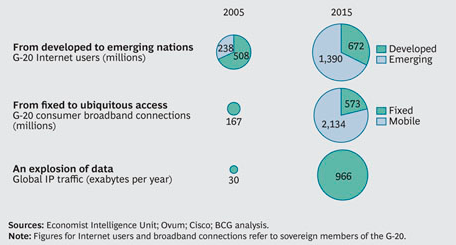
We all know that the web economy is exploding at the moment in terms of activity and users. In the next four years the value of the web is expected to achieve a valuation sum growing from 2.7 to 4,2 trillion pounds. This means that the value of the web economy in the G20 countries is nearly going to double in the next four years.

The global web user base is expected to increase foe 1,9 to 3 million users by 2016 – almost half the world’s current population. All these findings are based on a new report commissioned by the Boston Consulting Group. Still, the report also states that there is at present no standard way of measuring the parts of web economy that is ‘digital’.

Boston sees the growth in the evolution of the mobile web access as 80% are assumed to access the web via smart mobile phones. Thinking back to 2010, which is just about two years back, mobile internet access accounted for just over 4% of the G20 economies. The study makers claim that each household has an approximate valuation of 2,000 pounds worth of purchases online before buying.

Some more key conclusions from the study…


- Digital transformation is key for companies. Companies have to build their digital assets and reduce the digital liabilities that limit their ability to tap rich opportunities. People, processes, and organizational structures need to change and adapt them to the digital world.

- IBM forecasts 1 trillion devices to be connected to the Internet by 2015. This has an effect on the ways companies interact with customers and run their supply chains but also how traditional industries have to build their business.


- Companies such as Amazon, Apple, Facebook, and Google shape the Internet, in China this might be Baidu and Tencent or in Russia Yandex.

- The power of digital experience goes far more local in terms of impact on everyday life, reflecting economic, political, national characteristics and social influences specific to individual countries.

- The “Millennials” have different expectations as employees, consumers, and citizens. TheArab Spring protests and grass-roots “occupy” movements in the West are the most visible manifestations of the power of the Millennials to shape society and commerce.

Spot On!
Seeing the rapid economical and market changes, the intensity of competition will improve and increase. Companies and brands will need to plan more flexible in terms of their strategic approaches how to reach clients than in earlier years when long-term planning cycles were the common status. Today, it will be important to create an adaptive strategy planing and restructuring process.

PS. A challenge might be if evangelist entrepreneuers like this guy spread market distraction and confusion….

Top 3 Ways Web 3.0 Will Change Workflow

27.01.2012 von  
Kategorie: Daily Top 3

There are many ways to bolster the productivity of your workforce. You could bring in a business speaker to inspire the inner entrepreneur in your employees. You could offer financial incentives for reaching certain benchmarks. You could also upgrade the technological infrastructure of your office. Preparing for Web 3.0, for instance, will require all companies to rethink business as usual and adopt a wide-ranging portfolio of new online tools and services. The advent of Web 3.0 has already made a lasting effect and we can expect this trend to continue. Here are the top 3 ways it will change the workflow in the business landscape:

Real time collaboration. Complex projects can now be undertaken simultaneously by multiple people across vast distances. The software as a service model now so common with cloud computing services is making it so that documents can be synchronously changed on-line using Google docs and other services. This enables businesses to maintain a diverse and mobile workforce that can execute and launch projects outside the traditional constraints of an office. Web applications that facilitate real-time communication, such as Skype, also allow for non-location based business meetings between clients across the world. In the future, this should help reduce the energy demands of the modern office, as well as the broadband and IT requirements of the typical company.

Virtual reality communities. So far, the best example we have of a vibrant virtual reality world that has bred its own economy, global population, currency, and infrastructure is Second Life. In the future, many people will conduct the majority of their business transactions through sites like this. Everything from trade shows to business meetings to the stock market exchange could take place in an online virtual reality space. At present, VR systems are strengthening the efficiency of workplace environments by offering better visualization tools to manufacturers.

Ubiquitous smartphone use. As cell phones continue to be viewed more as online tools and replace PCs as the preferred method of web activity, we can expect businesses to adopt their widespread use. Smartphones are also increasingly used for journalism, file transfers and real time communication. Expect smartphones to be the pen of the future.

Web 3.0 will be making considerable headway in marketing, social media, and business protocol in the coming years. Many analysts expect it to dramatically change the way companies operate. Real time collaboration, virtual reality, and increased smartphone use are just three of the ways this change will be manifested.

The Social Media Rockstars – Community Managers (Report 2012)

Being a community manager in a company or a community center is the most popular position people can have in these Social Media times. Not only is this the person in charge of the engagement cycle of all Social Media topics but moreover that they become the main public touchpoint of the Social Media conversation of the brand or company, and thus their reputation becomes one of a kind of a rockstar…

Still, many brands and companies still hand over the Social Media responsibility to junior level people or trainees who then have to engage and manage their online communities. Would you say this is clever, or wouldn’t it be better to hand over the responsibility to a chief culture officer or an experienced market brain?

Socialfresh published an infographic and report data that illustrates the work, the tasks and capabilities that a community managers need to be able to cover. And these are some of the findings they provide.

Community Managers..
… commit most of their time with content, respectively online conversations
… 67% come from a brand side vs. 33% form an agency side
… are far more females than male (65% vs. 35%)
… have an average age of 30 years, however the 31-40 year olds make most money
… see more success on Facebook (52%) than any other platform
- gets an average salary of almost 62.000 USD

Ok, the salary is not rockstar-like but their chance to become one of the top 50 Social Media influencers is a sweet potential outlook…

Community Shopping on the street – NET-A-PORTER.COM’s Window Shop

26.01.2012 von  
Kategorie: English Content, Mobile

Augmented Reality shopping is definitely a new trend these days. NET-A-PORTER have launched their Augmented Reality Shopping Windows in different capitals around the world like Sidney, Munich, London, Paris and New York.

The following video demo comes from late last year’s Fashion Night Out celebrations in London and New York. It will be rolled out globally now for the new Karl by Karl Lagerfeld collection. Consumers need to download the NET-A-PORTER iPhone/iPad app, then visit the stores and can use the Augmented Reality like a new shopping experience.

When pointing the iPad camera at the window, this will publish 360 degree product models doing their best on a video catwalk. It also displays product information, the clothes price and obviously the ability to purchase immediately.

Isn’t this a cool idea to offer a 24/7 shopping life? These doors are always open in the future. Well, ok their online shop as well but it is a different kind of shopping experience right…? Community shopping on the street…

THX for sharing!

Edelman Trust Barometer 2012: CEOs down, Social Media getting better…

Year on year, Edelman’s Trust Barometer checks the credibility and trustworthiness of politics, companies, CEOs and media from a quite generalistic point of view.

The findings for this year were published in the 2012 Edelman Trust Barometer, a global survey which came out yesterday in its 12th year. The survey offers insights from over 30,000 people in 25 countries with the main focus on “Informed Publics”. By “Informed Publics” Edelman sees college-educated people between 25-64 years of age that are among the best earners in their countries and describe themselves as heavy consumers of media information.

Obviously interesting for me were two things… How are people trusting CEO’s after CEO’s criticized their marketers some month ago in a study by the Fournaise Marketing Group. And also, how are consumers worldwide gaining trust in social media as a source of business information.

Let’s start with the CEOs first.

When Edelman asked respondents how credible information coming from a CEO would be, 38% replied they would trust the information. Although this sounds not bad, it is a 50% dump from last year and the biggest drop since Edelman started doing the survey 12 years ago. And although government leaders were less trusted than CEOs, in more or less all the countries responding, 49% would want to see an increase of government regulation of business.

And how about consumers’ trust in Social Media?
Well, let’s put it that way… Social Media is on the rise but still lags behind corporate websites and traditional media. So, you marketers should better not rely solely on Facebook, Twitter and Google+ pages.
The 2012 survey tells us that 14% of respondents see Social Media as a trusted source of company information — an increase of 6% to one year ago. But it’s still getting the lowest trust score of the four options shown below. This comes close to the trust in company websites (16%). Traditional media still is top of “news pops” (32%).

Spot On!
So which business is trusted most? Technology companies are most trusted with 79% saying they believed tech companies do the right thing. Indian, Chinese and the United States tech companies earn most trust, UK, France and Germany rank lower. Trust in financial services companies and banks soars, and those companies are the least trusted businesses. 47% said they trusted banks to do what is right. 45% saying they trusted financial services companies.

Who do you trust? Would you agree with these Edelman findings?

At Mercedes augmented-reality lets gestures communicate

Some weeks ago, we have discussed the opportunity for car manufacturers with in-car internet access that KPMG sees as the “norm” in the near future. If this is to come true, then concepts like the Mercedes’ Dynamic and Intuitive Control Experience (DICE) is not far of, and the car windshield might get potentially more impact in terms of delivering essential contextual driving information.

The system was shown at CES for the first time and seems not to be too far away bearing in mind that we have seen smart windows from Samsung that become TV screens. Wether this is fiction or reaality soon, I definitely like the idea and the vision that Mercedes has…

The car manufacturer envisions complete new data transfer through windshields like seeing who is driving in front of you or getting relevant traffic data or restaurant tips. What sounds promising, might also become a challenge for the driver who needs to avoid being distracted by all that data. The Mercedes concept touches all new technology options that we know from smartphones and tablets in favor of gesture-based controls that communicate information while driving.

“With the DICE sculpture Mercedes-Benz provides a visionary perspective on how the vehicle becomes an intelligent mobility partner in the future. For this Mercedes-Benz uses a combination of Augmented Reality and natural gesture control to realize a completely new form of communication between people and their environment.”

Well, just have a look and decide if you like it or not..

comScore: Smartphones and tablets boost European media consumption ‎

The digital environment is chaining very fast, based on the evolution of the modern mobile devices which are offering new opportunities and challenges, depending on whether at home or at work. Some forecasts already proclaim the death of the desktop. Today, mobile devices like tablets and smartphones change the daily lives of Europeans, and the way we use our mobile devices was explained in one of my last posts. .

A recent study by comScore, Inc. and Telefónica Germany called Connected Europe -published during DLD Conference today- shows some five developments and gives an outlook where the mobile evolution is heading to. The study was based on a survey of mobile subscribers age 13+ and their primary device. These are the key findings the study is coming up with…

Smartphones and Tablets make PC more and more redundant.
Reasons: Lower hardware costs, increased subsidies, and aggressive operator price plans. A majority of non-computer web traffic comes from smartphones (65%) and especially tablets (25%) are picking up momentum in the EU5 (France, Germany, Italy, Spain and the United Kingdom).

Mobile Media is booming.
Reason: Ubiquitous 3G/4G networks delivering mobile ready content to multiple screens (PC, Smartphone, Tablets). 75% of the EU5 use mobile media users in October 2011 which is an increase by 62% in the past year.

Apple connected use wins in fragmented EU5 market across ecosystems.
Reason: However, there are powerful competitors (Nokia and Google), Apple’s iOS has the top spot when combining smartphones, tablets and other devices: 30% share of connected devices in use! Nokia’s Symbian and Google’s Android win in terms of the highest market share among smartphone.

iPad boost Apple’s market power.
Reason: iPad enthusiasm is not limited to Apple enthusiasts. Users of other phones such as LG (86% more likely) and Motorola (72% more likely) were overrepresented amongst iPad owners, as compared to their respective shares of the smartphone market. Obviously, iPhone owners were quite likely to have an iPad (66 times more likely).

Mobile commerce is increasing and changing expectations for the retail industry.
Reason: Smartphone users are massive mobile shoppers and push retail with double or triple digit growth rates across European countries. Just look at the use of modern mobile devices and their apps in the Prime Time and you won’t be surprised anymore.

Spot On!
According to the study, Germany had the fastest growing (increase of 112% year on year) user base and witnessed the quickest adoption of emerging technologies, such as QR codes. Interesting to me were two facts…
a) Men are still more likely to have a tablet than a smartphone compared to women, whether this is based on business issue or interest the study did not give an answer…

b) Smartphone and tablet is not an issue of income aspects. 65,4% of a household income under 40K EUR have a smartphone and 56% own a tablet.

Would you agree that calling a smartphone and a tablet your own will become as important as having a TV in the past?

Study: Social Sign-in generates 50% more time spend on websites

Isn’t it hard to get people on websites in general? And even more to keep them there reading as much of your business information as possible? How much time do your customers spend on your site? If you are not satisfied with the results you achieve with your visitors, here is some information that might boost your website staying time.

A recent research by the SaaS technology company Gigya helps companies and brands to become more social in order to engage more with their customers. And if they are doing their job properly, their aim is always to get people from social platforms to their website for a better conversion.

The Gigya research states that companies and brands, and obviously their websites, can increase the stickiness of their desired target groups with their website just by encouraging the coming back effect of visitors through social logins.

The Gigya’s results illustrate that site owners who implement Facebook Connect, Twitter sign in or Yahoo Login will be the winners. Users spend 50% more time on websites when they’re logging in through social networks. Just imagine if users spend four more minutes after a social login – whether it be on the Web, the mobile web, or apps. All of these options were tracked by the Gigya study.

The value of Facebook Connect in terms of giving an option to easily log-in on different other platforms and sites makes people carrying around their social graphs wherever and wherever they are online. And with all these connections our closest fellows, fans and friends find our restaurant reviews, cinema recommendations and places where I am immediately. With a target group of approximately 800 million users Facebook states a case for social sign-in opportunities.

The findings also show that it is the most popular source of social logins with 61%. It gets followed by Yahoo with 15% and Google 12%. It surprises me that Twitter is only at 10% and LinkedIn just gets 2% although we have over 120 million LinkedIn user. And users who logged in with a social network double the view of pages on a website.

Another interesting aspect is that with social plugins, users generally spend the most amount of time on the site, and page impression increase does obviously follow. Companies and brands should think about integrating value-add areas with log-in or comment or Newsfeed functionalities as the later come in first when it comes to spending more time with the site. So, add a comment section.

Spot On!
Some months ago, we already mentioned the importance of social sign-in processes with a study by Janrain and Blue Research. In that study, 42% agreed that companies offering a social sign-in option “are more up-to-date, innovative and leave a positive impression compared to those which do not offer this capability” on their sites. Well, it seems I should start thinking about integrating social sign-in here… From a comment technology point of view, which option would you recommend? Livefyre, Disqus,or the WordPress standard…? Open to suggestions…

The App for the “24/7/365-Connected-Mobile-Geek”

Just realized it’s Friday, and yes my head has been down on my mobile, tablet and laptop all week. Even in my meetings, the clients and me spend much time on these devices without even taking our heads up. And this will continue probably next week, and the week after, and…

For all of us who are “24/7/365-Connected-Mobile-Geeks” the Saturday Night Live season 37 gave advice in their episode 12 to use a great app that will leave our heads on our mobiles without distraction like clever and important suggestions “texting and driving is a NoGo” and so on.

Or should we better take our “Headz up”? You decide. Enjoy your weekends!

THX @boweryboogie for sharing!

ComScore study: 31% of banner ads get lost for viewers

© carlos castilla - Fotolia.com

Companies and brands love to book page impressions with publishers, shopping and trading sites. Users find themselves being bombarded with banner ads all over the web – and not often do these ads add any value on customer journeys and the digital shopping experience. Often they bore us (dresses and dishes), annoy us (gay ads for married people) or make us hate companies brands (you love a and get b beer brands). Real Time bidding (RTB), (Behavioral) Retargeting technology and demand side platforms (DSP) will become game changers in the ad space in the future.

Sounds good but do advertisers get what publishers promise today, just on the basis of ad impression buying? Well, not really…

Yesterday, ComScore announced their “Validated Campaign Essentials (vCE)” which is said to be a Holistic Measurement tool for verifying the effectiveness of advertising campaigns and their subsequent targeting tactics. Thus, ComScore can double-check of where the ads are being delivered, where they are positioned within a page and who’s eyeballs they meet with the optimization add-on to know where they can be better positioned and at what time. The new technology or tool (vCE) will allow ComScore check campaigns effectiveness on a demographics basis.

ComScore definitely recognizes clients need for a world of better performance with campaigns for a reasonable future of advertisements. However the good news, when you worried about the effectiveness of your last campaign, there is much worse stuff to think about…

ComScore has found, in a recent comprehensive study, that over 31% of online display ads get lost for eyeballs of potential viewers, and for some websites it is even a scary number of 91%. Reasons are obvious: Some of these ads are below the fold. User might not scroll down far enough to view them, and vice versa. Some people just scroll too quick and thus get passed them before they have been loading.

The findings also state that as many as 15% of campaign ads were delivered to viewers outside of the targeted media plan places. An average of 4% of ad impressions found viewers in locations that weren’t on the plan, or where products weren’t available. Do you still wonder why the above mentioned banner campaigns reach us? But ComScore works on the issue…

“One big issue with internet advertising is that not all ads that are served end up being seen. This is a core issue raised by the Making Measurement Make Sense (3MS) initiative. In order for marketers to have the same confidence in the digital channel as they do in TV, we need measurement around the visibility of ads.” Mike Donahue, EVP, Strategic Partnerships, ComScore

Spot On!
Google will penalize companies and platforms that have too many ads above the fold in the future: 3 ads per page is sufficient and strategically clever, Google advices in this video. Just imagine your banners are being delivered to platforms that are damaging for your brand. It happens. Impressions appear beside content that were defined as “not brand safe” by the advertiser. Of all tested campaigns, 72% showed up on pages that had objectionable content, as defined by the brand. Now, that ComScore and advertisers like Chrysler, Discover, E*TRADE Financial, Ford, Kellogg’s, Kimberly Clark and Kraft among others push the development of the third-party tracking, there might be hope that consumers and clients get banners delivered that are targeted the right way. Nevertheless, companies need to start thinking about the right call-to-action in order to get the right conversation figures…

Nächste Seite »