Study: Web economy expected to double in G20 by 2016

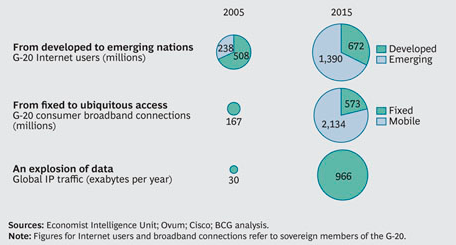
We all know that the web economy is exploding at the moment in terms of activity and users. In the next four years the value of the web is expected to achieve a valuation sum growing from 2.7 to 4,2 trillion pounds. This means that the value of the web economy in the G20 countries is nearly going to double in the next four years.

The global web user base is expected to increase foe 1,9 to 3 million users by 2016 – almost half the world’s current population. All these findings are based on a new report commissioned by the Boston Consulting Group. Still, the report also states that there is at present no standard way of measuring the parts of web economy that is ‘digital’.

Boston sees the growth in the evolution of the mobile web access as 80% are assumed to access the web via smart mobile phones. Thinking back to 2010, which is just about two years back, mobile internet access accounted for just over 4% of the G20 economies. The study makers claim that each household has an approximate valuation of 2,000 pounds worth of purchases online before buying.

Some more key conclusions from the study…


- Digital transformation is key for companies. Companies have to build their digital assets and reduce the digital liabilities that limit their ability to tap rich opportunities. People, processes, and organizational structures need to change and adapt them to the digital world.

- IBM forecasts 1 trillion devices to be connected to the Internet by 2015. This has an effect on the ways companies interact with customers and run their supply chains but also how traditional industries have to build their business.


- Companies such as Amazon, Apple, Facebook, and Google shape the Internet, in China this might be Baidu and Tencent or in Russia Yandex.

- The power of digital experience goes far more local in terms of impact on everyday life, reflecting economic, political, national characteristics and social influences specific to individual countries.

- The “Millennials” have different expectations as employees, consumers, and citizens. TheArab Spring protests and grass-roots “occupy” movements in the West are the most visible manifestations of the power of the Millennials to shape society and commerce.

Spot On!
Seeing the rapid economical and market changes, the intensity of competition will improve and increase. Companies and brands will need to plan more flexible in terms of their strategic approaches how to reach clients than in earlier years when long-term planning cycles were the common status. Today, it will be important to create an adaptive strategy planing and restructuring process.

PS. A challenge might be if evangelist entrepreneuers like this guy spread market distraction and confusion….

The 3 R’s of Social Consumers

In the last weeks, I came across the same issue in many meetings with clients. Social consumers increase their use of Social Media and social networks to state their opinion about a company, brand or service. Sometimes to rate the way companies make use of Social Media, or how they engage with them in campaigns or branded social hubs. Sometimes to complain about incredible customer service, or the quality of products. Sometimes just to link or share some content piece that attracted their attention.

The input described above by consumers can be summarized under the 3R’s: ratings, reviews and recommendations. These 3 R’s will challenge companies and brands in the future. Companies know that they have to find a way to deal with all the content published, as well as to establish ways to make use of it in the context of their business.

Ratings
Years ago, we would have seen ratings on Amazon, eBay or rating platforms Ciao. Today, there are external and internal rating opportunities for customers. Most modern content management systems have implemented rating systems. Content and shopping pages have their 5-star systems, percentage scales or „thumbs-up-and-down“ to evaluate the quality of the content or product provided. Facebook, Twitter and other social sharing buttons act in the same way, reach out and distribute ratings to a wider audience to name just some options the social consumer has here.

Reviews
While the chance to find yourself as a brand in a Twitterstorm was low in the past, the tables have turned. Companies like H&M, Motrin or BMW have become victims of reviews in the last years. Whether through crowdsourcing or blogging, reviews could leverage or damage your business success in a day’s time. The question remains the same for brands. Most consumers don’t differentiate between the trusted and personal reviews. In which reviews can they trust, what not, and what could end in a brand nightmare? The list of review sites is long, the one of personal blogs, social networking accounts, etc. even longer, and getting intense the more people review their personal views. And then, organizations have to bear in mind that 97% of purchase decisions are based on digital experiences.

Recommendations
Probably, the most dynamic part of the 3R’s is the recommendations part. In social networks (Facebook, Twitter, Youtube, LinkedIn) people hint, share and forward quick opinions about a film, a hotel or a show in minutes – and forget about it. Companies and brands need to take a position on these recommendations, or clear up the damage as best as they can. Well, if they find them and have the processes, people and resources in place to react. Some recommendations are still in the stealth mode as of semantic detection issues, or as they are only shared within the social graph of a person. And some recommendations are not even recommendations. They get catalyzed through social banner opportunities with Googe Plus buttons inside Google ads or via recommended people of the personal social graph in Facebook ads. And some will stay invisible for brands – most offline spoken words.

Spot On!
The challenge for companies in the future will be to educate social consumers on their way to social purchase. Social consumers often don’t pay attention to who said what, their gender, habits, age and preferences. Customers tend to be affected by a negative scale although it may be positive. 97% is not 100%, 4 start is not 5 star, the last opinion that was the only one negative, and so on. Most consumers don’t check who or how many people have rated the hotel on tripadvisor or booking.com. So, what is better? One rating in the 100% range, or 5 ratings getting 95%? A review where companies can react and improve the quality of their service? Or a recommendation that they could use as a statement to their blog? In my eyes, we will need to have seal of quality buttons that tell people to be aware of the fact that the 3 R’s are a good orientation for quality but not the final truth. And marketers should think about the best alternative to straigthen and strengthen their brands whatever effective the 3 R’s might be for their business.

Would you agree…?

Web or App? Nielsen study knows usage time of Android smartphone users

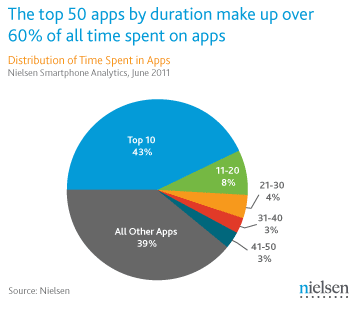
According to the latest findings of research firm Nielsen that tracks and analyses iOS and Android data, smartphone users spend twice as much time on applications than on mobile version of these websites. The study reveals also that –although there are millions of apps in the world- only “a very small proportion of apps make up the vast majority of time spent”.

The average Android smartphone user spends 56 minutes a day using apps and browsing the internet. Two-thirds of that time is usage of apps, the rest goes to mobile websites and 39% acccount for consumer app consumption. The study illustration below shows that mobile device owners spent almost half of their usage time on their top 10 favorite apps and 51% on their favorite 20 apps.

Let’s give it a guess… Probably most of the app usage of mobile device owners accounts for the following usage time: Checking email apps, Facebook, Foursquare or Gowalla, Twitter, and some of their favorite and coolest news or geeky gaming apps (very often used by their kids). And if you look at the top (free) list of apps you find Angry Birds, Angry Birds Rio, Google Maps, YouTube, Facebook Mobile, Skype, Tiny Flashlight, Viber and Drag Racing amoungst others.

The study supports my own feeling that although we continue to download apps and spend (2010 per user: Android 1,97 USD, iPhone 21,22 USD), we only use most of them them periodically, and only a few continously if the give us permanent benefit in networking or staying up-to-date on news.

Well, the time will come when HTML5 might change the market situation and developers will have an easy time working with apps. Amazon’s Kindle Cloud Reader gives insights in what is possible with HTML5 for the mobile web.

Spot On!
The study does not really give an answer to the question yet, or can give a recommendation to management. Still, Seeing these numbers, just imagine the chances companies and brands have when launching a new app to get under the hiflyer apps in the smartphone user market. Ideally, think about the five strategic reason that could make your app successful and be aware of the fact that most brand apps fail.

Social Media Monitoring is becoming mature, SocialCRM it’s future…

It seems to be the right time of the year. At the end of a quarter, companies are buying companies. Just look at how ebay grabed GSI Commerce yesterday. Suddenly the former number two in the retail industry is becoming a competitor for Amazon.

However, even more interesting for me was how quick the Social Media Monitoring (SMM) industry is becoming mature these days. The evolution started last year when the Attensity Group acquired Biz360

At a time when marketers realized the importance of social media monitoring but still have their internal issues with the listening and analysis technology, Social Media Monitoring will become a boost of awareness by the deals that happened this week. In one week we have two mergers… Meltwater, a social media monitoring provider, buys the Social CRM company named JitterJam. And today Salesforce, one of the leading CRM technology companies acquires Radian6, one of the top Social Media Monitoring providers which will give the “new” companies the opportunity to become a leading supplier of SocialCRM in the future.

Alterian‘s James Eiloart, SVP Sales and Marketing Europe, gave me their feeback on the merger of their main competitor in the Social Media Monitoring arena…

“The purchase of Radian6 by Salesforce.com endorses the importance of the Social Media Monitoring market which we invested in 2 years ago when we acquired SM2/Techrigy, bringing this capability to mainstream marketers and highlighting these tools as something which all organisations need to embrace. However we also recognise it’s not just about the tools or access to tools, it is about having the skills to use them at the micro level, and also being able to use social media data at a macro level, in context of the broader marketing picture. This is why we acquired Intrepid last year who bring the Social Media Monitoring insight services and also consulting to help our partners and clients really use Social Media Monitoring to generate real value across the organisation.”

The micro and macro level will probably become the next challenge for marketers and business leaders. Identifying important communities and social influencers, or analyzing Social Media does only make sense if marketers understand how to answer the Social Media ROI question. And this is a question of understanding the value of conversations. Businesses are build upon these pillars and their ground will be the evolution and execution of SocialCRM which will speed up as a business topic now that these mergers are done.

Spot On!
Social Media Monitoring has become mature… and goes out to get married. Just some weeks ago, Gartner VP Michael Maoz predicted SocialCRM is taking holidays, the social media industry makes an interesting move towards aligning the best of breed from social media and CRM technology. The importance of the social media monitoring tools for the SocialCRM development becomes clear when listening to Forrester analyst William Bandt. He shows some real interesting examples of companies already making use of SocialCRM by showing the value for sales and marketing teams on targeting, acquisition, retention, insight and collaboration with customers.

Personal Scoring Index = The future of digital identity?

Credits: Peter Kirchhoff / Pixelio.de

Three years ago, I was sitting together with a colleague in a coffee shop. It was snowing. We were watching the snowflakes falling down. We were talking some philosophy on how the future of individuality will look like ten years ahead, refering to the snow flakes and how their “individual dna” changes the world around us into a new one we have never seen before.

Sure, we were not sure what the future will bring. However, that day we were realizing some critical development that people define themselves through blog posts (like our fathers did with books), reviews (Amazon and the likes), ratings (in communities and networks, not only social ones…), and comments on articles and posts on websites all over the world. We saw that CV’s might loose their relevance for job search as there was an option to recommend a person’s capabillities and intelligence just by checking their digital engagement, output – their digital DNA. The feeling that humanity and ethic values will have a massive effect on how people might be defined from the outside world was obvious to us. Just like “perfect” snow flakes have somehow perfect formats than others. They have scored and thus indexed themselves as superior to the others.

Today, I know, see and read that scoring and indexing becomes a crucial part of our lives, our individuality, and our identity. Although it might just affect those who are really active social web users… for now. Still, the trend is alive. Platforms are tracking our digital footprints, our shopping behaviour like Blippy, our deepest desires, and try to predict our future purchase decision. The question is not whether we will continue to score value to our index, and/or if others will follow. It is more like… Will social pofiles, writing status updates, and sharing brain value enhance our individuality, and thus how will this influence our credibility? And who or which organization or association will be judging upon it? Or even more important, who will secure the validity of such an index process?

Just imagine we had some kind of trusted source or association that knows our scoring index on the personal likelihood of sharing some piece of information, the potential of reach and relevance? Ideas, news, rumors, and visions around brands, products and services would be addressed to that person via a newly-created trust agency. Agencies and brands would be much more interested in the long-tail ad market, in bloggers or in social medians in general. Artifical user reach would be shifting to real personal relevance. Brand intensity could be enlarged by user credibility. If the users voluntarily share their believe in brands, products and companies. But is this realistic? It must be, or how could Facebook pages have become so important for some of us? We love to score, define and index ourselves via the social web. And personal search engines like 123people or yasni are just two examples of possible scoring index platforms that undermine our aasumptions.

Obviously the social web will be changing into a pervasive web which people need to be aware of (and understand). Semantic impact needs to evolve, become a trustworty basis for credible metric which people could rely upon. And how does the amout of time invested in web engagement pay into the credit of our professional individuality? Is less more, or more less? How will Google change it’s algorithm and thereby the impact on our personal scoring index? Should we invest in Facebook, Diaspora or on Path (which by its definition may become the real base for our personal brandvangelism). And just think about the possibilities if you can match the personal index in a room via mobile and augmented reality tools? There will be no way around a personal web manager controling, checking and optimizing your personal branding in the future. Don’t you think?

“Like Larry Page and Sergey Brin changed the way websites are measured with their Pagerank, reputation scores will change the way people will be treated in the future. Reputation scores will change the classical customer relationship management as it was done bei companies in the past and will enable them to identify opinion leaders within their customers and attract them with special offers and treatment in order to use them as evangelists for their products. Knowing who the most valuable peers are provides marketing experts a complete new angle of doing campaigns – offline and online,” says Marcel Hollerbach, CEO of SiRANK (…a company that is working on a business model on indexing people’s reputation).

I am just waiting that there will be a platform that aggregates all the data that we leave as score data on the web, and that this platform then indexes us. Or is that a threat? Already becoming reality when we look at Klout, the first personal scoring index? Or is it just an assessment of social media influence?

Today, the snow flakes keep falling down…. Many of us have built an intense relationship on the basis of sharing and matching our most inner brain credentials. We work on our personal scoring index and hope whenever we need to differentiate ourselves from others, our social graph can enrich our digital identity.

Do you still wonder if and in which way some format of Personal Scoring Index (PSI) could become alive…?

News Update – Best of the Day

Have you ever heard of the X-treme shopper? Well, the amopunt of people that fit in this personalized power shoppers category increases. A new study by GFK research shows that already 31% of Americans find themselves in this category. They use all emerging technologies and information resources available in order to take control of their shopping and purchase experience.

“By mixing and matching information and shopping resources to meet their specific needs, consumers are now continuously creating unique pathways to purchase. This presents an unprecedented challenge for marketers who must take special care to ensure their various touchpoints work together seamlessly to help guide XTreme shoppers on their quest for the best values.”

Mike Kassab, senior vice president of Innovation and director of the Future Buy study, GFK

Did you know that the world population according to the United Nations is 6.8 billion people? And how many have a mobile phone? A new study by Ericsson says 5 billion…!

And what would people do if Facebook was closed tomorrow? A recent study by Andreas Weigend, former chief scientist of Amazon at Stanford, suggests that 40% of respondents would backup photos and 38.7% said they would backup contacts.

Der Zwang und Drang nach Information

Das Credo meiner digitalen Kreativität beherrscht immer der Grundsatz “Online ist nur ein Katalysator für die Offline Welt!”.

Nachdem ich nun Frank Schirrmachers Buch Payback überdacht habe, will ich eine Frage aufwerfen, die sich mir schon nach der Lektüre von Miriam Meckels Buch Das Glück der Unerreichbarkeit: Wege aus der Kommunikationsfalle aufgedrängt hat.

Ist es ein Zwang oder ein Drang nach Informationen, welcher uns so an die Faszination für die modernen und sozialen Medien fesselt?

Als Anregung sollen zwei Zitate Schirrmachers aus seinem Buch die Diskussion anregen…

In einem Einkaufszentrum können wir immerhin den Laden verlassen, in der digitalen Welt merken wir gar nicht, daß wir ihn betreten haben. Wir sind online, selbst wenn wir es nicht sind. Denn wir denken permanent an die Informationen, die uns entgangen sind oder die auf uns warten können.

Und weiter sagt der Autor…

“Früher haben wir uns unsere Informationen gesucht, heute suchen die Informationen uns.”

Dem stelle ich mal meine Version zur Frage gegenüber…

Die Faszination für die digitale Welt, die wir und in der wir leben, ist der gewollte Drangs nach Information. Es ist kein Zwang. Es ist kein Müssen. Es ist ein können wollen, oder wollen können. Es ist ein Bedürfnis nach Wissen. Keine Fessel, sondern ein Dürfen. Die Menschheit hat die Wahl.

Die Frage ist, ob Schirrmachers These nach menschlicher Differenzierung vom Computer durch Kreativität dafür nun ein ganzes Buch benötigt, oder ein gutes Blog es auch getan hätte. Die Frage stelle ich mir inzwischen bei so manchen Buch. Ein Blog mit diversen Posts, welches ähnliche Weisheiten gefördert hätte, hätte dieselbe Wirkung. Oder mehr? Gerade bei der heutigen Informationsflut, ist gezielte Pointiertheit und Präzision der Menschen Gnade…

Zudem… Wer spricht in dem Buch? Ein Opfer der Printindustrie, der sich dem neuen Drang nach Informationen nicht erwehren kann, nicht entziehen kann. Nicht damit klar kommt, daß die Masse an Medienproduktion nicht mehr zu bewältigen ist? Projeziert der Autor dies zu sehr auf die Allgemeinheit? Ist nicht das Schöne an den sozialen Medien die Kreativität, die fließen kann? Oder ist das dann wieder ein Zwang…?

Was als negativer Zwang geschrieben, kann auch als positiver Drang nach Informationen interpretiert werden. Es würde mich Eure Meinung interessieren. Ist es ein Zwang oder Drang nach Informationen, der Euch antreibt im Social Web mitzumachen?

Vom Kulturwandel zum Chief Culture Officer

Manche mag es nerven, wenn im Social Web permanent die Rede vom Kulturwandel ist. Andere leben diesen Kulturwandel, erfinden neue (Job)Titel wie den Personal Web Manager. Grant McCracken benennt in seinem (nicht mehr ganz neuen, aber sehr aktuellem) Buch eine moderne “Stabsstelle” in Konzernen danach: Chief Culture Officer.

In seinem Buch (und im Kleinen in diesem Videointerview) geht McCracken darauf ein, wie Firmen den Chief Culture Officer finden sollen, um weiterhin an vorderster Kundenfront den Puls der Zeit zu erkennen, und wie Kunden Marken mitgestalten können.

Die Person des Chief Culture Officer kann es derzeit sogar in unvollendeter Form schon geben. McCracken bezeichnet diese Personen als “Cool Hunter” oder “Guru”. Eine Art Visionär, dem es aber noch am tiefergreifenden Verständnis für den wandelnden Kulturanspruch fehle. Dieser dreht sich darum, was der Menschheit wichtig ist und was sie für ihr Leben benötigen.

Persönlich finde ich seinen Vergleich des alten und neuen “Marketing-Auftrags” interessant.

Alt: “You load up the canon. You come up with a simple message. You say it as often as you can, as load as you can until the dimmest person in the world understands that’s…”

Neu: “That’s just irritating for everyone. What we want instaed is something closer to conversation. And the buzz word that people are now usinmg is the social co-creation. If you want a vital animated brand, if you want to bring in people like this guyin the spot we just saw to help co-create that brand (…) so what you do is you send them of.”

Konzerne, die dem Kulturwandel einen Schritt näher kommen wollen, sollten sich das Video in Ruhe ansehen – und sich mal Gedanken darüber machen. Und idealerweise ihre Meinungen dazu mit uns teilen…

5 strategic reasons why brands need a mobile app

Many companies ask themselves whether it makes sense to set up a mobile app. Now, often customers may ask themselves if their needs or the business interest of the company is the main driver for this decision. One thing is for sure: Mobile Apps and the mobile web, not just because of the iPad hype, are getting more and more attention from a business perspective – from companies and brands as well as from prosumers.

But apps are not completely undisputable as a verhicle for company content. Some people are already talking about an apps economy and argue apps are “valled gardens”, going against the ideology of the web 2.0 and provide content censorship. Others appreciate the user-friendly approach they offer. App developers -according to a study by Appcelerator- are more and more interested in Android then in iPhone or iPad development. And another study shows that the user adoption of apps is comparable for both systems.

The discussion about the relevance, necessity and sustainability of mobile apps will continue. The hype is there and cannot be mistaken. This is the main reason why companies think about setting up an app. But before companies start to set up an app, they should be thinking about the customers intention to use such apps. In the end, apps serve the brands interest to keep customers and make them happy with their products.

In the last days, I have set up 5 reasons why companies should produce an app for their brand, product or service as an important tactic for customer engagement.

1. Trendsetter
Innovation is the quicksand for the future of a brand. Is a company’s strategic orientating going in the direction of an outstanding position for market development, the mobile app is expected internal and external. If the external perception by customers is similar, no company will miss the permanent access opportunity to talk communicate with their customers. Especially when the brand can offer all news to the customer any time, any place, anywhere in short and essential information flow – without any possibility of distraction that the web 2.0 offers. And, only customers that see themselves as trendsetters follow the news of a brand in real-time.

2. Brandsetter
Being the first and best brand is and was always a competitive advantage – not only in the real-time web (see Starbucks, Dell, Amazon, Spreadshirt, etc.). It generates powerful PR and the wonderful buzz effect of the social web community. In a competitive market landscape brands need to have a closer look at their presence and sustainability. The omni-presence and power of a brand can be optimized with as mobile app. Especially, in a consumer engagment driven economy marketers often asked: “What’s the latest cool app?” As soon as you show it to them, the app is being downloaded, tested and gets (in most cases) feedback by reviews. It climbs up in the app ranking and gets the desired brand attention from the app economy.

3. Fansetter
As brands are becoming more and more exchangable, the prosumer is more likely to swap from brand to brand. What Facebook offers with their Facebook ad strategy (including fan pages), is the app for the mobile user. It is a closed surrounding for interaction between customers and brands, in which brands can concentrate in the customer dialogue. Customers who “like” their brands will take time for it (even flyers and catalogues are used as cross-selling products and get their awareness) and want to be the first to know. In the past, Nokia and the symbian system owned the market. The iPhone has revolutionized this market. Android followed and offers some good alternative for the future. The choice for a mobile is changing quickly. Brands who want to keep their fans need to offer an app for all systems.

4. Standardsetter
Brands that want to keep their market leading position should set a standard. They can set up “rules” (standards) for industry sector processes, or may be offer those to the market. Often these lead to common sense standards which supports convergent markets and boost the brand. This applies for communication, product development and customer service. And although companies might learn from the mistakes of the competitors, the question is: Why not setting the standard for the competition? This is the idea of the web 2.0 ideology. Nothing is perfect from the beginning. if something is missing, it can be optimized, adjusted or set up anew – from the brand itself or from the community of the prosumer.

5. Servicesetter
24/7 service and support is a set standard for the modern customer. The more mobile the humen being becomes -not only in terms of web usage- the more it is awaiting the ‘always-on’acces to brand service. And the quicker the prosumer finds relevant data like hotlines, the happier he/she will be. An example? OK. This week, my wife called meand said: “Hey, you have the Nespresso app. Can you tell me their service hotline? The mashine is broken…” – “Sorry Darling, I can see their latest commercial, can buy tabs, etc. – but the hotline number is nowhere here…!”. Interested to see if Nestle understands what I mean (I doubt they will reply. On XING there was no feedback for weeks when I send them a message).

Spot On!
37% of smartphone user have bought with their mobile in 2009 according to a Compete study. And 91% of the Americans use mobile devices for social networking. if this is not enough to see where the trend is heading to, then I maybe misunderstanding the future and necessity for apps there.

BTW: The Strategy Web also has mobile apps which were nicely produiced by Motherapp – one for Android and one for the iPhone. THX, guys – you are doing a great job!

Futuretainment – A must read for CXO’s…

The cover reminds the reader of Facebook. The layout of the pages looks like some Flickr stream. And the text in them sounds like some kind of YouTube video that undermines with only some well-thought words the fast development of the social web world around us.

Futuretainment is more than a book for future management. It mirrors a consumer led-world, we cannot yet imagine in our business dreams – a world of social, media, entertainment and economic change. The world we are living in, is not facing a social media revolution anymore. The media revolution is getting closer to real life the moment these words get typed into my netbook.

Mike Walsh has been living and thinking about this social evolution of social media production and consumption from the beginning. This book shares his experience for all CXO’s to access a new understanding of modern customer’s culture of purchasing.

Businesses must re-educate themselves in their understanding of the way customers listen, read and watch product and brand innovation. The way consumers are broadcasting, gaming, branding, following advertisements and publishing is not following the old ways of traditional communication. Friends have more value than companies advertisments. They don’t believe in the authority of a big company any longer. They trust in the power of themselves: from customer to customer. Recommendation business is the future.

The CXO’s career success will be depending on how they can explain the change to themselves and to their stakeholders – and change the aspects of their business values to make the customer-led change happen inside their own company. A cultural change that will cost money, adapt identities, and move man power from traditional CV-based features to open-sharing minds. If you read the book you will know why it is worth while to go down that route.

Futuretainment… – The best idea is to buy this book for your management team as an incentive, and then build your business strategy on its theoretical and tactical basics. Re-invent your business strategy to become a part of the futuretainment world. Don’t try to hold on to traditional customer communication.

The future is moving fast. Entertainment is changing business values and workflows from desktops to mobile devices. Consumers love to be heard, and not to be manipulated. Thus, CXO’s better re-organize their internal and external cultural to keep up with the futuretainment’s pace.

Spot On!
In the last weeks, CXO’s and managers have asked me if this is all true about the social change and the myths around social media. I always adviced them to read this book by Mike Walsh, listen to his blog, or simply to follow him on Twitter. I absolutely agree with his words…

The book is published by Phaidon and art directed by the Vince Frost with Quan Payne.

Nächste Seite »