Study: Why most mobile brand apps don’t work…

The hype about mobile apps is still omnipresent. In which marketing meeting you are, people get mad about creating the next killer app. A recent study by Deloitte gives insights what makes a mobile killer app and why most of the developed apps don’t work.

Last year, the average Apple user downloaded 51 Apps, and it is expected to grow up to 83 of the approximately 400.000 in 2011. And although the app industry is growing as of the increasing tablet market, just a few apps become killer apps.

The study states that less than 1% of apps published by global consumer and healthcare brands were downloaded more than a million times. Whereas, 80% of all brand apps found less than 1.000 people who downloaded it. However, chances are high that people download your app. The study findings say that 45% of consumers with a smartphone download an app at least once a week.

So why is it a challenge to find the rock star app? What makes it so difficult to leverage the brand impact through an app in the mobile market? What are companies doing wrong?

Well, basically most companies don’t think about the value add and the service that these brand apps are meant to provide. Deloitte states that if you obey the following criteria then the chances increase that your brand app reaches the top apps…

- Portability– 81%
- Accelerometer – 77%
- Sophisticated touch screen use – 61%
- Location-based services – 61%
- Camera – 59%

“The app market has some way to go before it rivals TV or the web for penetration, but it is of growing importance for brands. Brands view apps as a golden opportunity to communicate directly with consumers and in a more meaningful, long term manner. When brands get it right, the returns can be huge.” Howard Davies, Media Partner, Deloitte

Which leads us to the question how to make things right, right?

Spot On!
First of all, companies need to understand that handing over an app to the customer is like a promise to care for the customer. It is not just another marketing or communication channel that brand can play around with – at least if mobile apps are not meant to get out of essential impact for business and web strategy in the future. If you as a brand manager think about some strategic approaches, I would be surprised if you don’t find the right “app fit” for your customers. And if you bear in mind that the app shops are quite crowded already, you will not forget to promote the app. Otherwise nobody will find it…

Ads on iPhone & iPad: Double the click rate to relative Android devices

MediaMind Technologies Inc. today released a new study “Tiny Screen, Huge Results“. The new mobile research finds that the iPhone is the trendsetter in the mobile advertising revolution delivering higher Click Through Rates than devices with other operating systems.

MediaMind reviewed over 230 million mobile impressions in Q4 2010 and Q1 2011. They discovered that devices based on Apple’s iOS operating system result in twice the performance of phones based on Google’s Android operating system, and even five times the performance of BlackBerry phones.

Above that, mobile ads achieved an impressive Click Through Rate (CTR) of 0.61%, while standard display banners for PCs are cited with a CTR of 0.07%.

When Mediamind analyzed the browsing habits of mobile users, the study revealed that people browsing PC screens peaks during business hours between 9 am and 5 pm. Mobile browsing are high during the evenings. Mobile Click Through Rates find their peaks in the evening and gain higher CTR than PC at any time of the day.

The study also found that most verticals achieved a high CTR, beating out benchmarks for browser Standard Banners. Entertainment, Retail and Financial Services are among the highest performing industry verticals on mobile, while Apparel and Government have the lowest CTR.

“Mobile is proving to be one of the most financially rewarding formats in the media mix” (…) This is most likely the result of mobile ads being a new experience for many users, and that they occupy a larger portion of the screen as compared to browser ads.” Gal Trifon, President and CEO, MediaMind.

Spot On!
At this point, however I rate these results as they sound amazing (and need to be obeyed and checked for the future of mobile advertising), it needs to be asked whether these results came together because of the curiosity of users using a new device, fingers are sometimes too big for the tiny screen, or people just not realizing that they are clicking on banners as people are not used to knowing where the banners are placed. It is still early stages in mobile ads. I have clicked on some banners and not intended to do so quite often on my iPad and iPhone. The study would be a perfect seelling piece for iAd, but I am asking myself if these results have any connection to marketers, agency people and creative heads using iPhones predominantly, and thus being more open to marketing messages than Android “developer-minded” people. But maybe I am thinking too far here. Any comments…?

Speech-recognition apps – a step into the mobile future?

In an interview for Bloomberg Television’s “Bloomberg West,” Gary Morgenthaler, a general partner at Morgenthaler Partners, speaks with Emily Chang about Apple Inc.’s potential strategy for speech-recognition applications. With the company’s purchase of Siri Inc. in 2010, Apple gained technology leadership that lets users search the Web by talking to their phones.

Sometimes I am asking myself if we are getting sucked into the opportunities of mobile (and Apple…) technology, or if people will move away from such “extreme” usage of technological progress. Or will it happen as it is Apple, or shall we better say Steve Jobs, who is in the driver’s seat saying: “It just works.”

Would be interesting to see how you, the social and mobile advanced users, if Apple is just catching up on an old trend or evolving the technology to make it market-ready…finally for the normal consumer…?!

Study: For Boomers Optimism and Social Conscience of brands is key

Marko Greitschus / pixelio.de

Are Boomers trying to be younger than they are? Are they just identifying themselves from a brand perspective with a more youthful mindset? Are they buying the latest product trends of brands? A recent study conducted by WPP’s The Geppetto Group states that adults -especially Baby Boomers- are seeking brands that mirror an optimistic feeling back to them. So in some way the study suggests that Boomers have a more sustainable perspective when buying brands.

The survey polled 200 men and women (35 – 64) to find out what drives this audience towards certain brands and how this might affect the purchasing decision process. The message is: We don’t forget those brands we had when we were young. Our personalities are closely connected with these brands – especially if these brands were associated with positive messages.

“Marketers need to ask themselves if they’re missing the boat when it comes to Boomers. Are they offering them optimism and social conscience, and are they identifying with inherent qualities of their youths? Think of the impact that kind of thinking could have for sports retailers or restaurant chains for instance.” Julie Halpin, Founder and CEO, The Geppetto Group

The study sums up three major findings that are important to know for marketers…

1. 66% of adults are looking for brands that express their personality

For the GenXers and Boomers technology brands express what their personality stands for. Especially if the brands are going hand-in-hand with expressing youthful qualities. Brands like Apple, Dell, Sony and HP were good reflections of their inner selves. And also Levi Jeans are still popular for them, not so much fashion brands like Diesel or Seven for all Mankind.

2. 57% of adults are challenging brands to surprise and delight them

The study finds that Boomers get exhited about brands that for younger generation might come along as boring. For Boomers brands like Swiffer, Keurig and Under Gear can be surprising again, the study reads. On this point I would have loved to get a clearer picture of how the argumentation

3. Optimism and (corporate) social ethics are important for Boomers

Are these values becoming more and more important, the more people experience in life? Is this because you think more about life, the older you get? The study states that brands that incorporate optimism and social responsibility in their messaging score 12-13 points higher for Boomers than for the Gen Xers.

Spot On!
Buying brands people always want to make a statement about their personality. Some to bolster their identity, some to define their personality – some to show off. Brands play a massive role in the process of self-definition in our global value system. If Boomers purchase products we used to think that trust and reliability plays a big role in the purchase process. The study now illustrates that the messages the “In” brands spread out, don’t necessarily reach the Boomers that are more aligned with the brands of the past, and might be embracing optimistic messaging than just running after the “latest and greatest” of the younger generation. For me it also makes clear that the value system of brands needs to be reviewed.

News Update – Best of the Day

A good explanation why Apple often wins against competitors. Just see how they behave. Sure, no one of their competitors will comment here…
A nice copy of the Facebook referential advertising idea? Google +1 comes in late but follows the line of an old guest post I wrote a while ago on Mediamind blog (formerly Eyeblaster)…

A great commercial idea from Mercedes. The Sprinter applies for a job…

News Update – Best of the Day

Do bank customers want ads in their checking accounts? Whether or not we like it, banks think about ways for new monetization opportunities but also try to strengthen loyalty programs of other companies. The big alignment of the industry and the end of the plastic loyalty card? Banks just ad links to the last transaction and you get the voucher for some benefit at the next check-in.

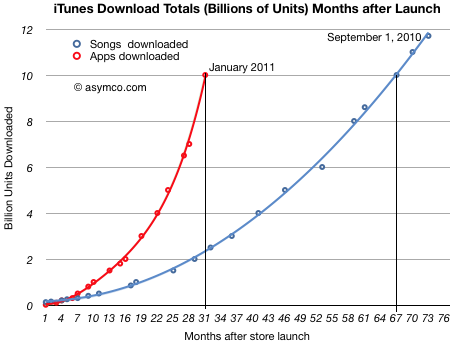
Apple released some numbers that every iPhone user has approximately 60 apps on their device which sums up in 10 Billion app downloads from their store. It took Apple 31 month compared to 67 month to sell the same amount of iTunes songs.

In their latest commercial, MINI battles vs. five-ton monster truck. Can a monster truck jump really clear the whole MINI family becomes the question? And just watch the feelings and what happens to those who watch the challenge. Can love be described better?

LeWeb10 – Learnings & Review

Before I came to Paris to participate in the LeWeb10, I was quite amazed how excited everyboody was about the event. Tweets went to and fro about what we can expect as revolutionary input (comparable to Cebit in the 90′s when companies were launching their most important technology inventions). On Facebook people were awaiting the great party with DJ Bob Sinclair. And people did their networking via Presdo which was used as the “official social network” for participants.

So, what was my impression of LeWeb10? Of an event where 2500 devices got connected, 300 Gigabytes of data were going in and out…

Obviously, the networking part is the most important topic of all events in this business. And so I was networking with many people from interesting people (like Jeremiah – interview follows…) and companies like Pearltrees which introduced new technology or business opportunities. As some could not make it, we will have to evaluate Presdo’s real social networking after-event benefit in some days. So far, so good…

They keynote by Carlos Ghosn, Chairman & CEO, Renault S.A. & Nissan Motor Co., Ltd. was impressive and honest. It showed how much the automotive industry and the IT are coming together, although the former cannot keep up with the speed of innovation the later embraces. The New Megane will have as much IT build in as the first Airbus 300 about 20 years ago. Global warming (also air polution), oil price and the future of mobility will be challenges the car industry will neeed to tackle, Ghosn said, facing the fact that there will be 2 billion cars globally by 2020. A topic I have actuall picked as a futuristic project for me and IDG…

The plenary hall talks were the usual PR outlooks (most not much enlightening…). Interstingly enough, for the first time I saw somebody praising openly the quality of their competitor’s device. Marko Ahtisaari, Director of Design Strategy at Nokia, mentioned the “beautiful elegant” and “easy to learn” of the Apple UI. Obviously, these words were to underline that their new Meego-based platform will kind of “revolutionize” UIs in the future (launch in 2011). He also mentioned that Nokia has 1.5 billion mobile handset users a day and 3.5 million app downloads a day in their Ovi store. Seeing this under the findings of the latest Handmark Mobile Media Consumption Report that mobile replace desktops for breaking news and events consumption, Nokia does well to make their devices more user friendly. Most of my friends don’t have Nokias anymore. Apple and Androids are their choices. So, the competition will be interesting…

For some months, we have been discussing internally the value of MySpace. Or if their market has gone already. Mike Jones, the CEO of MySpace, reaffirmed (or redefined?) their new positioning to the world. MySpace does not want to be a social network anymore but a social entertainment platform (which explains the mayor partnership with Facebook). MySpace is reinventing itself. User shall get recommendations for music, TV and other entertainment content, in some way similar Facebook’s social graph approach (250 mio. peoplle use Facebook Connect button). Music seems to be the focus for them in the future.

“My goal is you come to MySpace, you listen to some new bands and connect to those bands. I don’t wanna be the place that replaces iTunes. I wanna be the place where you learn about music and then take that to wherever your music consumption happens. If we connect you to curators who bring you the best content, your repeat visits go dramatically up,” concluded Jones.

Some of the Ignite speeches were mentionable and thought-provoking (Fumi Yamazaki about the Japanese Geek culture of openness and collaboration).

Side notes… Finally I saw the first Promoted Tweet activity appear in my Tweetdeck account pop up. And I agree with the findings of a study by TWRTCON and oneforty about promoted tweets: Yes, it is was a positive experience (as long as it comes up like this… see picture) and No, it did not target me, so I did not click…

The food was really good – THX to the founders Geraldine & Loïc Le Meur! Maybe work on the registration process. Standing in the rain for an hour is “sub-perfect”… ;-)

Spot On!
The funny thing in the last two weeks was that wherever I was going (Munich, Paris and London) the world collapsed as of serious snow conditions. Two hours waiting on a plane, getting stuck in Heathrow for another day, and no cabs available in Paris for hours were my learings on how much we depend on nature. No matter how clever our technology is. And then you realize how much you use modeern technology. You pick up the iPad and watch TV (live or on-demand) and participate in webinars or conferences. Conversations continue consistently. And sometimes you ask yourself: Do we really need to fly to these countries to join these events anymore? Especially, when these events can be viewed on a live stream? And then you think about Bob Sinclair and listen to his fantastic party tune “World hold on!“…

You answer this question or add thoughts to the future of mobility and events if you may… Much appreciated!

Nielsen study: iPad users open for ads

When the the iPad certainly was introduced by Apple’s CEO Steve Jobs it was said to be “a truly magical and revolutionary product.” This week I have bought an iPad myself and have tried to understand what the tablet is capable as a mobile business device. I cannot really say it failed. And a new study by Nielsen asking 5.000 mobile users shows us how the iPad is delivering businesses from the perspective of a new ad platform.

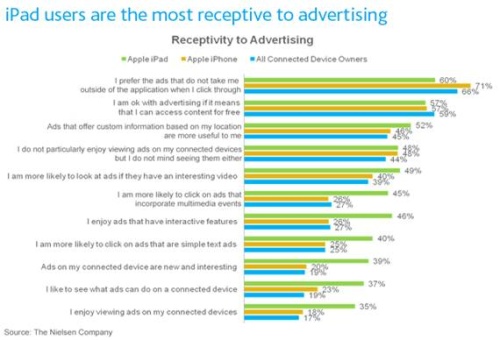
The Nielsen findings from their new “Connected Devices Playbook” suggest that the iPad owners are more open and responsive to advertising than mobile users of other devices – even those of the iPhone. The study shows that iPad users are more likely to buy products after being introduced to ads. And 60% of the respondents of users across the iPad, iPhone and all other connected devices responded they were “OK with advertising if it means I can access content for free.”

The magic formula for making ads for iPad users effective are interactive features: 45% of iPad owners said they were more likely to click on ads that included multimedia than 26% of iPhone subscribers and 27% of other connected device owners. Isn’t this perfect news for the launch of Apple’s iAd platform?

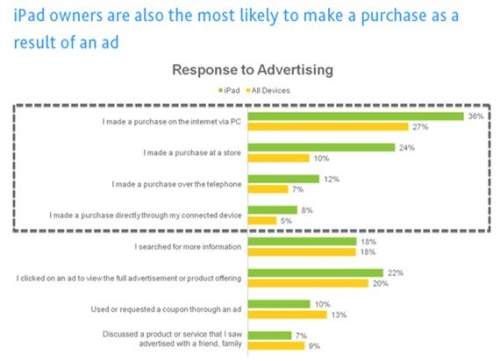
What makes marketers even more happy is that iPad users indicate that they buy a product via their mobile device because of an ad. 24% of iPad users made an in-store purchase compared to 10% of those who use other devices. It seems that the iPad and other mobile devices might offer a helping hand as a revenue driver to all retailers or shop-owners. Nevertheless, we might ask the question whether this is as of the new product and the hype around it, or if this will last in the future. The final question could be how Apple will change their single app sales strategy to make the use of the iPad more cost-friendly for users.

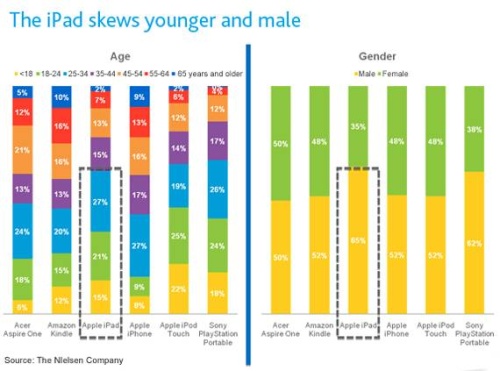
So, who is the typical iPad user? The Nielsen study says they tend to be younger and more male than users of other devices like users of the Acer Aspire One, the Kindle, the iPhone, iPod touch or the Sony PlayStation Portable. 65% of iPad users were male and under the age of 35.

Spot On!
Sometimes it is funny when you read these studies and remember your own shopping experience. Some weeks ago, when the iPad was not even available I remember a 45 year old posh women rushing into the Apple shop. She did not even realize that the sales guy next to me was explaining the benefits of an iPad to me. She just asked when the iPad will be available, got her answer and rushed out with the same urgency she came in. The sales guy was shaking his head that day, saying some of our clients are weird. When you think about how eager she was to buy the product, I can understand that advertising is still effective… not only on an iPad.

The idea of the non-privacy generation

The talk around Google Street View seems to be never ending by the elder generations. Parents get upset that Big Brother visions have become reality, grand parents see geo-data services as a threat well known from the times when war was a child of their past. When people think about the potential of the latest social web technology opportunities they fear that foreigners or even neighbour’s interest might make those spy out their privacy. 

Not so the younger generation it seems. It handles data exchange cooler, or more naive? Privacy data protection worries the younger generation less. Although they won’t leave or share their passwords online which a survey showed this year. Do they really understand that Google Street View is just taking photos of a street that is not interactive, or cannot be zoomed in like the Google Maps version?  

Young people love to log in on Facebook Places. By updating their status they make available the place they have stayed to all of their friends. They do social badging on mayorships via Foursquare. Or they use location-based marketing bargains offrered through services like Groupon. Privacy topics are not interesting to them – although there are reasons for cyber-bulling threats out there.

On a flight last week I had a very interesting discussion with some teacher from a university. The woman I was talking provided the following thesis… 

“There is a new generation on the rise. This young generation can be called the non-privacy generation. It does is not afraid of having somebody chasing them in the virtual or offline world. Or obeying them whereever they go. Or finding out secrets about their privacy. They just enjoy the opportunities that the social web has to offer. Networking and exchanging data. Sharing ratings and reviews on purchases or events. Exploring the future…”

Well, obviously there is some value and a lot of truth in this statement. In our conversation we came across other platforms. She asked why nobody has ever talked about Bing Maps. A platform that takes advantage of pictures by Blom. A company you have probably not even heard of yet, right? They offer pictures of a cross-view of buildings, making backside views of gardens available to everyone. Connected with phone book data, it becomes a great privacy data source – not only for marketers.

The non-privacy generation even uses platforms like Openstreetmap, and thus competes with the Google Street View model. They take pictures with their GPS-enabled iPhones or smartphones and share them on the platform.  Other platforms could be mentioned like Gigapan, a panorama photography – patchwork of tiny pictures put together giving most exact insights in areas. Or even Apple mobiles could be mentioned that in a 12-hour-period tell the head-quarter the position of Wifi hot spots and mobile masts. And Vodafone above all shares their users’ activity data with TOMTOM to improve traffic forecasts as they say.

Is the non-privacy generation not aware of what they are doing to their future? Are we heading away from an age of Big Brother visions? Of old-fashioned fears where people have been chased by the “unknown but realistic” bad, or anything similar to it?

Looking forward what you think about this view on the non-privacy generation…

News Update – Best of the Day

02.09.2010 von  
Kategorie Daily Top 3

Facebook, Twitter or LinkedIn seem to be not enough social networks for the world. The Wall Street Journal is even asking already who has time for another one… I would assume nobody but still there are more and more coming up. See the latest 3 social network innovations from some students, Apple and AEG…

Now, on 15th of September we are awaiting the launch of Diaspora, a community managed social network, which will start with the vision “The privacy aware, personally controlled, do-it-all, open source social network”. The project is financed by Kickstarter.com and is looking at an investment fund of 182.000 USD. The four students driving the project will compete against Facebook’s efforts to monetize on Social Graph data knowledge – and Mark Zuckerberg is said to have invested in the project as well.

The second new “social network” is basically an extension of Apple’s iTunes 10 platform – called Ping. Richard MacManus explaines the social network and all the feature here. The main basic features are the opportunity to comment and rate on music, use the ‘like’ button we know from Facebook and it offers the same asymmetry that Twitter has, in that you can ‘follow’ people and music stars that don’t necessarily have to follow you back. The monetization strategy behind it is clear but still quite aggressive to me. Sharing Richard’s view that I absolutely agree with from a user’s point of view…

“The fact that you need to be inside the iTunes Store to create new content or like something, seems a rather cynical move to encourage people to buy more music. Why not let users search inside Ping for a song or album? Or, even better, let them right-click and comment, like or rate music from within the iTunes player?”

The third new social network I found was created by HUGE, digital agency in the US and part of the Interpublic network. The company just launched a new social platform, called Perfunkt for Electrolux, via their AEG brand. Perfunktis looking for perfect functionality, ideas and techniques. It is said to represent the biggest bet on branded content and social media by a major appliance brand to date. The platform is already generating new heights of engagement with consumers around branded content through stunning videos and one-on-one interactions with users.

« Vorherige SeiteNächste Seite »