The virtual dollar – the future of web monetization?

money-sepiaAccording to a survey by the market analyst firm Frank N. Magid, the market for virtual goods will grow in 2009 to a volume of 1,8 mio. dollars. One out of ten Americans has spent real money in return for virtual goods in 2008. And we are not talking about pennies like in the advertising industry. The people that have spend money for virtual goods said they have invested up to 100 US dollars or more. The average invest is somewhere at 30 US dollars.

No surprise: The group around ‘Massively Multiplayer Online Role-Playing Games’ (MMORPG) is the most willing target group for virtual goods. Nearly half of this group of ‘gamers’ spent money for levels or items. Another quite obvious target group is the iphone user who spends money for apps (28%) and the members of social networks (27%).

One of the biggest success stories for virtual goods is probably China and their popular social network Tencent’s which has a special focus on virtual goods and its power on monetization. And if we look at the gaming industry, we can also find Internet Gaming Entertainment that is doing well in offering virtual goods services to collect and receive new game levels and items.

If it is Facebook selling virtual presents like nice flowers, beer glasses or kisses in the format of an icon for one dollar. Or let’s say the social network Hi5 with their casual games section. Money becomes virtual coins and you can easily spend it for a game of dart or for a video wall in your own virtual room on Smeet. Or let’s think about Second Life that is selling virtual ground in a virtual world for real hard dollars and some years ago made Ailin Gräf rich. She became a real-estate tycoon on Second Life – and thus, she became rich in the offline world.

Spot On!
This all reminds me of the good old Tamagotchi days. We were taking care of and feeding virtual animals in order to keep them alive. I am asking myself if this is a possible business model for social networks. You can buy your personalized virtual Tamagotchi and place that on your Facebook account, your iphone or your HTC mobile. So, everybody in your social network can see how you care about your ‘best friend’ – and how open you are to the virtual dollar…

Hey, why don’t we have that virtual Tamagotchi already?

Let me know how you see the future of virtual goods. And may be you want to share some ideas that would be really thrilling for companies to think about. Curious what will be coming up with…

Kevin Spacey explains David Letterman Twitter

23.07.2009 von  
Kategorie Daily Top 3

Kevin Spacey and David Letterman gave the perfect show act at Letterman’s Late Night show on CBS TV. And suddenly these guys were talking about Twitter … pinging verbal tweets to and fro. And then, Kevin Spacey finds the perfect business model for Twitter. Okay, maybe a bit expensive…!?

David Letterman: Did it cost you money to be on Twitter?
Kevin Spacey: (scared) No, it does not cost you money…
David Letterman: I don’t know how you…
Kevin Spacey: …(amazed, shaking his head)…
David Letterman: I don’t know how it works.
Kevin Spacey: A penny for every letter. It’s so expensive Dave…
David Letterman: I don’t know anything about it.
Kevin Spacey: Are you on Twitter?
David Letterman: No, I don’t know. I can’t afford it…

Spot On!
If Twitter costs something? Yes, it does – a fortune of time, Kevin could have answered. But … ah, his answer is much cooler. Just enjoy it!

News Update – Best of the Day

All social media platforms are looking for ways to monetize their business. Jun Loayza writes about five business models for social media start-ups.

Politics and good Twitter case studies – in no way possible? Yes, it is possible… Just read the post about Rep. Laura Brod in the US.

Will advertising and sponsorship of objective journalism survive? What’s the future of newsrooms focusing their traditional news business? Former president of CBS News, president of the Newspaper National Network and CEO of Air America Media is talking on the content crisis.

10 general questions on web monetization 2.0

Brainstorming… ! This is a project which needs your help in order to start saving the future of the web in all its facets…

A post for you, me and all of us platform owners, web maniacs, companies, advertisers, affiliates, social medians and web workers to do some brainstorming and share some thoughts on the future of monetization.

In a lot of discussions, talks and chats with partners, clients and friends, we came across these questions. It is time to find some answers…

Please, tackle this project with me and give as much feedback as possible. We all want to participate in the future of the web. So, let’s do some work…

10 Questions on web monetization 2.0

What if…
1. … all companies respect that platform owners (social networks, media publications, portals, etc.) start their web activities in order to monetize their business like they do?
2. … web platform owners never had started using the measurement argumentation versus the former print world?
3. … companies accept that web platform owners start their business model to earn money – not just to be a service provider?
4. … web platform owners never had started the price competition in order to ‘drag away’ clients from each other – resulting in cpm values of cent amounts?
5. … companies had not overrated the measurement options and tried to buy ROI value (leads, orders & revenue) only – than simply the ‘best price’?
6. … web platform owners never had started cpx payment, let’s call this ‘performance payment’, but were using the old advertising model: ‘pay for play’?
7. … companies suddenly stop advertising the ‘pay for play’ way and just strive for performance payment?
8. … web platform owners need to go for ‘free-mium’ or premium service payment for users, as they cannot afford to run their business any longer without the support of the ad industry from the last 5 years?
9. … companies could finance, sponsor or take over the costs for those ‘free-mium’ or premium service payment for certain target groups?
10. … finally, we users all understand that without web platforms owners generating any revenue, the internet is nothing more than a shell without pearls?

Pick a question, share your views and posts and give us some answers.

Looking forward to your comments…

Dead or alive? Some philosophy on the future of blogging…

Last week, there was a lot of talk on the future of blogging, online – and offline at ‘online-minded’ events. The coincidence crossed my way that last week some of my closest friends (no bloggers by the way) were sitting together, discussing heavily on why blogging is the future of media – and obviously micro-blogging as well. The conclusion we came up with can be found in the ‘Spot On!’ at the end of this post.

Let’s give the word to the blogging experts and their thoughts first…

A kind of an ‘inner circle’ had dinner at TheNextWeb09 and was brainstorming in a relaxed atmosphere on the topic if blogs are dead. Now, Andrew Keen shares this controversial conversation with us and quotes on his blog Hermione Way, founder of Newspepper: “Blogging as we know it is dead”. The co-founder of WordPress, Matt Mullenweg, sees more of a different new approach for blogs and the way people will handle blogging in the future…

“Blogs will become aggregation points” (…) “They will become our personal hub. Places where we store all our personal media content such as our flickr photos and Twitter posts.”

Especially when we think of micro-blogging, this seems to be the state of mind for a lot of the Twitterati – and some also do it vice versa in a (sometimes self-referential) cross-promotional way.

But, are Mullenweg’s thoughts not interfering with the business model of bookmarking sites, websites such as Mister Wong, Digg, StumbleUpon, Technorati or others, someone may ask? So, is the future of micro-blogging a mixture of bookmarking with the positive effect that you share personal or follower content with friends and followers?

And finally, let’s listen to the words of David Tokheim, Six Apart Media, top manager of an American blogging service provider…

“The lines are becoming blurred between a standalone blog that might be created on TypePad or Blogger or WordPress and blog content that’s created by The New York Times.”

And eMarketer defines blogging today this way…

“…today’s (blogs) are about two-way conversations that take place on many fronts: independent, standalone blogs; social networks; e-commerce and mainstream media sites; and micro-blogging platforms such as Twitter.”

Obviously, times for blogs are changing. The former definition of blogging as a personal expression using an easy self-publishing tool has gone lost on most of the blogs. It seems that blogs are becoming mainstream as a modern format of publishing in the meaning of creative thought sharing … So, we may be asking ‘Why?’.

Spot On!
Now, reading all these opinions, my answer and view on blogging is more a conclusion that goes in the direction of Richard Jalichandra, CEO of Technorati: “You’re also seeing mainstream media coming in the other direction by adding blog content”.

Being an online publisher for more than 10 years now, there are coming different memories to my mind that bring my vision on the future of blogging to you. Memories from past days where the following “unwritten editorial manifest” counted, using the good old editorial questions (and old silicon brand slogan) …

who cannot write professional is meant to leave the pen in the bag, better stop expressing opinions open wide and keep their mouth shut. – Now, most of the blogosphere has forgotten pens exist, publish excessive, express great visions and are not even physically meant to keep the mouth shut.
what intelligent brains cannot control in their minds or ‘scribble’ in books was not worth to be mentioned as it lacked the only format of intellectual value proposition: print. – Now, the web is crowded with blogs (and will be even more in the next decade) offering more intelligent content output in not more than 500-750 words but hundred times more trendsetting, enlightening and progressive than some theses.
when choosing the ‘right’ content management system (cms) was key for the success of online publishing. – Now, there are content management systems, called blogging tools, comparable to former publishing cms systems, leveraging an individual’s mind to the status of a well-rated publishers level.
where long, grey-haired editors with black, stand-up collar long-sleeves or flashily-dressed outfits were the only valid authority of the written word. – Now, we have casual-dress code at Tweetups, meet calling cards of the blogosphere in jeans giving advice on stage to white-collar professionals and suits. University education turned upside down…
and why the individual, the economy and the industry is not publishing? Media experts were doing it much better, more professional, well experienced and with heart and soul. – Now, the world is overwhelmed how complex, creative and informative individuals, employees and companies find ways to be heard by the world, their target group and their customers – just by (micro-)blogging.

The glory of blogs has just been brought to life. Blogging is alive – different from its beginning, sure. But the future of blogging has not even started being perceived as the leading new format for digital portals, magazines, newspapers, custom-publishing, or even digital TV broadcasts. And there will be companies and individuals becoming new famous publishers with their blogs that we don’t even know yet.

This is my take on the future of blogging and I love to hear other views…

Parody: Is Twitter out and nanoblogging the next trend?

If you are on Twitter there are three things we don’t like: people that talk to much, the speed of the service and the interruption time. Now, there could be a new alternative to Twitter called Flutter.

This nanoblogging service will restrict users to blogging in 26 characters or less. A new blogging trend? At least if you believe in the theory of Matt Ibsen, founder of Flutter…

The cool idea about Flutter would be that you can update your updates from other social media sites and Flutter will automatically cut them down to the 26 character limit. A brevity which all our followers and friends will appreciate…

Sure, this is a fictitious parody on the latest innovation drive in the ‘social media industry’ by the Slate Magazine. The world needed someone to make some fun out of the latest madness around Twitter.

Spot On!
Some questions we do not need to ask for evaluating Flutter: Did we all get the benefit of the business? What is their business model? If it is really a great concept… why do we see such a ‘poor’ delivery on the concept by the execs? Why don’t the execs explain the essence of their business model in 26 characters? This could be an interesting approach for Twitter’s 140 as well…

In some way this parody reminds me of…

Twitter Ads: Thoughts on the test

Now, there has been a lot, a lot, a lot of thoughts and talk lately on how Twitter will be making money. Finally, Twitter is experimenting with a new revenue model as Techcrunch tells us…

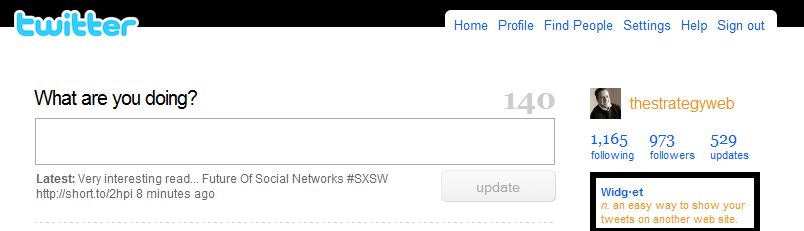
First, it seemed like a nice idea to promote their own service (i.e. widgets and search), which I thought is the case. This well-placed add-on feature makes it easier to work with Twitter, especially heading towards their search site, when you are not using any of the helpful Twitter apps. And there were also some good thoughts on Twitter becoming a search engine and as how this will be a driver monetizing their business. But Overture (now controlled by Yahoo), has patented placement of text ads on a search results page. So, this was probably a difficult pitch.

Now, back to what is happening, see the black box on the right hand side on ‘Widget’…

It is obviously really a ‘simple’ test for some solid revenue stream generating business, we all are familiar with via Google text ads. But can this be an appropriate test to recall on revenue models?

The two test objects, Twitter search and the above mentioned Twitter widget link, belong directly to the Twitter concept. It offers some immediate navigation benefit to the user. This is what users are after for a long time. Thus, ‘Twitterati’ will click on the links and appreciate the easy way accessing their search service. So, the results Twitter sees with the test don’t reflect in any way potential click rates on text ads as these are dependent on results.

Isn’t there a difference if you promote some internal service or feature, or if you run a promotion from some external party or company? In my experience, in terms of text ads, and those generating results, we can definitely say, there is a huge difference on the click rates. Hence, on the conversion rate clients will find the difference as well. Editorial focus is not comparable to advertising, reaching out for awareness, right? And as clicks is the interactive currency ‘No. 1′ for marketers and convergence their need, according to yesterdays CMO report, the test sounds like comparing apples and oranges.

Spot On!
Nevertheless, the test is worth some thought. And just imagine Amazon and Twitter are getting engaged, the business model becomes clear based on some semantic web thoughts: connecting Amazon’s product catalog by connecting tweets and related products. Someone talks about a film and gets an offer from Amazon in the text ad. Or maybe Yahoo could be the new ‘Who is buying Twitter at last’ as they could compete in the long-tail market. In general, Google could finally face a competitor here…

Print and Online: thoughts on modern publishing

This week, there was some interesting buzz around modern publishing. How the future might look can only be found between the lines of the news. Let’s face some of these indicators of the modern publishing industry…

Print
In Germany, we have had the breaking news that Vanity Fair will be closed down – the magazine survived only two years. Is this a sign for the publishing industry that print is dead? Or just an proof that the publishers have not found the right approach for a target group? OK, America loves VIPs, so does the UK, and even Austria the famous opera ball (yesterday) indicates some addiction to vanity sanction. In these countries people love luxury goods, focus on lifestyle and want to be up to date in the VIP scenario. Pure news business, great for ‘word-of-mouth’ conversation in the bars.

Some thoughts… In Germany, can we doubt that people don’t even appreciate socializing in bars in the night? Is jealousy a ‘critical’ mentality topic in the German society? Is there a nightlife that the other mentioned countries can offer? In the end, how about the editorial approach when all these questions remain with an at least ’50% Yes’ in the room, and when there is no word-of-mouth VIP-society?

Online
The TIME magazine just awarded the 25 best blogs in 2009 – but also ‘downsized’ the ‘ratings’ of some famous blogs. Let’s have a look at the top and flop 3…

Top 1: Talkingpointsmemo.com
Top 2: The Huffington Post
Top 3: Lifehacker

Flop 1: TechCrunch
Flop 2: Gawker
Flop 3: The Street

Are we surprised that the Huffington Post is amongst these top three blogs? They raised 25 Mio. US Dollars investment this week. But wait a minute? How are they monetizing their platform? Classical advertising models like banners, text-ads, paid links and Google AdSense, right? Is this the future of monetizing an online publishing platform – monetizing based on reach? Is this pioneering?

If you doubt this, then how do we have to face modern publishing reality? What is responsible for the Huffington Post success? Editorial credibility (3,5 Mio uniques, 60 mio. page impressions), the political new way of opinion-forming, the modern blog publishing format or just the name of the founder Arianna Huffington? Or was it just the Obama hype that made this blog famous? A mixture of everything maybe…?

Techcrunch is one of the most quoted websites in the world today. Nevertheless, it finished in the flop 3. Did the quality go down because Michael Arrington wants to sell the blog? Or are there other reasons for their downsized rating than those of the TIME magazine?

Spot On!
According to the cluetrain manifesto: markets are conversations. Bearing this in mind, publishers of all kind need to have a close look to the talks of the target group they intend to address, which market mentality they wish to access and above all, if there is a ‘word-of-mouth’ power for the publication in the entered country. The publisher editorial teams need to find the right investigative approach to modern journalism that makes people want to think and generate content for them, not answering peoples’ thoughts – in order not to face a publishing crisis. Having a monetizing model in place is the justification for a business model and an investment round. But it does not have to be innovative, it seems…

PS: Can we summarize… First, there were print magazines, then there online magazines and now we have blog magazines? A lot of questions… open to your word-of-mouth.

The business network netiquette

About four month ago, I wrote a post on the XING Netiquette which made its way to the XING experts blog. The reason was that some of my colleagues, relatives and friends realized the unfriendly and unprofessional style of communication with business contacts on business networks such as XING or LinkedIn. This was also some development that the XING expert experienced, Joachim Rumohr, who added the post to his professional blog. And, as this post was read very often in German, I decided to write also an English version about the topic: business network netiquette.

We all know from management trainings and media that the first impression counts to the highest degree. So, if we are reaching out for new contacts, or looking to kick off interesting partnerships, or just doing some ‘investigation’, we should all be aware of the actions and reactions this might cause.

Why? Every single web activity might affect our online (and offline) reputation. There are several people already focusing on this personal branding topic as a business model in terms of ‘creating’ books or blog posts, or reputation ID networks or they are just ‘visionering’ about this topic.

In terms of business networks such as XING or LinkedIn, the stumbling block is not the contacts that we are linked or connected with. Normally, people know how to behave and interact there as they know each other. It becomes more difficult when contacting an unknown business user in an online business network. In this case, it does not matter if you are contacting somebody or if some business person is addressing you. Although the networks advise with ‘FAQ’s’ and ‘Help’ sites on how to ‘meet online’ with somebody on a business level, these websites are quite often well-hidden and enlighten only some parts of this special topic called ‘netiquette’.

Let’s have a close look at some general principles which are definitely necessary and have to be taken into account when contacting somebody on LinkedIn or XING (or any other business network).

The business network netiquette

When you are contacting some business person…
a) Send a message: Be friendly. Keep your message short. Refer directly to your request.
Why are you approaching this special person? Be aware that the contacted person you are referring to might not have very much time for online networking – especially if this person has a high level of responsibility and credibility inside his company. Although all these people would love to have a personal web manager in order to spend more time for online networking, they actually don’t have any.

Be prepared to get some feedback. This feedback might be completely different from what you think and wish to achieve. Nevertheless, respond to this person no matter how the feedback ‘sounds’ in your ears.

b) Via direct connection: If you have had no contact before (online or offline), it is advisable not to contact these people directly without having addressed these people in an email, spoken on the phone or in persona before. Obviously not, when you are just a collector and hunter…

If you contact somebody, give this person the opportunity to communicate with you offline and online straight away. In some business networks you can also activate the contact details without being linked with somebody. Never stay incognito!

When you are being contacted…
a) Receive a message: In the ‘unlikely’ event of receiving an email with some business network member contacting you, this person definitely has a very serious and valid business reason to address you…. and it is you, you, you! If somebody has chosen to contact you (and no-one else!), this is an honor – please look upon this action favorably.

b) Via direct connection: If you had no contact at all before somebody is contacting you (offline or online), please evaluate whether you accept this contact. Having tones of contacts looks nice (as does having lot of followers on Twitter) but does it serve your purpose? Caring about all of your contacts is difficult and becomes unprofitable quite quickly.

If you think this person is beneficial (in private or for your job), then there is no reason not accepting this contact. Don’t be afraid of denying irrelevant contact offerings though. BUT: Definitely use the ‘Add’ or ‘Deny’ button and don’t leave this person desperately waiting for an answer in your folder ‘Inbox’ or ‘Contacts to Add’.

In any case, if somebody is getting in touch with you via business networks, it is an ‘unwritten’ duty to respond with an answer – no matter if long or short, positive or negative or if you have some business interest in this person. Even if this request is in your eyes uninteresting, boring or not fitting
your profile details. Everybody has deserved to get an answer.

Let’s take an example from the offline world… If an employee or some partner has a business idea that he wants to share with you, you are not just turning away, saying nothing, right? The same applies to the online world. And, premium-user do see and know more or less everything in business networks – also that you have been looking at the profile of the person that has send you a mail via the business network.

The above mentioned advice is also applicable for all group activity in business networks and for common email communication, too. Be friendly, offer the dialogue and be authentic.

Spot On!
Be the virtual person that you are in the offline world! This is the only way being authentic and successful. Contacts know easily by monitoring who you are, what you do and why you will be interesting – they might know your digital dna without even checking it for negative examples.

Always imagine you are joining a big business card party and you ignore somebody who might be introduced to you 5 minutes later. Remember… You always meet twice in life! In a digital networking world, when being a virtual person with a business network profile this might happen quicker than you maybe want it to happen…

Cost per User – the next digital currency?

The discussion about the best advertising currency is long-lasting. It may never be ending. Still the discussion needs to be continued. The web publishing space had all the options on the table: cpm, cpi, cpc, cpl, cps and so on. And each and everyone of those failed in a way that makes all sides of the publishing and web value chain happy. The only currency that did not seriously come up as a currency ratio in media is cost per user (cpu) although every company follows this metric to evaluate their website costs.

Advertisers love to purchase ‘cheap’ quality space of extraordinary target groups. Platform owners need premium-price compensation models in order to provide high-quality content to their users. The users don’t care. Although they are the stumbling block, the center of attention, in this issue between platform providers and advertising clients. Now that web 2.0 and social media comes into the ‘cpx-game’, everyone gets a chance to rethink digital currency models. What is missing in this discussion is the cost per user model.

A Retrospect on Controlled Circulation
If we go way back to the beginning of this century, there was an interesting discussion about controlled circulation going on in the publishing industry. This discussion indicated that the best value of a medium is the registered or qualified user. Someone who gives away a lot of personal data in order to receive a medium for free. And there were numerous print magazines in the market that do and did controlled circulation. And today? There are hundreds of community-based business models on the web – all of these are to a huge degree controlled circulation orientated. Only a few of these businesses know about it, or see the premium value of controlled circulation media in this advertising space.

Now, what exactly is controlled circulation?
In a lot of meetings with clients, the question came up a thousand times when we explained our old community model. Controlled circulation is a distribution model, usually free of charge, for newspapers and magazines that wanted to have a deeper control of their target group. Thus, controlled circulation magazines offered the ideal targeting of the best quality audience for their advertisers. The benefit was quite obvious if we read the articles here and there. Advertisers spend more money for an ad in the controlled circulation arena than for the classical news-stand magazine. In booking controlled circulation media advertisers know in details what target group get for their money. This premium model could have been applicable to business models on the web. But only a few saw this option and took advantage of the ‘closed’ access door idea.

Why is controlled circulation a winner?
The big benefit of controlled circulation is that non-profit organizations audit the reader database of magazines or web platforms in terms of database quality and quality reach: for print BPA and for web platforms ABC Electronic. Both independent ‘controllers’ double-check in the means of the advertisers what kind of target group quality content providers ‘pretend’ to offer to the advertisers. Advertisers love the audits as there is some reliable data that marketers could show to their bosses or the management team after the sales people had captured the marketing-office for their sales pitches. It needs to be said that the audits were based on projections – only 10-20% of the total database really was tested, but still the quality check was much appreciated by the advertisers.

Controlled circulation and the modern web communities
The question is: Why did the controlled circulation discussion ‘die’? Why was it not carried on as an idea for a premium-priced advertising currency in the web world? Why did the focus on the high-profile individual user registration get lost when there was such a huge benefit for the advertising industry? Did it get killed alongside the top-valued personalization idea which got stepped down by the advertising cpm valuation? Maybe…

Nevertheless, in days where social media, social networking and community-building is exploding, is it not the right time to focus on the value of the registered user in terms of digital currency and critically scrutinize the ‘odd’ cpm valuation? Does not the individual need to be in the center of attention of the modern web 2.0 world? The modern web individual that communicates with companies. The one that reads, comments, blogs, publishes, networks, rates or reviews?

A vision
Just imagine there was a kind of database that all magazines and platform owner have to use who want to earn advertisign dollars. That database is held by a non-profit organization or the government. A system where all users unite, active and inactive web users. Every user could define their most interesting platforms and status of activity which would lead to a cost per user index for each online magazine or web platform, based on consumption intensity of the average user, social networking value of the active user and staying-time frequency of each individual. In the end, the combined data of the website generates a platform coefficient which leads to a cost per user. This is the cost that advertisers want to book, right?

Spot On!
In the modern social media world registration processes become daily business for users. If it was one database as described above, the users would be held responsible. They would be more careful on how to define access and care about their data. From day to day, users get more open minded about showing their data on other media including registering their preferences, interests and hobbies. And platform owners benefit from that. In the future, it will become a state of the art for publishing houses and digital platform owners to have their own web community visible on the side-bar for new visitors. This is a huge success for web platform owners. What could be a better reference if you can show your audience, visual and accessible for everyone with avatar picture that the users upload themselves? Bloggers already use this option to attract more interest. The single user will become the reference for each platform.

So, what if the best targeting measurement of a platform becomes the cost per user (cpu)? If we think about how connected (via Google, Facebook or Yahoo) these platforms are becoming and see all the website and social media metrics we could monitor, the question rises: Is there an option to standardize registration on web platforms and communities plus integrating all the generated data of these platforms into one non-profit system or organization which calculates a cost per user index based on targeting criteria like b2b or b2c and different demographic data? Is Cost per User the next digital currency? The discussion is yours…


« Vorherige SeiteNächste Seite »