
Email Evolution or Revolution – From Goethe to IBM Verse
Eyes wide open, the two IBM gentlemen look at me. They sit up right. Professional. Spot On. You can feel their enthusiasm, their expectations are high. Both are social collaboration leaders at IBM, evangelizing on the #newwaytowork. That’s how the software technology company hashtags their latest journey to the revolution of the email as they call the launch of their new inbox communication software “IBM Verse”. You can tell how excited the two managers in front of me are to talk about the IBM success story. The launch seemed to have gone well so far.
On my opening question both face each other, not sure who shall answer. They are professionals in communication, they are prepared. “The term Verse is historic for communication and conversation”, replies Dr. Peter Schuett, Leader Social Business Strategy at IBM. “In times of Goethe, when carriers brought people hand-written letters, all the communication that went to and fro was written in verse.” The answer surprised me as IBM’s development sounds like a trip in the past.
It is not. For the first time, IBM has taken a new development approach. They made their customers think about the new software solution by inviting customer to their labs, by rethinking email, and by thinking design and customer experience first, based on real customer feedback, input and inspiration. Not the cheapest way to innovate. The product development cost 100 Mio. US Dollars according to them. It has got to be effective from a customer perspective.

For a long time, IBM has been a forerunner in terms of modern workplace technology. Their “Outside the Inbox” evangelist Luis Suarez has already been preaching for a business world with less emails. We all know the reasons why he was addressing this. People get approximately 127 emails a day. This means emails kills 28% of our daily work-time, and thus of our daily productivity.
With IBM Verse the software technology company wants to shift productivity. Creating a more effective business culture is the aim. From Ed Brill’s perspective, he is IBM’s social business transformation specialist, email should function as a transmitter. Email today should be serving notes like a private letter what Goethe used to do in hand-written form: delivering private information.
“Email is the service forever. But it needs to be a personal service.” Dr. Peter Schuett, IBM.
Focussing on the new software solution, I brought up the question in which way this is a revolution to email communication. Ed Brill emphasizes that IBM did not want to reinvent the email. IBM wished for a better email. However, IBM wanted to create a new intersection of email, calendar, social media and analytics. That’s what they have done with IBM Verse.
When I showed a bit of my disappointment around the new solution’s capabilities in terms of being an aggregation platform for direct messaging and functionality as an inbox management system in general, Ed Brill rearranges my expectations in bringing the metaphor on suits which might all look different in design but are in a sense all alike from the amount of innovation in style and structure. And by the way, the power users of enterprise email are still personal assistants.

True, sometimes people forget where they stand in the evolution of modern communication. With their “People” and “Analytics” functionality, the modern way of a more personalized communication approach seems to get in that social direction in the future. At least, when we compare IBM Verse and Facebook from a superficial point of view. With IBM Verse people also move into the centre of the communication universe which is meant to map the efficiency form content to people. IBM Verse “People” learns to show the users dynamically who is important to their communication, by hour, meeting and topic of conversation. Obviously, users can also change that and arrange it according to their premises. The world of communication gets filtered more and more.
Spot On!
IBM Verse is definitely a big evolution step in email communication. Still, they could have made it a bit more of a revolution in delivering a multi-messaging and communication management platform in my eyes which integrates direct communication via Facebook, Twitter and others.
Brill agrees that when CEOs wanted to spread the word around some company, product or people changes in the company, IBM was about to use email for that communication. Today, via IBM Connections -the internal use of their own company community platform- gets 7 Mio. accesses a month, and the CEO messages will reach (and achieve more feedback) more people via internal social messaging than via email in the past.
Nevertheless, the two gentlemen did not want to commit to a statement whether IBM Verse and IBM Connections might become one platform in the future. But the approach to one collaborative workplace platform, serves the option to have fewer apps in the future. But hey, there is hope: “Rome was not build in one day!” summarizes Schuett in the quick Snapshot video interview in the end of our interview, and smiles.


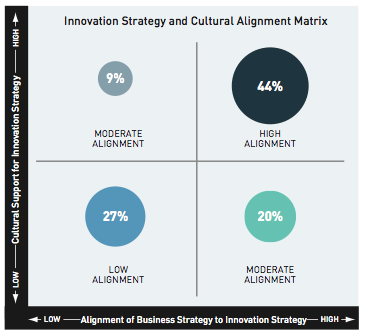 Moreover, about the same proportion say their innovation strategy is inadequately aligned with their overall corporate strategy. And although entire industries, such as pharmaceuticals, continue to devote relatively large shares of their resources to innovation, the results are much less successful than they and their stakeholders might hope for.
 It seems to be a love and hate relationship: Executives and Social Media. On the one hand, companies see how
  Jive Software recently published a
 One-on-one interview with John Hernandez