Mobile is on the rise but web is still king? Well, it is one of these findings that makes you wonder on first reading. Although websites still reach bigger audiences, web users spend most of their time in mobile apps according to comScore.
Monitoring the time between June 2014 and 2015, comScore finds in some research that the audience for mobile websites is around 250% bigger than mobile apps. Furthermore, it is growing twice as fast as apps. As a reason for this development comScore sees the closed garden phenomenon a challenge for apps. Web versions are much more fluid in terms of linking between content, social and search.
comScore also found that FB and Google own eight of the 10 most-visited mobile apps with Facebook winning the “competition” (almost 126 million unique visitors) with nearly one in two users who installed the app saying using it most frequently.
It is not surprising that Facebook’s app as of it’s reach is not the fastest growing app any more compared to Google’s audio-video sharing platform Youtube (9 to 18% growth) with 99 million users. However, after seperating their Messenger app from their main Facebook platform, the Messenger was grew double the size compared to last year.
Where people between the age of 18 and 34 spend most of their time is on Facebook (nearly 26 hours a month), Instagram (7 hours), Snapchat and Tumblr (6 hours) and Twitter (3,5 hours).
ComScore said mobile phones now account for 62% of all time spent online. Within that total, the research firm said 44% of time is spent on smartphone apps, up from 33% two years earlier. Mobile users spend more than 70% of their time in smartphone apps, dwarfing time spent on tablet apps and mobile websites.
Spot On!
The comScore mobile report gives a good indication of where the evolution of apps and their usage might lead in the future. It shows that “messaging is a very hot sector for apps” but is still early stages in the US. Looking at the time people spend with certain categories, the leading areas of interest were social networking (29%), radio (15%), games (11%), multimedia and instant messaging (6%), and music (4%).
As the research was monitoring the US audience, the two apps that were not owned by Facebook and Google under the top 10 were the music apps from Pandora and Apple Music. Furthermore, new service apps like Uber and Lyft have become more and more popular, comScore finds.
https://thestrategyweb.com/wp-content/uploads/2017/11/strategywebLogo-300x139.png00The Strategy Webhttps://thestrategyweb.com/wp-content/uploads/2017/11/strategywebLogo-300x139.pngThe Strategy Web2015-09-24 07:14:532015-09-24 07:14:53comScore: Increase in app usage, mobile web still important
Some say, email is a dead media, some know it is not. At least not on smartphones in the U.S… For American adults email is still the most common activity on smartphones. In the second place comes Web browsing, closely followed by using Facebook. This is the result of the “Always Connected” study from IDC. The study is based on feedback from more than 7,400 iPhone and Android users between 18 and 44 years old.
These are the main findings of the study….
– 78% check email on smartphones
– 73% browse websites
– 70% using Facebook in some way
– 131 minutes per day communicating on their smartphones
– about 33 minutes of the above are spend on Facebook.
Now, it has to be mentioned that the study was sponsored by Facebook. The study supports the fact how important Facebook is for the communication via smartphones. It also makes clear how much time users of social networks spend their daily time when they are out on the streets, at work, at shopping or following sports activities. Obviously, most of the time is spend on Facebook – in eight different activities, people responded that they are almost 4-5 times more likely to be on Facebook than using Twitter or LinkedIn.
Spot On!
The value of the study can in some way put into question, although we have seen many studies in the last years that demonstrate the importance of direct one-to-one communication on Facebook and the mobile use of Facebook. Another study by Localeze/15miles/comScore Local Search found that not email but search is the main activity of the mobile users. However, the approach of the study was different. It looked at people not only in the 18-44 years range and it proved the use of smartphones and tablets. there must be a reason why Facebook sponsored this study. I would not be surprised if they will publish some new mobile advertising opportunities soon.
https://thestrategyweb.com/wp-content/uploads/2017/11/strategywebLogo-300x139.png00The Strategy Webhttps://thestrategyweb.com/wp-content/uploads/2017/11/strategywebLogo-300x139.pngThe Strategy Web2013-04-03 20:34:492013-04-03 20:34:49Facebook/IDC study finds, email top activity on smartphones
In a recent report called “2013 Mobile Future in Focus” comScore released their outlook for mobile trends. The report shows the U.S. mobile and connected device landscape in 2012, which is meant to the set the stage for the international expansion of the mobile revolution. It offers insights into mobile media consumption, mobile networks, platforms, as well as OEMs. It also includes key mobile market insights from the United Kingdom, France, Germany, Spain, Italy, Canada, and Japan.
The report illustrates the following trends for the mobile year 2013…
Multi-mobile use shapes the “Brave New Digital World”
The U.S. is surpassing 125 million U.S. consumers and tablets in mobile consumption. More than 50 million own smart mobile devices which make consumers being always connected. Americans spend more than one out of every three minutes online on mobiles. Does this show the end of the desktop?
Smartphones surpass 50% penetration and start ‘Late Majority’ of adopters
In 2012 the U.S. smartphone market became the year of mobile by finally surpassed 50% market penetration. It enters the “late majority” stage of the technology adoption curve. Smartphone subscribers increased 29% from a year ago and 99% from two years ago. 72% of all newly-bought devices were smartphones.
Android and iOS Control U.S. Smartphone Market
Google’s Android OS and Apple’s iOS dominate the U.S. smartphone landscape with almost 90% of the market today. The well-developed app ecosystems makes it even more difficult for competing platforms to narrow the gap.
Samsung makes splash in smartphone OEM market
Samsung strongly competes more and more with Apple that is still the leading smartphone OEM. The year-over-year increase of more than 100% from Samsung and a two-year increase of more than 400% shows how much they are challenging Apple. The gap between the two competitors is steadily narrowing though.
High-Speed mobile connectivity speeds up mobile content consumption
Wider availability of high-speed internet access has increased the average user’s media consumption experience. Default Wi-Fi accessibility for smartphones and tablets like in coffee shops contributes to the new workplace and a better browsing experience for users. But also the availability of better networks speed (4G and LTE technology) will leverage the mobile content adoption.
Spot On!
The report shows that 2013 was kind of the “year of mobile”. With the rise of smartphone adoption to an over 50% penetration but also tablets becoming more prevalent, it seems that the world is moving more and more away from desktop internet usage. Mobile devices make up the digital media consumption of consumers these days. Obviously, marketers and media companies need to adapt their businesses to the emerging mobile multi-platform world but should also see the opportunity of mobile car technology (Google Glass Project), Augmented Reality (IKEA), QR codes (Adidas) or “mobile storytelling” (AUDI).
So now up to you. What has changed in your mobile adaption from last year? What are you missing in terms of mobile marketing development? And what would you be open for when marketers address you with mobile content?
https://thestrategyweb.com/wp-content/uploads/2017/11/strategywebLogo-300x139.png00The Strategy Webhttps://thestrategyweb.com/wp-content/uploads/2017/11/strategywebLogo-300x139.pngThe Strategy Web2013-02-26 08:02:572013-02-26 08:02:57Report: comScore unveils insights in main mobile development for 2013
In a recent study the research companies comScore, Accenture and dunnhumbyUSA found some significant relevance between in-store sales and a company’s web presence. The study was based on a panel of CPG customers and one million U.S. Internet users who have given comScore explicit permission to have their online activities continuously measured and matched to their in-store brand buying behavior provided by dunnhumbyUSA.
The report comes to the conclusion that consumers who visit a website prior to their shopping experience in a company store spend 34% more with that company and 57% more on products or services based on their specific industry sector. It also states that visitors of brand websites are frequent buyers of the brand in retail stores. It shows that 42% more of these clients finish their transactions than non-visitors. Furthermore, website visitors are also heavier buyers in a brand’s product category. They are spending 53% more in their category dollars than non-visitors.
“Since website visitors have higher affinity to the brand and the overall product category, there is an opportunity for brand marketers to drive loyalty through personalizing the website experience, catering to the preferences of their best customers.”John LaRocca, Vice President, Strategic Partnerships, dunnhumbyUSA
And again another study highlights the importance of content marketing as the new emerging trend in marketing. Shoppers were more aggressive in their approach to understand and evaluate their purchases prior to their visit in shops as a result of the massive information access through the web. According to the research, content marketing plays a significant role here. So, campaigns on the web not only add value to web shopping but also -and for some companies and brands more importantly- will help to drive and boost in-store habits and sales – apart from positioning a brand’s capability.
“Marketers who create compelling (brand) website experiences for consumers are extremely effective in driving incremental and profitable in-store sales. Analysis shows that consumers visiting the best of the 10 CPG brand websites evaluated in the research study, spent over 200% more on the brand than non-visitors.” Jerry Lohse, Senior Director, Accenture Interactive
Based on the fact that Brafton reported some weeks ago that the average consumer visits more than 10 web pages before a purchase decision, this study marks an important point in the relevance between online and offline shopping. This might be catalyzed by the new opportunities that smartphones, tablets or Augmented Reality (see real-life community shopping) offer, and shows the straight relationship between the two shopping experiences which more and more merge to one close shopping cycle.
Spot On!
More companies are realizing that offering web shoppers the same information and service as in-stores will lead to more purchase at both ends of the shopping cycle: online and at offline locations. The challenge for companies is to differentiate the shopping experience by using SoLoMo (social – local – mobile). Here the question for the future will remain whether in-store shopping needs to become more of a lifestyle experience or adventure to attract more consumers to join in-store activity (see IKEA Sleepover), or wether people will want to have real people around them and thus make it a social reality world, rather than a social web world…
Companies and brands love to book page impressions with publishers, shopping and trading sites. Users find themselves being bombarded with banner ads all over the web – and not often do these ads add any value on customer journeys and the digital shopping experience. Often they bore us (dresses and dishes), annoy us (gay ads for married people) or make us hate companies brands (you love a and get b beer brands). Real Time bidding (RTB), (Behavioral) Retargeting technology and demand side platforms (DSP) will become game changers in the ad space in the future.
Sounds good but do advertisers get what publishers promise today, just on the basis of ad impression buying? Well, not really…
Yesterday, ComScore announced their “Validated Campaign Essentials (vCE)” which is said to be a Holistic Measurement tool for verifying the effectiveness of advertising campaigns and their subsequent targeting tactics. Thus, ComScore can double-check of where the ads are being delivered, where they are positioned within a page and who’s eyeballs they meet with the optimization add-on to know where they can be better positioned and at what time. The new technology or tool (vCE) will allow ComScore check campaigns effectiveness on a demographics basis.
ComScore definitely recognizes clients need for a world of better performance with campaigns for a reasonable future of advertisements. However the good news, when you worried about the effectiveness of your last campaign, there is much worse stuff to think about…
ComScore has found, in a recent comprehensive study, that over 31% of online display ads get lost for eyeballs of potential viewers, and for some websites it is even a scary number of 91%. Reasons are obvious: Some of these ads are below the fold. User might not scroll down far enough to view them, and vice versa. Some people just scroll too quick and thus get passed them before they have been loading.
The findings also state that as many as 15% of campaign ads were delivered to viewers outside of the targeted media plan places. An average of 4% of ad impressions found viewers in locations that weren’t on the plan, or where products weren’t available. Do you still wonder why the above mentioned banner campaigns reach us? But ComScore works on the issue…
“One big issue with internet advertising is that not all ads that are served end up being seen. This is a core issue raised by the Making Measurement Make Sense (3MS) initiative. In order for marketers to have the same confidence in the digital channel as they do in TV, we need measurement around the visibility of ads.” Mike Donahue, EVP, Strategic Partnerships, ComScore
Spot On!
Google will penalize companies and platforms that have too many ads above the fold in the future: 3 ads per page is sufficient and strategically clever, Google advices in this video. Just imagine your banners are being delivered to platforms that are damaging for your brand. It happens. Impressions appear beside content that were defined as “not brand safe” by the advertiser. Of all tested campaigns, 72% showed up on pages that had objectionable content, as defined by the brand. Now, that ComScore and advertisers like Chrysler, Discover, E*TRADE Financial, Ford, Kellogg’s, Kimberly Clark and Kraft among others push the development of the third-party tracking, there might be hope that consumers and clients get banners delivered that are targeted the right way. Nevertheless, companies need to start thinking about the right call-to-action in order to get the right conversation figures…
https://thestrategyweb.com/wp-content/uploads/2017/11/strategywebLogo-300x139.png00The Strategy Webhttps://thestrategyweb.com/wp-content/uploads/2017/11/strategywebLogo-300x139.pngThe Strategy Web2012-01-19 23:05:282012-01-19 23:05:28ComScore study: 31% of banner ads get lost for viewers
Augmented reality (AR) has a glorious future according to a new market research published by MarketsandMarkets. It will be interesting to see which role QR codes play in that future as more and more technologies arise.
The new market research report “Global Augmented Reality (AR) Market Forecast by Product (HMD, HUD, Tablet PC, Smartphone) for Gaming, Automotive, Medical, Advertisement, Defense, E-Learning & GPS Applications (2011-2016)” states that the total Augmented Reality applications market will be growing by over 95% from 2011 to 2016. The research sees it reaching a market volume of $5151,74 million.
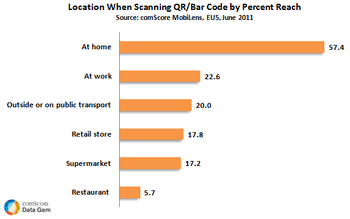
According to Comscore research almost 10% of all smartphone users have scanned QR codes in June this year. The interesting fact is that most users scan their QR codes from home (57,4%). In public only 20% use those QR scan options from outdoor advertising or in public transport.
Although screen technology (smartphone, tablet and eye-wear) is still in its infancy concerning AR, and also facing some challenges, the Universities of Washington and the MIT see a better future on the experience horizont. Especially, the head up and head mounted displays have become mature, finds the study. Leading and growing in use are online apps, gaming apps and GPS apps. So far, campaigns like the following by MIRAT Paris work on the basis of QR coding…
By loading the video, you agree to YouTube's privacy policy. Learn more
But what kind of Augmented Reality technologies are rocking the transformation from the physical to the virtual world, or shall we say to the mobile world?
Some months ago, we only had browser technology like Layar and Wikitude. Today, companies like Tesco are experimenting with other capabilities in their retail shops. For a long time, we had to use QR codes or trigger points to initiate some activity with AR technology.
Layar’s latest innovation called “Vision” is another reason why QR codes are becoming uncool. Vision is a tool that lets advertisers and content owners integrate Augmented Reality ads in publications. As an example you may watch the Dutch magazine Linda how the technology works…
By loading the video, you agree to YouTube's privacy policy. Learn more
Some other technology innovations are also evolving that might catalyze the technology shift in the AR sphere. Here are three of them…
Aurasma
The Aurasma technology -unlike the GPS based technologies Layar (until the Vision version) and Wikitude that merely recognizes what someone has tagged as locations or places- is a new generation augmented reality browser. Aurasma recognises images through cameras in a way search engines recognise words. The browser then creates so-called 2D or 3D „Auras“ which show animated audio-video content. Just watch some examples of Aurasma campaigns.
By loading the video, you agree to YouTube's privacy policy. Learn more
blippAR
With blippAR the whole advertisment becomes the response tool. It is enough to simply point in the direction of the ad with the app. Still, the awareness challenge needs to be solved. And, the need for a specific browser to use the technology. See some examples of blippAR usage. At the moment you can even participate in the interactive blippAR campaign “escape the map” by Mercedes Benz.
By loading the video, you agree to YouTube's privacy policy. Learn more
Printechnologics
Printechnologics is based on Touchcode carrier technology. It contains a blind or transparent code which is embedded via invisible data storage development inside print products like carton, foil or simply paper. Printechnologics turns the AR identification around as you lay the paper on top of the tablet or smartphone, and not the other way round. And you don’t even need to modify your device, download a browser, use NFC (near field communication), or a camera for it to identify and initiate the online activity form the offline trigger. The last issue from the ICONIST carried a Printechnologics card and here you can see how it connect the two worlds….
By loading the video, you agree to YouTube's privacy policy. Learn more
Spot On!
In some months, the QR codes might be gone as an AR trigger, and thus leave the advertising world. However, all AR technologies have one weakness: You need to know that these technologies are embedded in any forms of campaigns. You need some trigger point, button, picture, image or QR code that people see. Thus, the main challenge for QR codes and Augmented Reality is to build awareness and understanding what it can do. Nobody is using a browser or a camera if there is no “visual” reason for virtual interactivity. I see TV using any of the forms as an extension for their TV shows in order to promote their digital content and advertising opportunities, just like the print industry did in the past. One thing is for sure: Augmented Reality will definitely become a new playground that connects the TV and online markets in the future…
What’s your view on Augmented Reality and QR codes? Let us know…
https://thestrategyweb.com/wp-content/uploads/2017/11/strategywebLogo-300x139.png00The Strategy Webhttps://thestrategyweb.com/wp-content/uploads/2017/11/strategywebLogo-300x139.pngThe Strategy Web2011-12-06 14:49:482011-12-06 14:49:48The near future of Augmented Reality (AR) and QR codes
One thing leads to another. Today we could transfer this quote to: One search leads to another social activity, and vice versa. And this interconnection of web-strategy tactics amplifies the user’s purchase decisions.
A new study from GroupM and comScore states that 40% of consumers who search for products to purchase are taking a social activity as a next step to finalize their buying decision. And the activity can be seen from the other direction as well: 46% of consumers who use social media are searching for products to expand the basis on a product range to take a decision.
58% of users begin their journey to purchase with search. Company websites come in at 24% and social media by 18%. The opinion of “friends” on the purchase decision is highly rated in social networks and cannot be underestimated these days from brands and retailers any longer.
The study reveals interesting insights in the time period that make the essential change in the buying decision process. The “late kick” comes 30 days prior to purchase when brands and companies have to engage with their audience – and can leave search tactics behind. A difficult topic to handle in the B2C industry but for B2B very helpful.
“There are still many brands who haven’t figured out why they’re in social media. We still talk to brands that are trying to determine if they should be in social media. The data suggests the two most important subsets in social are user reviews and category blogs, rather than sites like Facebook, Twitter and YouTube.” Chris Copeland, CEO, GroupM Search
Some important findings on how social and search are linked together…
– 86% see search engines important in buying decisions – Consumers use search in buying cycle as a pricing tool (research products and select purchase location)
– 45% use search throughout the buying cycle
– 26% use search at the beginning of their research and shopping process
– Social is essential in the consideration process
– 30% use social media to create a shopping short-list
– 28% say social media has a valuable impact in creating awareness for brands and products
Spot On!
The study shows the impact that the combination of social and search have on the purchase decision. The challenge for companies will be to understand in which way to balance their tactics between search and social in reference to seasonal sales timing, marketing opportunities while not destroying maximum margin, and customer loyalty programs to amplify brand buzz. Another study by econsultancy also illustrates how undervalued social media and search are from a sales perspective. The study says that Social Media “gets eight times less credit for its direct contribution to sales than it should” and “Generic SEO gets credited for 14 times less sales than it deserves”.
What comes first when you take buying decisions? Search or Social? And how does it amplify your buying process? Interested in your thoughts…
https://thestrategyweb.com/wp-content/uploads/2017/11/strategywebLogo-300x139.png00The Strategy Webhttps://thestrategyweb.com/wp-content/uploads/2017/11/strategywebLogo-300x139.pngThe Strategy Web2011-03-03 00:42:562011-03-03 00:42:56Study: Search and Social amplify purchase decisions



 These are the main findings of the study….
 In a recent report called

 In a recent study the research companies
 According to
 One thing leads to another. Today we could transfer this quote to: One search leads to another social activity, and vice versa. And this interconnection of web-strategy tactics amplifies the user’s purchase decisions.