Study: Web economy expected to double in G20 by 2016
29.01.2012 von Martin Meyer-Gossner
Kategorie English Content, Featured Stories, Mobile
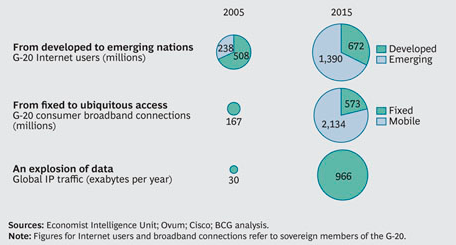
We all know that the web economy is exploding at the moment in terms of activity and users. In the next four years the value of the web is expected to achieve a valuation sum growing from 2.7 to 4,2 trillion pounds. This means that the value of the web economy in the G20 countries is nearly going to double in the next four years.
The global web user base is expected to increase foe 1,9 to 3 million users by 2016 – almost half the world’s current population. All these findings are based on a new report commissioned by the Boston Consulting Group. Still, the report also states that there is at present no standard way of measuring the parts of web economy that is ‘digital’.
Boston sees the growth in the evolution of the mobile web access as 80% are assumed to access the web via smart mobile phones. Thinking back to 2010, which is just about two years back, mobile internet access accounted for just over 4% of the G20 economies. The study makers claim that each household has an approximate valuation of 2,000 pounds worth of purchases online before buying.

Some more key conclusions from the study…
- Digital transformation is key for companies. Companies have to build their digital assets and reduce the digital liabilities that limit their ability to tap rich opportunities. People, processes, and organizational structures need to change and adapt them to the digital world.
- IBM forecasts 1 trillion devices to be connected to the Internet by 2015. This has an effect on the ways companies interact with customers and run their supply chains but also how traditional industries have to build their business.
- Companies such as Amazon, Apple, Facebook, and Google shape the Internet, in China this might be Baidu and Tencent or in Russia Yandex.
- The power of digital experience goes far more local in terms of impact on everyday life, reflecting economic, political, national characteristics and social influences specific to individual countries.
- The “Millennials” have different expectations as employees, consumers, and citizens. TheArab Spring protests and grass-roots “occupy” movements in the West are the most visible manifestations of the power of the Millennials to shape society and commerce.
Spot On!
Seeing the rapid economical and market changes, the intensity of competition will improve and increase. Companies and brands will need to plan more flexible in terms of their strategic approaches how to reach clients than in earlier years when long-term planning cycles were the common status. Today, it will be important to create an adaptive strategy planing and restructuring process.
PS. A challenge might be if evangelist entrepreneuers like this guy spread market distraction and confusion….
Top 3 Ways Web 3.0 Will Change Workflow
27.01.2012 von Martin Meyer-Gossner
Kategorie Daily Top 3
There are many ways to bolster the productivity of your workforce. You could bring in a business speaker to inspire the inner entrepreneur in your employees. You could offer financial incentives for reaching certain benchmarks. You could also upgrade the technological infrastructure of your office. Preparing for Web 3.0, for instance, will require all companies to rethink business as usual and adopt a wide-ranging portfolio of new online tools and services. The advent of Web 3.0 has already made a lasting effect and we can expect this trend to continue. Here are the top 3 ways it will change the workflow in the business landscape:
Real time collaboration. Complex projects can now be undertaken simultaneously by multiple people across vast distances. The software as a service model now so common with cloud computing services is making it so that documents can be synchronously changed on-line using Google docs and other services. This enables businesses to maintain a diverse and mobile workforce that can execute and launch projects outside the traditional constraints of an office. Web applications that facilitate real-time communication, such as Skype, also allow for non-location based business meetings between clients across the world. In the future, this should help reduce the energy demands of the modern office, as well as the broadband and IT requirements of the typical company.
Virtual reality communities. So far, the best example we have of a vibrant virtual reality world that has bred its own economy, global population, currency, and infrastructure is Second Life. In the future, many people will conduct the majority of their business transactions through sites like this. Everything from trade shows to business meetings to the stock market exchange could take place in an online virtual reality space. At present, VR systems are strengthening the efficiency of workplace environments by offering better visualization tools to manufacturers.
Ubiquitous smartphone use. As cell phones continue to be viewed more as online tools and replace PCs as the preferred method of web activity, we can expect businesses to adopt their widespread use. Smartphones are also increasingly used for journalism, file transfers and real time communication. Expect smartphones to be the pen of the future.
Web 3.0 will be making considerable headway in marketing, social media, and business protocol in the coming years. Many analysts expect it to dramatically change the way companies operate. Real time collaboration, virtual reality, and increased smartphone use are just three of the ways this change will be manifested.
The social web and the digital change
10.06.2011 von Martin Meyer-Gossner
Kategorie English Content, Web Strategy
Gerd Altmann/moshxl.de / pixelio.de
This weekend, I just want to get you thinking about the future of the Social Web by focussing on three studies. All studies have an impact on our digital lives from a personal and our business professional point of view: They illustrate how the social web is changing the world we are living and working in…
So, here we go…
1. Digital Profit. The latest study by Regus asking 17,000 managers and business owners across 80 countries makes clear that companies can win new business with Social Media. Main aims are to gain new customers and keep the ones companies have. “Social networking has fully evolved from a nice-to-have to a necessity as the majority of businesses in the U.S. (69%), and internationally (74%) agree that social media activity is playing a bigger role in their marketing strategy,” claims the study. The finding sounds as if marketing objectives and personal reputation uplift are still the main driver why people use the Social Web.
Right or wrong?
2. Digital Visibility. A recent survey from ROI Research, sponsored by Performics of 2,997 active social networkers states that 59% of respondents said it is important to have a LinkedIn account, more than any other social network. “We may not necessarily be in a double-dip recession but, individuals have embraced social networking as a means to actively manage their personal visibility in the global economy.” said Daina Middleton, CEO of Performics. The finding, apart from sounding very general, seem to state that Twitter and Facebook are about to miss the boat with respect to their importance for professional career visibility.
Right or wrong?
3. Digital Divide. The University of California, Berkeley, suggests in a study that the Social Web is increasingly not the people’s Web. “The working class is underrepresented on the Internet. (…) Without their voices, their issues are ignored,” summarizes Jen Schradie, a doctoral candidate in sociology and author of the study at Berkeley. The finding sounds like a bigger digital divide is about to arise from the Social Web as the input on social media just reflects perspectives of college-educated and Web 2.0-savvy users.
Right or wrong?
Are we still in the “conversation mode” which was mean to be the imperative of the social web? Three study findings and three simple questions. It would be interesting to get your views on them. Looking forward to your feedback.
Content Marketing – Insights in an emerging digital topic for CMO’s
08.04.2011 von Martin Meyer-Gossner
Kategorie English Content, Featured Stories, Web Strategy
This week, the Custom Content Council and ContentWise released their American survey “Characteristics Study: A Look at the Volume and Type of Content Marketing in America for 2011” that indicates the future for a young type of branding: content marketing. The study states that CMO’s are spending an all-time high of $12.5 billion of their budgets in emerging platforms for custom content marketing with virtual events, mobile, video, and educational content.
The platforms for content marketing are still ruled by a $24 billion spent on print production and distribution. It shows the relevance of print for their marketing activities. CMO’S dedicate 29% of their average overall marketing, advertising and communications budget to content marketing activities. Those custom content products and platforms are becoming increasingly important to chief marketing officers. The study reveals that 87% see content marketing is valuable, and more than one-third of CMOs (35%) believe custom content marketing is the future of marketing, an increase by 19% in 2006.
“While print remains the choice du jour for most custom media programs, new media channels are providing more growth opportunities for the custom content industry” (…) “This year’s study underscores multiple expansion areas for content. As the economy continues to rebound, the future of content looks very promising.” Lori Rosen, Executive Director, Custom Content Council
Some further key findings of the study are that for example video content is growing: 57% of marketers will produce video, (increase of 3% to last year). Website and blogs are still on of the main topics CMO’s are focussing on next to print custom content marketing formats: Website updates of articles, blog posts and other content is for 79% the main activity.
Spot On!
Consumers seem to value the custom content from brands and companies. 69% like when custom content marketing targets their interests and 67% see it is valuable. An even more important finding for me is that 61% admit they feel better about brands when these deliver custom content. AND: These consumers report to be more likely to make purchases with these brands and companies. Marketers should pay attention to this development of the power of digital content marketing, especially as content curation will affect their SEO strategies of their social web activities acording to a study by Curata.
Although probably most CMO’s agree with these motivations, more than 73% also admit that creating original content is the main challenge for marketers.
There’s obviously a lot that content marketing could do for brands and companies in the future. As money seems to be made available by companies, it’s just depending on the usual bottle-necks: people and time.
Social Media oder die Qual der Wahl
16.08.2010 von Martin Meyer-Gossner
Kategorie English Content, Featured Stories, Web Strategy
Wir haben gestern einen Ausflug gemacht. An den Tegernsee, denn wir lieben die Bergregion um München. Schöne Berge, traumhafte Natur und auf den Almen immer nette Menschen und leckeres Essen. Aber eine Sache macht uns immer wieder zu schaffen. Die Qual der Wahl… Die Qual der Wahl, welche Hütte wir diese Wochenende “bewandern”. Welchen Weg wir nehmen sollen. Oder, welches Essen uns wohl am meisten ansprechen wird, wenn wir oben auf dem Berg angekommen sind. Und selbst wenn wir es wissen, lesen wir die Karte und sehen immernoch vor der Entscheidung … oder haben weiterhin die Qual der Wahl.
Eine große Auswahl zu haben, ist eine schöne Sache. Man könnte sagen, ein Luxusproblem… Aber wie auch schon Miriam Meckel in ihrem Buch Das Glück der Unerreichbarkeit klar macht, ist die Qual der Wahl eine unserer größten Herausforderungen der Zukunft. Viele Sachen stimulieren uns, viele Sinne rühren uns, viel Auswahl verwirrt uns. Ohne Filter wird alles zu einem einzigen Chaos.
Wir lieben es Karten zu lesen, die eine große Auswahl bieten und soind enttäuscht, wenn die Karte nur klassische Breotzeit offeriert. Es sei denn auf der Hütte, wo die Brotzeit zu einem kulinarischen Highlight avenziert. Und wie es immer so ist, scheint der Hunger und die Begeisterung größer als das Bedürfnis. Die Qual der Wahl wächst…
Warum erzähle ich das alles?
Manchmal möchte ich nicht in der Haut von den Leuten stecken, die ich so berate oder beraten habe in den letzten Wochen und Monaten. Social Media Marketing scheint einen ähnlichen Effekt auf Marketing-, PR-, HR- und Customer Service Manager zu haben.
Die Qual der Wahl stapelt sich für sie in Form von zahlreichen Fragen…
- Nutze ich Social Media überhaupt? Eine Wahl, die eigentlich keine mehr sein sollte…
- Bleibe ich besser bei meinen Leisten und erklimme nicht die Höhen und Tiefen der modernen Medien?
- Welche Kommunikationmedien nutzt meine Zielgruppe (am liebsten und in 5 Jahren noch)?
- Welche Plattform schmeckt mir (Benutzerfreundlichekeit, Usability, Technik) am besten?
- Welche Plattform oder welche sozialen Medien ist/sind für mich zielführend?
- Kann ich eine Strategie, die meisten meinen eher eine taktisches Vorgehen, eines Mitbewerbes adaptieren?
- Geht die Geschäftsführung d’accord mit einer unstrategisch wirkenden Trial-and-Error Phase?
- Welche Tools, Taktiken und Trends nutze ich um meine Botschaften anzubringen?
- Wie und womit hört man eigentlich am besten in die Zielgruppe rein?
- Wie kommunizire ich und mache die Marke menschlich?
- Mit welchen Techniken oder Apps erhöhe ich meinen ROI-Output?
Die Qual der Wahl ist wie ein unbewanderter gebirgiger Waldweg. Man muß sich ab des Weges der Konformität wandern und testen, wenn man dann doch mal mit Ruhe einen klaren und zielführenden Gedanken fassen will.
Ein paar grundsätzliche Fragen, die man sich machen sollte…
- Wer ist meine Zielgruppe und wie ist sie im Social Web heute und morgen unterwegs (Baby Boomers, Gen X, Gen Y, Gen Z)?
- Wann soll mein Auswahl Erfolg zeigen? Deklinieren Sie vom kleinsten gemeinsamen Nenner der Unternehmensziele (Markenbildung, Engagement, Leads, Umsatzzahlen…
- Was schränkt mein Vorgehen (One-Voice Policy, Kunden Status Updates, Kommentare oder Posts) mit den sozialen Medien aufgrund business-strategischer Vorgaben ein?
- Warum scheinen soziale Medien für meine Zielgruppe am aussichtsreichsten? Eine gute Analyse der Erfolgssäulen gehört vorangeschaltet, um Kosten, Personalaufwand und sonstige Resourcen abschätzen zu können…
- Wie setze ich die sozialen Kommunikationskanäle Blog, Twitter, Faceboook, Youtube oder XING/LinkedIn zukunftsträchtig als Informationsmedien auf, wer testet und wer optimiert? Wie kann hieraus ein steter Prozess entstehen?
Vielleicht bietet der Post eine Leilinie zur Entscheidungshilfe. Falls nicht, sagen Sie mir, wie sie mit der Qual der Wahl umgehen oder umgegangen sind. Die Diskussion ist eröffnet…
News Update – Best of the Day
14.04.2010 von Martin Meyer-Gossner
Kategorie Daily Top 3
About a year ago, a Robert Hall study showed that 55% of CIOs don’t allow the access to social networking sites like Facebook and Twitter. This year’s study shows that the IT policies are changing to stricter guidelines…
- 38% have implemented stricter social networking policies regarding personal use of social media sites
- 15% have become stricter regarding business use
- 17% have become more lenient
Booz Allen Hamilton just published its “Marketing Media Ecosystem 2010″ report which sees a significant necessary change away from a “traditional marketer/client – agency – media company structure” to an economy that needs to change the pace of adopting new marketing tools towards a new marketer to end user relationship.
The key findings show the relevance of reference marketing…
- 88% agree the speed of marketing execution will become more important due to digital
- 80% believe insights into consumer’s digital behavior and related targeting will become more important
- 55% of users see consumer recommendation more important than pur brand knowledge
- 59% lack sufficient experience with digital/online media
- 51% do not have adequate senior support for digital
This commercial from Jack Rabbit Beer might be made for male humor. But it is more the chronology of the narrative time that makes it funny.
5 strategic reasons why brands need a mobile app
12.04.2010 von Martin Meyer-Gossner
Kategorie Daily Top 3, English Content, Featured Stories
Many companies ask themselves whether it makes sense to set up a mobile app. Now, often customers may ask themselves if their needs or the business interest of the company is the main driver for this decision. One thing is for sure: Mobile Apps and the mobile web, not just because of the iPad hype, are getting more and more attention from a business perspective – from companies and brands as well as from prosumers.
But apps are not completely undisputable as a verhicle for company content. Some people are already talking about an apps economy and argue apps are “valled gardens”, going against the ideology of the web 2.0 and provide content censorship. Others appreciate the user-friendly approach they offer. App developers -according to a study by Appcelerator- are more and more interested in Android then in iPhone or iPad development. And another study shows that the user adoption of apps is comparable for both systems.
The discussion about the relevance, necessity and sustainability of mobile apps will continue. The hype is there and cannot be mistaken. This is the main reason why companies think about setting up an app. But before companies start to set up an app, they should be thinking about the customers intention to use such apps. In the end, apps serve the brands interest to keep customers and make them happy with their products.
In the last days, I have set up 5 reasons why companies should produce an app for their brand, product or service as an important tactic for customer engagement.
1. Trendsetter
Innovation is the quicksand for the future of a brand. Is a company’s strategic orientating going in the direction of an outstanding position for market development, the mobile app is expected internal and external. If the external perception by customers is similar, no company will miss the permanent access opportunity to talk communicate with their customers. Especially when the brand can offer all news to the customer any time, any place, anywhere in short and essential information flow – without any possibility of distraction that the web 2.0 offers. And, only customers that see themselves as trendsetters follow the news of a brand in real-time.
2. Brandsetter
Being the first and best brand is and was always a competitive advantage – not only in the real-time web (see Starbucks, Dell, Amazon, Spreadshirt, etc.). It generates powerful PR and the wonderful buzz effect of the social web community. In a competitive market landscape brands need to have a closer look at their presence and sustainability. The omni-presence and power of a brand can be optimized with as mobile app. Especially, in a consumer engagment driven economy marketers often asked: “What’s the latest cool app?” As soon as you show it to them, the app is being downloaded, tested and gets (in most cases) feedback by reviews. It climbs up in the app ranking and gets the desired brand attention from the app economy.
3. Fansetter
As brands are becoming more and more exchangable, the prosumer is more likely to swap from brand to brand. What Facebook offers with their Facebook ad strategy (including fan pages), is the app for the mobile user. It is a closed surrounding for interaction between customers and brands, in which brands can concentrate in the customer dialogue. Customers who “like” their brands will take time for it (even flyers and catalogues are used as cross-selling products and get their awareness) and want to be the first to know. In the past, Nokia and the symbian system owned the market. The iPhone has revolutionized this market. Android followed and offers some good alternative for the future. The choice for a mobile is changing quickly. Brands who want to keep their fans need to offer an app for all systems.
4. Standardsetter
Brands that want to keep their market leading position should set a standard. They can set up “rules” (standards) for industry sector processes, or may be offer those to the market. Often these lead to common sense standards which supports convergent markets and boost the brand. This applies for communication, product development and customer service. And although companies might learn from the mistakes of the competitors, the question is: Why not setting the standard for the competition? This is the idea of the web 2.0 ideology. Nothing is perfect from the beginning. if something is missing, it can be optimized, adjusted or set up anew – from the brand itself or from the community of the prosumer.
5. Servicesetter
24/7 service and support is a set standard for the modern customer. The more mobile the humen being becomes -not only in terms of web usage- the more it is awaiting the ‘always-on’acces to brand service. And the quicker the prosumer finds relevant data like hotlines, the happier he/she will be. An example? OK. This week, my wife called meand said: “Hey, you have the Nespresso app. Can you tell me their service hotline? The mashine is broken…” – “Sorry Darling, I can see their latest commercial, can buy tabs, etc. – but the hotline number is nowhere here…!”. Interested to see if Nestle understands what I mean (I doubt they will reply. On XING there was no feedback for weeks when I send them a message).
Spot On!
37% of smartphone user have bought with their mobile in 2009 according to a Compete study. And 91% of the Americans use mobile devices for social networking. if this is not enough to see where the trend is heading to, then I maybe misunderstanding the future and necessity for apps there.
BTW: The Strategy Web also has mobile apps which were nicely produiced by Motherapp – one for Android and one for the iPhone. THX, guys – you are doing a great job!
5 strategische Ansätze, warum Marken eine mobile App benötigen
12.04.2010 von Martin Meyer-Gossner
Kategorie Mobile Business
Zahlreiche Unternehmen stellen sich die Frage, ob es überhaupt sinnvoll ist, eine mobile App programmieren zu lassen. Ob dabei unbedingt der Kundennutzen oder eher die kommerziellen Interessen im Vordergrund stehen, sei mal dahingestellt. Fakt ist: Die mobilen Apps und das mobile Web (Studien-Ausblick bis 2015) bekommen, nicht nur durch den kürzlichen iPad Hype, zunehmende Aufmerksamkeit in der breiten Masse der Prosumer.
Allerdings sind die Apps als Zugangsvehikel zu Unternehmens Content nicht ganz unumstritten. Manche Insider disuktieren über die App Economy und sich sind uneins, ob Apps als perfide Content-Zensur gesehen werden soll oder höhere Benutzerfreundlichkeit liefert. Andere dagegen frage sich, wie man diese in die Plattformstrategie einbindet. Und die App-Developer sind -laut einer Studie von Appcelerator- immer mehr interessiert an Android Entwicklung denn an iPhone oder iPad App. Eine andere Studie belegt, daß das Nutzungsverhalten von Apps durch den User auf beiden Systemen vergleichbar ist.
Die Diskussion über die Relevanz, Notwendigkeit und Nachhaltigkeit von mobilen Apps wird sicherlich noch lange andauern. Der Hype hingegen ist nicht zu verkennen. Und ganz schnell könnte man als Unternehmen zu dem Ergebnis kommen, man sollte es einfach mal machen. An erster Stelle sollte bei allen Überlegungen der Kunde stehen. Schließlich will man den ja auch weiterhin mit seinen Produkten und Services beglücken will.
In den letzten Tagen sind bei mir 5 Gründe eingefallen, warum ein Unternehmen durchaus eine mobile App für seine Marke, ein Produkt oder eine Dienstleistung als startegische Massnahme einsetzen sollte.
1. Trendsetter
Innovationen sind der Treibsand für die Zukunft einer Marke. Geht die Strategie eines Unternehmens in die Richtung der Vorreiterstellung bei Markteröffnung und -entwicklung, wird die mobile App den standesgemäßen Erwartungen intern wie extern nahezu gleichgesetzt. Ist die Außenwahrnehmung durch die Kunden der Strategie entsprechend, wird kein Unternehmen auf den permanenten Zugang zum Kunden verzichten wollen. Zumal das Unternehmen alle Neuigkeiten dem Kunden jederzeit und an jedem Ort je nach Wichtigkeit kurz und bündig mitteilen kann – ohne Ablenkungsmöglichkeiten, die das Web 2.0 nunmal bietet. Aber nur wer sich auch als Trendsetter fühlt, verfolgt die Neuerungen einer Marke (nahezu) in Echtzeit.
2. Brandsetter
Der Erste und Beste zu sein, ist im Echtzeitweb ein Wettbewerbsvorteil (siehe Dell, Starbucks oder Spreadshirt). Es garantiert PR-starkes Feedback der Social Web Gemeinde und den gewünschten Buzz-Effekt. Im stark umkämpften Mitbewerbsmarkt müssen Marken stärker auf ihre Präsenz und Nachhaltigkeit achten bzw. dieser frischen Nachdruck verleihen. Die Omnipräsenz und Wirkungsstärke der Marke beim (potentiellen) Kunden kann mittels mobiler Apps optimiert werden. Gerade im Consumer-Engagement geprägten Markt, habe ich oft die Frage gestellt bekommen: “Hast Du mal wieder eine gute App gefunden?” Sobald ich diese zeige, wird sie auf dem eigenen Device installiert, gestestet und erhält (manchmal) eine Bewertung. Schnell kann sie im Ranking steigen und die gewünschte Marken-Aufmerksamkeit durch die App-Economy generieren.
3. Fansetter
Der Prosumer ist aufgrund der Austauschbarkeit von Marken, Produkte und Services (Preiskampf!) wechselwilliger denn je. Was Facebook mit seinen Anzeigen den Unternehmen bietet, ist die App für den mobilen Nutzer. Eine für die Marke geschlossene Umgebung, in der sich Unternehmen auf das Wesentliche konzentrieren. Wer als Kunde seine Marke liebt, wird sich mit ihr beschäftigen (selbst Flyer und Kataloge werden heute noch genutzt!) und will die Neuerungen als Erster wissen. Hatte früher Nokia aufgrund von Symbian die Nase vorn, so hat das iPhone den Handymarkt revolutioniert. Android hat nachgezogen und bietet gute Aussichten für die Zukunft. Schnell ändert sich die Wahl des Handies. Wer seine Fans behalten will, kann nicht umhin für alle Handyplattformen seine App anzubieten. Zumindest wenn man seine Fans nicht im mobilen Web verlieren will.
4. Standardsetter
Wer die Vorreiterstellung im Markt übernehmen will, muß Standards setzen. Er stellt Regeln (Standards) für Abläufe und Prozesse für die Branche auf bzw. stellt und schlägt diese dem Mitbewerbsmarkt vor. Schnell ergeben sich hieraus allgemeingültige Vorschriften, die konvergente Märkte bedienen und somit die Marke stärken. Das gilt für die Kommunikation, in der Produktentwicklung und im Kundenservice. Auch wenn man aus den Fehlern der Mitbewerber lernen und eigentlich erstmal mit der Entwicklung einer App abwarten kann, kann man aber auch selbst Standards für den Mitbewerb setzen. Das entspricht dem Web 2.0 Grundgedanken. Da ist nicht gleich alles optimal. Wenn etwas fehlt, wird es optimiert, nachjustiert und neu aufgesetzt – vom Unternehmen aus oder von der Community der Kunden.
5. Servicesetter
24/7 Service und Support ist für den heutigen Konsumenten schon (fast) zum Standard geworden. Je mobiler die Menschheit -nicht nur im Web- unterwegs ist, umso mehr benötigt sie den schnellen Zugriff auf Markenservice. Und je schneller der Mensch die relevanten Daten wie zum Beispiel Hotline Nummern findet, umso zufriedener und weniger “abwanderungswillig” ist er/sie als Kunde. Erst gestern habe ich mich geärgert, als meine Frau mich anrief, die Kaffeemaschine sei hin. “Check mal schnell die Nespresso App nach deren Hotline Nummer!” – “Herzblatt, die haben zwar eine App, bei der ich einkaufen kann, aber die Support-Hotline fehlt leider…” Versteht Nestle wohl, was ich meine (fragwürdig… da man nicht mal auf eine XING Anfrage reagierte)?
Spot On!
37% der Smartphone User haben 2009 gemäß einer Compete Studie schon online gekauft. Und 91% der Amerikaner nutzen bereits mobile Telefone, um Social Networking zu betreiben. Wenn das nicht grundsätzlich schon klare Trends sind, als Brand oder Unternehmen mal über eine App nachzudenken, dann muß mir jemand die Zukunft des mobilen Internet und Shoppings erklären. Aber vielleicht liege ich ja falsch? Was denkt Ihr?
PS: Von The Strategy Web hat mir die Mannschaft von Motherapp eine Android Version und eine iPhone Version erstellt. THX, guys – you are doing a great job!
Can corporate social media engagement replace customer loyalty cards?
01.02.2010 von Martin Meyer-Gossner
Kategorie English Content, Featured Stories, Social Media
We all have our purse full of plastic cards for customer loyaly programs. These won’t make us rich. They make us save money, or get kickbacks from companies and brands if we want. And the philosophy of these programs is clever. Companies have the feeling of being in touch with their clients on a regular basis, making sure customers stay informed about their product offerings.
The customers bottleneck is, well yes, we have to carry multiple plastic cards in a credit card format with us. So, why not leaving these cards behind after 20 years and just make customers fans on Facebook and/or followers on Twitter of brands?
Imagine you go into a store and you’ll see a “Follow us on Facebook or Twitter or on our iPhone app” sign taped to the cash mashine instead of receiving print and plastic to carry home?! – Why not save the trees and oil resources!?
Companies install reward program cards to make us buy more of their products, or more frequently. And companies get more feedback on our buying habits. So, for companies these cards are an essential part of their customer loyalty strategy.
And customers with a big purse are happy. Others don’t want to have all these cards. Thus, these customers are not lsitening to what’s the latest promotion. Now, who of the male world is happy with all these plastic cards making our trouser pockets look like fat kangaroo pouches?
In most cases, these loyalty cards are addressing and being used by an old-economy’s vanity (IMHO), or women. “Look how much companies are interested in having me as their customer”, I heard a woman say the other day.
A recent study by the CMO Council “The Leaders in Loyalty: Feeling the Love from the Loyalty Club” shows the trouble of loyalty programs. 54% of consumers mention that irrelevant messages, low value rewards, and impersonal engagements may decrease their loyalty for brands and their services, and with that their loyalty programs.
And yes, we can understand this fact when our online and offline mailboxes are full of non-personalized, unexhiting and unintersting promotions from company’s so called loyalty programs. Talking of me, these loyalty programs get one chance and I cut those cards into pieces straight away when the company loyalty program fails.
Now, what does this means for loyalty programs when we match these results with the latest survey by MarketingSherpa. The new web generation and prosumers love following brands as they expect savings, learning about specials and sales as the top motivation to friend and/or follow a brand online. If companies are aware of this fact and learn from it, why not replacing the old loyalty card concept then?
The benefit of the fan and follower systemtic is quite obvious…
- You become a fan and/or follower when a brand becomes of interest for YOU as a customer
- You become a fan and/or follower of your favorite brand when YOU are in a purchase process
- You can check status updates on sales, discounts and promotions when YOU need them (not when the company wants to sell more products)
OK, thinking of business intelligence and data mining sales cycle topics, it might become difficult for companies to track purchase processes as good as now. But, isn’t the customer king with the rise of social media? And companies could save money for print mailings and their plastic card production, right?
Spot On!
Some weeks ago, I have thought about Twitter as a sales tool and with this post, I am trying to take this idea a bit further. It shall illustrate how much a company’s sales and customer service strategy gets influenced by a new social web strategy where the customer holds the power of interest in promotions.
So, let us know what you think about the idea that Facebook fan pages, Twitter company accounts or corporate LinkedIn groups could replace loyalty programs in the future? A dream, a vision or a stupid idea?
Is e-meeting a trend or the future?
27.01.2010 von Martin Meyer-Gossner
Kategorie Sales
While some signs suggest the economy is stabilizing and the global recession might find an ending, the majority of business travel managers will be looking for alternatives to travel that can be enabled by technology in the future.
A recent survey “2010 Corporate-Travel Spend Plans & Tactics,” conducted by Kotler Marketing Group, in conjunction with the Association of Corporate Travel Executives (ACTE) provides a detailed analysis of enterprise travel spend plans versus the growing use of electronic alternatives (e.g. web- and video-conferencing) to offset travel.
- 55% of respondents would rely on electronic alternatives more in the future in order to reduce travel expenses.
- More than 40% said their organizations are replacing sales-related travel with conferencing in coming years.
- However, web and video conferencing were not rated as “usually effective” means in accomplishing the goals of their meetings.
Another interesting result of a study by the Palm Springs Desert Resort Communities Convention and Visitors Authority shows that desert hotels lost an estimated $30 million in convention and meetings travel from late 2008 through May.
Now, we might argue and ask the question if executives refrain from going on planes the way they did in the past. And we might ask if spending money for big conferences is ‘out’. So, will department kick-offs with nice trips to the US (or some other interesting places worldwide) be a thing of the past in some years?
Spot On!
Some years ago, one of my partners said: “Can I insert my Miles&More card in our new video conferencing system?” What sounds funny to us has more impact than most of top management members might think. Traveling is a personality statement for a lot of managers. It is also about gestures, mimic, sensual perception, hand-shaking and all that which makes more impression on our business contacts and our deals than some stockholders might think when looking at their shareholder value. Meaning, companies will face a conflict in terms of cost savings and probably embrace the trend of the new technology. Nevertheless, businesses will be trying out alternatives to traveling for meetings with web- or video conferencing. In my opinion meetings need to happen in real life more frequently than online.
Do meetings not have a deeper meaning for business? What is your perception about the effectiveness of these new meeting technologies as travel replacements?