Social Web: Biermarken werden zur digitalen Kunstbar

Als Claudia Sommer vor ein paar Monaten schrieb, Twitter sei “wie eine Kneipe”, da hat sie definitiv weniger an Biermarken gedacht als vielmehr die Tatsache, wie sich der Mensch in Twitter bewegt und kommuniziert. Als ich am Wochenende das aktuelle GQ in der Hand hielt, mußte ich wieder an ihr Zitat denken. Vor mir eröffnete sich eine relativ neue Marketing-Taktik der Biermarken Veltins und Becks Gold. Sie bewarben mit Printakampagnen ausschließlich ihre Social Media Aktivitäten – und nicht mehr die klassische Homepage oder sonstige Kontaktoptionen wie Email oder das Service-Telefon. Und im Vordergrund der Kampagne stand nicht Fussball, wie zu vermuten wäre. Nein. Kunst und Kultur stehen im Mittelpunkt…

P1030669Becks und die urbanen Erfahrungen
Vor allem die Marke Becks Gold zeigt sich im Social Web äußerst aktiv, wie das Advertorial klar macht. Mit zahlreichen Zugangspunkten im Social Web initiiert man Gespräche wie in einer digitalen Kunstbar. Den Startschuss hat dabei -laut der Anzeige- ein Offline-Event gegeben, was ich angesichts meines Leitspruches (Connecting Online and Offline) als einen sehr cleveren Schachzug sehe. Unter dem Claim Beck’s Gold Urban Experiences hat man Ende Oktober in Berlin die Ära des Social Web mit einer extravaganten Laufsteg-Veranstaltung aufleben lassen: originell, stylisch und hochwertig – ganz getreu dem hochwertigen Image.

Den eingeleiteten Prozess des Erforschens modernen Stadtlebens will man nun online weiterleben lassen. Inhaltlich beschäftigt sich die soziale Kommunikation mit Kunst, Mode, Design und Film. Die Auftritte mittels Blog, Twitter, YouTube, Facebook bieten soziale Austausch-Plattformen und liefern die Visualisierung der Veranstaltungen und Diskussionen für Fans und Follower. Der Dialog wurde vorwiegend mittels klassischen Gewinnspielen angestoßen. Es zeigt sich bei genauem Hinsehen, daß Moderation der Community auch bei erfolgreichen Brands im Social Web eine wichtige Komponente bleibt.

Fazit: Eine aufwendige Social Marketing Idee, die interessant und ansprechend konzipiert ist. Offensichtlich begeistert sie auch, wenn man sich die zahlreichen Fans ansieht. Ein guter Start, der allerdings auch langfristig ein volles Fass an Inspiration bieten muß und cleveres Social Media Promotion Management erfordert, wenn man dem hochwertigen Image treu bleiben will. Ein wenig erinnert alles an das Social Web Konzept von Adidas UrbanArtGuide, das es sogar schon als mobile iPhone App gibt. Aber das sein nur am Rande erwähnt…

P1030668Veltins geht an die Facebook-Theke
Veltins wechselt von klassischen VIP-Testimonials zu sozialer Kommunikation von und mit Kunden. Und für diesen Wechsel hat Veltins sich offensichtlich viel Zeit genommen. So war die Trennung von Assauer und Thomalla zu Jahresanfang für Veltins vermutlich ein nun willkommenes Ereignis – aus Werbesicht. Auch wenn die beiden über Jahre für witzige und Rollen-vertauschte Beziehungswerbung. Frau war Frau, Mann war Mann und doch irgendwie nicht. Frau durfte mal schnell behaupten, Bier sei aus. Mann durfte die leckere Frau für eine kühles Blondes liegen lassen. Die Videos der Biermarke standen für humoristische Gleichberechtigung und Beziehungsfrohsinn – und belebten den Social Talk der Offlinewelt.

Diesen menschlichen Werbetouch will Veltins nun mit Social Media Aktivitäten weiterführen. Unter dem Motto ‘Moderne Braukunst’ stellt die neue Print-Werbung -neben dem Gewinn des reddot design awards- vor allem den Facebook Auftritt in den Mittelpunkt, der mit einem fetten Schriftzug beworben wird. Nein, keine weiteren Kontaktoptionen. Ja, das ist wahrlich neu und immer mehr im Trend – gerade bei Marken, die letztendlich über Partner vertrieben werden. Da die Partner den unmittelbaren Feedback-Kanal zum Hersteller nicht so oft nutzen, eröffnet die Marke mit dem Social Web jetzt einfach eine Reihe digitaler Kunstbars und kommt so mit den Konsumenten direkt ins Gespräch.

Fazit: Veltins setzt offensichtlich voll auf Facebook – und ebenfalls auf den künstlerischen Urban Touch. Die Kampagne linkt auf ein Gewinnspiel für hochwertige Kunstdrucke (inklusive Lead-Generierung). Auch die Kommunikation innerhalb der Page geht vorwiegend um Modern Art und Design. YouTube langt man vermutlich nicht an, da die bisherige TV-Werbung vermutlich immernoch der Marke ihren Dienst erweist. Interessanterweise gehört der gleichnamigeTwitter Account ‘Veltins’ offensichtlich einer Privatperson, die zwar beachtlich viel über Bier spricht, aber nicht über eine Biermarke: Veltins. Man kann verstehen, wenn man bei Twitter als Marke das Ziel verfehlt, aber den “branded account” sollte man sich schon organisieren.

Spot On!
Veltins und Becks Gold öffnen also die digitale Kunstbar. Und die anderen? Es gibt zahlreiche weitere große Biermarken, die noch nicht auf die Social Web Welt setzen. So fehlen beispielsweise offizielle Varianten von Warsteiner, Krombacher, Radeberger oder Paulaner. Ohne Zutun der Marken gibt es dennoch zahlreiche sozial-engagierte Gruppen von Fans, die offensichtlich die offizielle Variante zur Kommunikation und dem Bekenntnis zur Marke nicht benötigen. Stellt sich also die Frage, ob die obigen Brauereien die Kontrolle lenken wollen, oder es um das Mißverständnis geht, daß Social Media kein Werbemedium ist.

Welche Variante findet ihr denn besser? Die offizielle Page oder der Ansatz einer selbst-organisierten Fangruppe?

2010: Webstrategie in Zeiten der Engagement Economy

webstrategieBeim Thema Webstrategie sollte man sich vorab fragen, inwieweit das Unternehmen sich im Sinne einer nachhaltigen und langfristigen Business-Strategie im Web positionieren will. Langfristigkeit ist keine Selbstverständlichkeit.

Plant man seine Taktiken von Jahr zu Jahr um? Begründet aufgrund der Dynamik der Märkte, des Internetwandels oder aufkommender neuen Hype-Produkte wie Twitter oder Google Wave? Oder ist die Strategie wirklich langfristig ausgelegt und mit einem Ziel versehen? Denn eigentlich können Sie nur dann eine wirkliche Strategie haben. Jegliche Anderungen der Wege und Aktivitäten um das Web sind dann auch nur taktische Optimierungen. Aber auch diese sollten einem langfristigen Ziel dienen.

Was kann man also bedenken vor der Planung der strategisch-orientierten Webaktivitäten für 2010? Ein paar Gedanken hierzu…

Die “Engagement Economy”…
Das Web wird sich immer weiter von der klassischen Unternehmens-Homepage als Zugangspunkt für die Kunden entfernen. Galt die Unternehmensseite bisher als Visitenkarte für den über Google Suchenden, so gilt es sich für die moderne “Engagement Economy” neu aufzustellen. Sein Unternehmen, seine Produkte und seine Dienstleistungen gebündelt auf einer Homepage mit blinkenden bunten Bildern zu präsentieren, ist weniger wichtig für das Business als die neuen Zugangspunkte zu identifizieren, die sich durch das Social Web auftun.

Es wird nicht funktionieren, die eigenen Produkte oder Dienstleistungen nur mit Bannerkampagne im Web zu promoten. Oder ganze Produktkataloge mit Affiliate Marketing an den Mann/die Frau zu bringen. Oder dem Kunden ein ‘One-size-fits-all’ Lösung oder Angebot über moderne Social Networks ‘unterzujubeln’.

Die “Homo Engagementicus” läßt sich nicht durch platte PR-Meldungen beeindrucken, geschweige denn, diskutiert diese Spezies darüber. Aber ein guter Tweet, ein guter Post, eine gute Fan Page, die wird von der “Engagement Economy” aufgenommen und untereinander ‘geteilt’. Ist diese Kommunikationsform der Einbindung des Kunden in die Unternehmenskommunikation nachhaltig verhaftet, bleiben die Kunden bei der Stange.

… produziert, reflektiert, engagiert sich …
Aufgrund der Vielzahl der Social Networking und Social Media Angebote verteilt sich der Content über ein Unternehmen – weg von ihrer Homepage, hin ins Social Web. Dort engagiert sich der Kunde, atomisiert den Content um die Firma, die Produkte, die Dienstleistungen. Es ist Teil seiner zahlreichen Timelines, die in ihrer Interaktivität nicht zu bremsen ist – mal aktiv getrieben, mal passiv beeinflußt.

Und diese Interaktion führt mit der indirekten Einbindung und Teilnahme der Digital Natives an Unternehmensprozessen zu einer neuen Unternehmenskultur. Kann eine klassische Webseite dieser Dynamik des Engagement Prozesses Folge leisten? Wohl kaum…

Sprich: Wenn wir über einen webstrategischen Ansatz für die Zukunft reden, dann wohl nicht mehr vom Ausgangspunkt einer klassischen Unternehmens-Webseite.

… will teilhaben, sich austauschen, mitdiskutieren …
Hat man früher Content selbst produziert, mußte man nur noch schauen, wo er reproduziert wurde. Morgen wird man viel intensiver und genauer monitoren müssen, um zu wissen: Wer produziert meinen Content über mich, mein Unternehmen? Wer verteilt diesen und mit welchem Sentiment tut der User dies? Welche Kommentare gibt es auf die Blogposts über die Unternehmen? Wie wirke ich selbst als Mitarbeiter oder Manager auf die Unternehmenskommunikation ein? Was lerne ich aus dem Multilog zwischen Firma, Partner, Kunde und Kunde und Kunde und…

Firmen werden Initiatoren und Motivatoren der Kommunikation – die Moderation zu übernehmen wird die große Herausforderung.

Es gilt den interaktive Diskurs mit Kunden auf den unterschiedlichsten Plattformen zu führen, die sich zukünftig bieten und von denen man gegebenenfalls noch nichts weiß. Das gefällt der “Engagement Economy”, das treibt sie voran und daran sollten Unternehmen partizipieren wollen.

Wenn die Kommunikation die “Engagement Economy” bedient, kann das Brand nur gewinnen. Anders herum wird es schwierig. Egal um welche Branche, Produkt oder Dienstleistung es sich handelt.

Webstrategie wird von der “Engagement Economy” aus geführt. Und diese “Engagement Economy” gilt es für jedes Unternehmen selbst zu identifizieren, zu monitoren, zu verifizieren sowie Informationen und Meinungen zu teilen, als wäre man sein eigener Kunde.

… und will als Partner respektiert werden.

Fragen, die sich Unternehmen zur eigenen Webstrategie fragen könnten…

Grundsätzliches…
Sprechen wir als Unternehmen noch von einer Plattform (Homepage), oder von Plattformen (Social Web)?
Wie sprechen wir die Zielgruppe an: Einbahnstrasse oder multidimensionale Kommunikation?
Wissen wir, wie jedes Segment unserer Zielgruppe unsere Inhalte nutzt?
Versuchen wir hier den Dialog herzustellen oder Multilog zu initiieren?
Begleiten wir die Kommunikation der Kunden “untereinander miteinander”?
Wie können ihre zufriedenen Kunden durch Empfehlungsmarketing zum Motor für die Umsatzzahlen werden? Der Treiber sollte nicht das Unternehmen sein…

Spezielles…
Welche Zugangspunkte des Social Web (Facebook, Twitter, MySpace, etc.) nutzen die Kunden? Und aufgrund welchen Contents oder welcher Produkte?
Auf welche dieser Stationen der Kundenkommunikation fokussieren wir uns? Trends sind schön, können aber auch Budgetfresser werden…
Wie könnte ein Zugangs-Netzwerk durch das Social Web entstehen, um den Kundenkommunikation zu motivieren und initiieren?
Wie steht es um die Shopping-Gewohnheiten? Kennen wir diese? Sind unsere Online-Shops, wo die Kunden sind? Lässt sich eine E-Commerce Komponente im Social Web platzieren?

Spot On!
Die Unternehmens-Webseite ist der Hub ihrer Webstrategie nach extern. Intern gilt es die externen Signale aufzufangen, zu kanalisieren und zu optimieren. Früher haben die Unternehmen in kurzfristigen PR-/Marketing-/Sales-Aktionen oder Kampagnen gedacht. In der Zukunft gilt es für die Unternehmen, sich selbst zu langfristiger nachhaltiger Kundenbindung zu verpflichten. Das Social Web bietet hierfür beste Voraussetzungen. Es schafft Schranken ab, öffnet Chancen und ermöglicht beidseitige Zugänge. Nicht alles wir sofort gelingen – aber auch Software braucht die BETA-Phase um ein optimales Ergebnis zu erzielen.

Webstrategie ist für Unternehmen wie ein Spiegel der Business-Strategie. Und die fängt zukünftig bei der Engagement Economy an: von Kunde zu Kunde. Und dort hört sie auch auf…

News Update – Best of the Day

daily1Measuring the return on invest (ROI) is difficult - especially when it comes to social media activities. Christina Warren wrote an interesting post on how to define goals, which metric tools and the sentiment analysis. And she refers to a presentation by Oliver Blanchard who created a funny presentation on social media and the ROI…

… and btw: Omniture just announced a new social media measurement product that they will launch.

A recent UK study by the IT consulting company Morse showed some very interesting findings… The use of social networks by employees at work is costing UK businesses £1.38 billion each year in lost productivity – including especially the security dangers) . 57% use it for personal purpose instead of business means. More about the study on the Morse homepage

A funny commercial just reminded me of the cold age that is about to come up… and I am asking myself where I have seen this years ago. Can you help out..?

PS: The Premier League has made its way to Facebook. See who is leading

Wie mit Twitter monetarisiert wird…

twitter-monetarisierungDarf man seinen Twitter Stream mit Werbetweets monetarisieren? Sich Follower kaufen? Falls nein, wieso eigentlich nicht? Falls ja, welche Möglichkeiten bietet der Social Media Markt derzeit? Fragen, die mich in den letzten Wochen beschäftigt haben.

Während die ersten Fragen ethische oder moralische Standpunkte erwarten lassen, ist die Monetarisierungsfrage eine pragmatische. Man schaue sich einfach an, wie derzeit über oder mit Twitter Geld von Hand zu Hand wechselt.

Eine Übersicht derzeitiger Business-Modelle, wie mit Twitter Geld verdient wird…

Be a magpie
Magpie bietet Werbekunden die Option, Kampagnen zu erstellen und findet die einflussreichsten Magpie Twitterati für die Kampagne. Die Basis liefert eine Auswahl von Keywords. Die Kampagnenmodell kann eine Anzeigen Botschaft oder Anzeigen Keyword Kampagne sein bis hin zu Cost-per-… Click, Follower, Lead oder View sein. Die Twitterati monetarisieren somit ihre Gefolgschaft. Magpie -zumindest sagt man das- ‘identifiziert’ die Anzeigen einer Kampagne mit dem, worüber man generell tweetet und spielt die relevante Werbetweets ein.

BeTweeted
Das Ad Network BeTweeted ermöglicht Werbekunden die Netzwerke der Twitterati zu adressieren. Das Monetarisierungsmodell erfolgt auf CPC (cost-per-click) Basis. Der Anbieter behält 25% der Einnahmen für sich.

FeaturedUsers
FeaturedUsers ist ein Twitter Applikationen Ad Network. Werbekunden kaufen Banner, die wiederum auf ‘Recommended User’ Bereichen der Twitter Applikationen laufen, welche zum FeaturedUser Netzwerk gehören. Der Dienst fokussiert Entwickler von Twitter Applikationen und ist weniger für Werbekunden geeignet.

Million Dollar Follow
Was die Million Dollar Page nicht alles bewirkt… Als Netzwerk ermöglicht Million Dollar Follow dem Twitterati mehr Follower zu verdienen. Man investiert ab 1 US Dollar, kauft eine Anzeige, kommt in einen Lostopf, in dem man neue Follower gewinnen kann. Der Clou: Von dem Moment an, wo man sich als Werbekunde registriert, wird man bei 150 Accounts (z.B. Werbekunden) eingecshrieben und das System wählt nach Verkauf der 1 Millionen Werbeplätze dem Zufallsprinzip einen Werbekunden, der eine Millionen Follower erhält.

PaymeTweets
Paymetweet ist eine einfaches ‘Pay per RT’-System: Man loggt sich mit seinem Twitter Account ein und folgt @paymetweets. Sieht man einen Tweet auf der @paymetweets Account-Seite, der zu dem was man selbst tweetet paßt, klickt man den rtee.me Link am Ende des Tweets. Nur eingeloggt, kann man den gesamten Tweet sehen, wie dieser sich bei Twitter darstellt. Der RT beginnt mit PRT (für Paid Retweet), gefolgt vom @User, von der Person oder Marke, die den Tweet gesponsert hat. Man kann bis zu 18 US Dollar pro Tweet bekommen, heißt es auf der Seite (…aber nur, wenn man die Gefolgschaft von GuyKawasaki oder Chris Brogan hat – ließt man in Tweets).

Twittad
Das Ad Network Twittad funktioniert nach dem Targeting-Prinzip. Twitterati können ihr Profil monetarisieren, in dem sie dem Ad Network demografische, geografische, örtliche und themenspezifische Daten liefern. Wer sich dort registriert, bekommt ein “Dollarwert”, der aus einer speziellen Rechnung nach Followern und anderen Parametern erstellt wird. Werbekunden bieten ähnlich dem Google-Adwords System für eine Platzierung auf der Profilseite des Twitterati. Via API werden vom twitterati akzeptierte Anzeigen auf den Profilstream hochgeladen.

Twivert
Mit Twivert können Werbekunden Werbe-Botschaften erstellen und zeitlich festlegen, wann die Ads erscheinen sollen. Die Micro-Blogger registrieren sich für die Anzeigen und veröffentlichen die Paid Tweets gegen Bezahlung.

uSocial
Inzwischen gibt es aber auch Dienstleister wie die australische Social Media Marketing Agentur uSocial, die wie bereits vor Wochen beschrieben Twitter Follower zum Kauf anbieten. 10.000 Follower gibt es dort schon ab unter 400 US Dollar.

Spot On!
Die einen bieten die Erweiterung der Follower-Base. Die anderen wiederum ermöglichen Werbungtreibenden den Zugang zu neuen Zielgruppen innerhalb der Twittersphäre. Grundsätzlich stellt man sich jedoch die Frage, warum eigentlich nicht Twitter selbst mit einem Monetarisierungsmodell aufwartet, welches die stark wachsende Gemeinde der Twitterati auch in bares Geld für das Team um Twitter Gründer Evan Williams ( hier im Interview) werden läßt. Mehr als Ankündigungen findet man nicht.

Bis das Monetarisierungsmodell von Twitter kommt, machen sich manche lustig über Twitter, finden Shortcomings oder diskutieren Monetarisierungs-Ideen und die Folgen für das Folgen … von Twitterstreams.

Und was sagt Ihr zu Werbung auf dem Twitterstream oder das Kaufen von Followern?

Real-time is the future and real-time starts with Twitter?

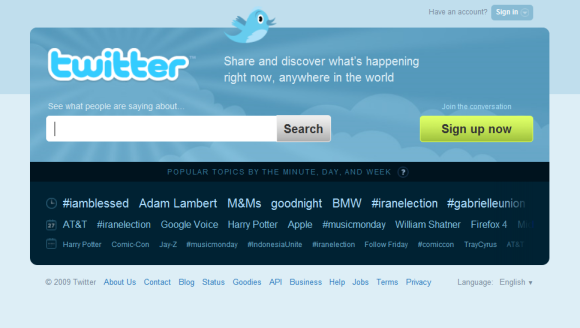
It was about time to relaunch the Twitter front page and some days ago, Mashable already mentioned this next step. From the old front page it was nearly impossible to understand what this platform is all about, the new one shows what this platform could be in the future…

Twitter becomes more like a mixture of user-generated CNN, Facebook and Google in taking the best of bread from all platforms. It is a real time information exchange news service in a social networking coat.

new-twitter1
Now, their new front page focuses on their biggest benefit for every single user in the world: their real-time search engine. In placing this in the main center of attraction and attention, Twitter leaves a lot of open space for thoughts and speculations about their future strategy in expanding their business (and business value).

The new real-time strategy is supported by the three tag lines…
- Popular topics right now (main tags real-time search)
- Popular topics today (last 24 hours)
- Popular topics this week (last 7 days)

Will they finally follow the Google business? At least some kind of similar bottom up strategy can be seen in this approach. A road that Google started off some years ago…

old-twitterCompared to the old front page (see right), the main benefit of Twitter becomes more clear now for new users and makes the USP of the platform obvious right from the start.

If we are just talking about search and the business benefit of “being and knowing first-to-market”, this will be a clear winner for Twitter compared to Google where search results for certain topics can be some years old.

Real-time is the future (of news business) and real-time starts with Twitter?

Studie: Dwell Time – neues ROI-Verfahren für Onlinekampagnen?

eyeblaster-dwell-timeMit dem Ende der Page Impression in der Vermarktungspraxis ist die Diskussion über das Messverfahren bei Online-Kampagnen ebenso neu entbrannt. Die Click-Through-Rate als finale Messmethode scheint nicht aussagekräftig genug. Die harte Währung der puren ‘Conversion’ zu drastisch. Zumal sie den Awareness-Charakter der Kampagne vernachlässigt bzw. gänzlich außer Acht läßt. Und der Unique User wird als ordentliche zukunftsträchtige Vermarktungsgröße überhaupt nicht wertgeschätzt.

Was feststeht ist, daß eine neue ‘Messwährung’ her muß. Nur welche?

Eyeblaster liefert jetzt mit seiner aktuellen Studie „Trends of Time and Attention in Online Advertising“ die Basis für ein mögliches neues Verfahren, welches sich “Dwell Time” nennt. Was bereits im letzten Jahr als neues Messverfahren angekündigt und mit einem Fallbeispiel unterlegt wurde, findet in dieser Studie seine konsequente Fortführung.

Was ist Dwell Time?
Es ist die “average number of seconds the user engaged with the ad – including mouse-on-ad, user initiated expansion, user initiated video & timed custom interaction”.

Die Studie bringt dabei sehr interesante Erkenntnisse und hebt damit den Wert der Online-Werbung im Allgemeinen. Denn: Online-Nutzer setzen sich ausgiebig -sprich: deutlich länger als 30 Sekunden (Länge eines klassischen TV-Spots)- mit Online-Werbung auseinander.

Die zentralen Erkenntnisse der Studie im Überblick…
- Es ist 25-mal wahrscheinlicher, dass sich ein Online-Nutzer mit einer Online-Werbung beschäftigt als darauf zu klicken.
- Wenn sich Online-Nutzer mit einer Online-Werbung beschäftigen, dann tun sie das intensiv: im Durchschnitt eine Minute lang.
- Die Nutzungsdauer steigt um 100 Prozent (global), wenn Video eingesetzt wird.
- Die Länge der Nutzung hängt von der Tageszeit ab.
- Auf den Homepages der Publisher beschäftigen sich Online-Nutzer zwar sehr intensiv mit der dort gezeigten Werbung – allerdings nur kurz.

Bei der Dwell-Time wird unterschieden zwischen Dwell Rate und Dwell Duration. Die Dwell Rate misst, wie häufig ein präsentiertes Werbemittel von Online-Usern genutzt wurde. Der Prozentwert fasst alle Interaktionen mit einer Werbung zusammen, geteilt durch die ausgelieferten Ad Impressions. Die Dwell Duration hingegen, wie lange sich Online-Nutzer mit einem
Werbemittel auseinandersetzen. Sie ist ein Durchschnittswert, der in Sekunden angegeben wird.

Spot On!
Es kommt Bewegung rein in die Messverfahren von Online-Werbung. Endlich wird der Unique User mit der Dwell Time in den Mittelpunkt der Vermarktungsstrategie geführt und dort als feste Größe positioniert. Zudem gewinnt die zeitliche Auseinandersetzung mit Online-Werbung und damit der Awareness-Charakter selbiger an Bedeutung. Mittelbare und unmittelbare Interaktion mit der Online-Werbung ergänzen sich somit. Stellt sich nur die Frage, wie lange es dauert, bis sich dieser Standard durchsetzt und ob die Vermarkter das Verfahren als neuen ROI Mess-Standard akzeptieren.

PS: Das Messverfahren „Dwell Time“ wurde von Eyeblaster mit führenden Werbetreibenden und Agenturen weltweit entwickelt. Man analysierte damit über ein halbes Jahr lang 42 Milliarden Rich Media Impressions.

How to attract more visitors – The 10 most important visitor resources for blogs

How can you find a lot of users for your business blog?

How can you find a lot of users for your business blog?

Is there a secret, why corporate blogs and business blogs have more success than traditional corporate websites? Is it the modern architecture of blogging systems? Is it the exiting and exhilarant spelling style of bloggers? Or is a conspiracy of the digital natives against the internet retirees?

Nothing of it! Blogs and bloggers are simply using some very effective methods to attract visitors.

The 10 most important visitor resources for blogs:

  1. Feeds – Blogs are read via feed reader predominantly, not via browsers any longer. Well-known blogs have more than 100.000 feed reader per day. On a normal day in Germany, there are some blogs with more than 10.000 feed reader.
    Highlight your RSS feed on your blog and take advantage of a feed service like Feedburner
  2. Google – Visitors through search engines are the second largest visitor group of blogs. Bloggers use always methods of search engine optimization (SEO) in order to achieve good rankings with important key words.
    Write in a search engine friendly way. Use Google’s Webmaster Tools and install a SEO plug-in like wpSEO!
  3. Pingbacks and Trackbacks – Links don’t just offer a value-add for your own users but also backlinks and numerous new users.
    Link all directions as often as possible and learn to use trackbacks in a proper way.
  4. Twitter – with the micro-blogging service you can approach users faster than with your blog. News with real add-on information are spread via Twitter the “viral” way very fast.
    Work on broadening your Twitter follower base. Promote your Twitter account on your blog and vice versa. Twitter your blog postings at the right time!
  5. Social Networks – Promote your important blog postings on XING, Facebook or LinkedIn.
  6. Forums – Are you an accredited expert, for example a wine blogger?
    If you see in a forum the question: What are the most expensive wines or the 10 most dry French ones? Write a posting on your blog and post only the link in the forum.
  7. Blog directors and RSS feed directories – Just some selected directories (Technorati, Blogoscoop, Bloggerei, Wikio) generate new visitors. Especially, if you are ranking well in these directories.
  8. Your comments on other blogs – Make yourself heard on other blogs as a constructive business partner – far and foremost in not well-known blogs. This will result in new visitors. Beware the free of sense comments! This will damage your own blog reputation in the long term.
  9. Comments of others on your blog – This is the secret of well-visited blogs:
    Be responsive to comments – You will win permanent visitors!
  10. Guest writers – Invite readers/users, other bloggers or “VIP’s” from the offline and online world to write guest posts. Every guest author will be talking to others about it or link directly to this post.
    Your creativity has no limits: travel agents blog about journeys of their customers, hotel managers animate guests to write about their vacation resort, … Your customers don’t want that? Ask them if they want to publish some of their holiday pictures on your homepage! You will be surprised seeing the reaction…

Did I forget something? Is your ranking of visitor resources different? Where do you see options to attract more visitors for your blog? Looking forward reading your comments and reading your ideas and thoughts!

Guest writer Karl-Heinz Wenzlaff is the German expert and consultant for business blogging. He knows the useful tips and tricks, and is specialized on professional company blogs, product blogs or employee blogs. Some month ago, he helped me migrating from Blogger to Wordpress in order to set up a magazine theme.

Thank you for being one of my guest writers, Karl-Heinz.

Enterprise 2.0: Classic or Social Media Branded Website?

Some weeks ago, I raised the question via Twitter…

“What is more important: homepage or company branded social sites?”

This all resulted in the post ‘Let’s prove the power of the share economy‘. Why do I post that again? As there is a company example which definitely has to be discussed…

First, there was Modernista and Zeus Jones, now we have Skittles. They relaunched their websites so that it is becoming essentially a social media branded website, i.e. with Twitter search results for the word “Skittles”.

The menu on the Skittles website also offers links to YouTube, Facebook, Wikipedia and Flickr,

What this does to their brand? Obviously, create complete transparency… Good or bad?
Good: A great idea to create massive buzz around their brand…
Bad: What if somebody tries to abuse transparency? Moderating? Not possible…

Let’s have and share your ideas on this interesting approach…

Top IT Consultants: What is your Twitter strategy?

Yesterday, we were focusing on the Twitter strategy from top strategy consultants, today we will finish this report with checking the activities from the top IT consultants. If these companies don’t use Twitter there is no reason saying they are the ‘technical specialists in communication’. We will merely focus on the official company accounts and the possible company brand accounts.

One thing before we start: Compared to the strategy consulting companies, IT consulting companies are quite ‘open-minded’ about the share economy. There is no hiding in the communication fields of the old economy. This is -in most cases- talking markets, showing transparency, creating value for the web busisness community and believing in the power of social software.

Let’s make the case…

Top IT consultant companies (in alphabetical order)
The questions that The Strategy Web asked these companies were like… Do you have a corporate Twitter account, how do you use it and what is your strategy behind it? Please find the answers, some were translated into English by The Strategy Web …


Company Account
twitter.com/BearingPoint

twitter.com/GovTwit
The first impression counts in business, the people say… “My personal Twitter strategy I learned directly from MC Hammer – ‘Forget the number of Tweeters – just stay interesting!’.” Paul Dunay, Director of Global Field Marketing at Bearingpoint, knows of personal branding, reputation marketing and the changing world of communication in the sense of ‘getting things gone differently‘.

Summary
Let’s talk about the GovTwit account first. This is one of the most excellent examples of a Twitter directory that probably exists on the web with Twitter IDs and links to official government blogs and URLs noted in Twitter bios. Beraingpoint knows how to share and all companies can learn from that example..
Nevertheless, the second one, the brand Twitter account, seems quite down to earth like a simple press release-RSS-push. But there is a clear strategy line as this Twitter account is the access point and traffic driver for the corporate blog which lives and broadcasts social media.


Company Account
twitter.com/CiscoSystems

twitter.com/CiscoGeeks
So, there are two different interesting Twitter streams: the first one for press releases, news on personal and management changes, and it picks up RTs of stories around Cisco from followers (Nice give-and-take scenario!). The second one (start Dec. 2008) pushes their Cisco AXP contest for application developers who are meant to “think outside the box”. No, the top brand account belongs to someone else. And Cisco started early sending tweets out… so this is to everone: you better hurry up to get your brand account.

Summary
Cisco has defintely entered the web 2.0 scenario big way. Using different social media like blogs, FlickR and sure, Twitter – to get all these activities around modern communication and messaging fly high. Twitter seems to be adding value to their marketing, their pr, and pushes corporate branding.


Company Account
twitter.com/gartner_inc

The man behind the corporate Gartner account is Andrew Spender -Vice President, Corporate Communications- and this company has more than 60 analysts (!) on Twitter. The corporate Twitter account from Gartner mixes internal knowledge, pr releases, communication on consulting issues, hints to their analysts and shares company experience from events and career opportunities. It’s the aggregator of their global Twitter and business knowledge satellites.

Summary
“Briefly, we use Twitter to communicate with a broad range of people. This includes IT end-users, technology providers, journalists, bloggers, etc. It has become a very effective way of developing a direct, credible, authentic two-way relationship with people who have an interest in what we have to say about the business of technology. Twitter is a great way for anyone to engage directly with our analysts and we’re always listening for feedback!” (Andrew Spender)
PS: Again, the most obvious account belongs to someone else


Company Account
Many! – … and the brand account…?

There is nearly nothing that Twitter does not support for IBM: business sections here, here and here, events here and here plus community building accounts here. Is the brand account changing it’s owner? There were more follower, there is no actual IBM logo and there is definitely something going on…

Summary
IBM is a very active user of Twitter. It becomes obvious from the named examples that IBM uses new media for their communication strategy – not surprising as collaboration software is part of their business. “Social media tools are impossible to be taken away from an innovative communication concept.” says Petra Bauerle, Web Managing Editor at IBM – yes, she twitters as well.

Company Account
twitter.com/oracle

Similar ’strategy’ that IBM has: Twitter for big events like Open World and it’s push as well as it’s blog), for tech communities around Oracle Technology Network (OTN) as well as an ‘cocktail-mixing’ aggregator account. Wanna see all Oracle Twitterati? Go ahead… and check their wiki with Oracle and non-Oracle people.

Summary
“Generally, as a company, we encourage communication among our employees, customers, partners, and others – and blogs, social networks, discussion forums, wikis, video, and other social media can be a great way to stimulate conversation and discussion. They’re also an invaluable tool for experienced Oracle users who want to share information and tips on the use of Oracle products. (…) I’m not aware that we have a formal, documented plan for the use of Twitter, just as we don’t for other social media, but we definitely have a level of participation, since it can be a good way to reach out to and engage with a variety of communities.” Steve Walker, Vice President EMEA


Company Account
None – brand account options difficult.

“At the moment, the trend washes Twitter in the spheres of a brand name like Google: Twitter is not only seen a web-service for micro-blogging but a synonym for for the dialog in 140 words – you “twitter” like you “googled”! This trend makes the service and the micro-blogging attractive for a bigger user group.” Torsten Schollmayer, Senior Associate Marketing & Analytics

Summary
Sapient sees the value of also for business accounts for the benefit of social information finding and -exchange, and supporting own brand building – Twitter offers direct and konvergent 1:1 and 1:n-dialogue with clients, competitors and specialists. That’s the reason why Sapient will be on Twitter in a short time period in order not to lose innovation leadership in te market of interactive consulting. BUT: The brand account is gone, so we will wait and see what the digital consulting experts will be doing… The question remains: Why do they start so late on Twitter?


Company Account
Many – company does not make them public as project-based…

“The motivation for our involvement in Twitter and other micro-blogging tools is connected with expertise. Through the use of these tools, experts of Siemens IT Solutions and Services can not only exchange information or present their expertise, but also interact with customers and stakeholders. Networking and open innovations play an important role within the Siemens group, therefore we also designed the open source tool ESME (Enterprise Social Messaging Experiment), which can be use by every enterprise.” Janine Krebs, Media Relations


Company Account
None – brand account options difficult… or not?!

Unisys pr agency answered briefly: “Unisys has decided not to go with Twitter. The companies opinion goes along the lines that Twitter is interesting, generally speaking, but up to now, there is no response from clients to head for Twitter.”

Summary
I am sure there will be some activity when they have been reading about the Twitter options in this post… if so, tell us in a comment, ok?!

Spot On!
We can learn a lot about the pr and career chances, capabilities and possibilities of Twitter from the IT consulting companies, and nearly all of them are using Twitter in a big way. If you need some more background on the Twitter effect for the benefit of your marketing, you should listen to Jon Samsel’s advice. Generally, the especially the real-time business benefit is obvious…

Before companies even join, they can search on Twitter and monitor what people are saying for any term or terms about their employees, their company, their industry, their branch etc. – and then simply put the results into a RSS feed reader.

The real time focus makes it one of the most valuable resources in fast moving industry days. And it tells companies very early when customers have a problem with their communication (see Johnson&Johnson Motrin example) or customer service.

Seeing all the positive aspects… there is one thing that needs to be said about the no. 1 micro-blogging tool: All the positivism in mind and seeing the wonderful new world of communication, Twitter can also be a time-thief if not treated carefully. For some managers professional support will make sense. Tweets attract your personal psyche, shake their body of words and love the power of anticipation in dissipation just like … does.

Anyway, happy to hear what you think of these IT consultants strategies…

Let’s prove the power of the Share Economy

When the web was born in 1989, the system aimed to facilitate ’sharing information among researchers’. Now, who are these researchers and what are they sharing today? And, what do companies do about this ’share’ vision in difficult economic times?

According to research projects, studies and common knowledge (also the common creative one), we all know that the customers is the researcher. He is sharing information and opinions on services, writing product reviews, bookmarking success stories or ‘chatting’ about brands. Customers want the online communication, but do companies want it too?

Yesterday, I shared a question on Twitter after a client asked me in a meeting:

‘What is more important: homepage or company branded social sites? Your answer is…’

And here are some of the thoughts that people shared – all limited to 140 words…

@MarksKiosk “Both. Your home page is basic info, a requirement. Social media churns current info and drives traffic. Vice versa.”
@flobby “well it’s all about information, not about the way it’s broadcasted. but a website is obligatory”
@david_ethority one way talking is history. customer dialog is presence, thus a corporate website without social tools is a phase out model.
@davidgammel “Both. It’s not a zero sum game, there is a lot of value in synergy between the two.”
@samraatkakkar “both, home page is info dissemination, branded social media site is engagement since this wud be interactive
@larsbas Is there a difference? I think there’re just good or bad homepages, depends on your business and what you want to achieve
@tsv1860 “right now: 50/50. and that’s as precise as my gut feeling gets.”

The answers show that some have thought about this question, some not, some even answered more often with different ideas. But all of them have their homepages, probably a few of them have social branded sites on Facebook, MySpace, Twitter and so on. Just imagine how…

… many customers have shared this thought. ‘Where do I go first?’
… many of you business partners share this discussion offline?
… many much information could have been shared without 140 character limitation

Spot On!
So, let’s continue sharing this discussion! If this is really a ‘share economy’, then keep sharing this question, keep sharing your ideas in comments to this post in order to give all companies the latest buzz on the question…

‘What is more important: my homepage or company branded social sites? Your answer is…’

Nächste Seite »

Get Adobe Flash playerPlugin by wpburn.com wordpress themes