The 3 types of social networkers that influence the buying process
02.08.2010 von Martin Meyer-Gossner
Kategorie English Content, Featured Stories, Social Media
It’s been a rumour in the industry for quite a long time now: Facebook and Twitter are becoming indirect shopping platforms and their buttons can boost sales. A recent survey by the research firm Gartner Inc. discovered that most of the users appreciate and take suggestions from their friends through social networking sites before purchasing products. And furthermore, they rely on three types of social networking friends for their purchasing decision process.
The Gartner study asked nearly 4,000 consumers across 10 key markets. The interesting part is that people in the social networks are taking different positions inside the purchasing process when recommending products to people they are connected with. Gartner identifies three types of people and roups them into three categories: ‘Connectors’, ‘Mavens’ and ‘Salesmen’.
So, how do they differentiate from each other?
The ‘Connectors’ are defined as those who “perform a bridging function between disparate groups of people and enjoy introducing people to each other”. The ‘Mavens’ are “knowledge exchangers or information brokers”, who are experts in particular area and people go to them for advice. But they are not people who wish to convince people to buy certain items; they are more interested in acquiring new knowledge, it said. The ‘Salesmen’ are those, who have “extensive social connections” and the personality trait that persuade people around them to “act on information in highly directed ways”.
“Our survey results showed that one-fifth of the consumer population is composed of Salesmen, Connectors and Mavens. These are three roles that are key influencers in the purchasing activities of 74 per cent of the population.” (…) “Salesmen and Connectors are the most effective social network influencers and the most important groups for targeted marketing based on social network analysis.” Nick Ingelbrecht, Research Director, Gartner
Gartner advises companies based on the findings of its survey to pro-actively engage with these different types of people on social networking sites. Not surprisingly, they define these categories of social media influencers as the “critical, but underutilised, aspect of the marketing process” for the future.
“Companies attempting to use social networks should develop relationships with key customers over a period of time and progressively refine the social network profiles of those individuals.” (…) “Retailers who run small shops have instinctively done this with their best customers for years with the intention that these ‘VIP’ customers will not only buy the new products but recommend them to their friends.” Nick Ingelbrecht, Research Director, Gartner
Spot On!
For me, there is a strange thing about this study. It causes a Deja-vu, I have never had before in my life. Two years ago, I published and explained -in German- in a long post the importance of these three types of people in business networks for business decision makers, and how businesses should focus on them when talking about their social media approaches. And guess what: Two years ago, I came to the same conclusion and refered to the same types of people. In these days, I have read the book “Tipping Point” by Malcolm Gladwell for the second time. And in this book you will find the same categories of people, and you are told to rely on them and work with ‘Connectors’, ‘Mavens’ and ‘Salesmen’.
The main question is now, how to address these social networking influencers? Can you call them up and talk to them directly? Send an email? Invite them for dinner or lunch? What is the best way to start the conversation with them?
CeBIT 2.010 – Always mobile, always social, always on
09.03.2010 von Martin Meyer-Gossner
Kategorie Featured Stories, Webstrategie
Als mobile Devices (altdeutsch = Handys) erfunden wurden, dienten sie dem Sinn, im Notfall in Echtzeit Informationen auszutauschen. Das mag zwar heute immernoch so sein. Dennoch hat die CeBIT 2.010 die soziale Erweiterung des Nutzungsbeweggrundes sowie die damit einhergehende Bedeutung für Sales und Marketing den Massen eindringlich verdeutlicht.
Tippte man früher umständlich die notwendige Nummer ein, um schnellstmöglich die Polizei, den Krankenwagen oder Abschleppdienst zu einem Unfallort zur Hilfe zu holen und den Verkehrsfluß wieder zu gewährleisten. So wird heute mit dem Handy ein Film (Bild ist schon fast uncool) vom Unfall gemacht. Dieses Video wird dann in einem sozialen Netzwerk hochgeladen und die Freunde auf die verkehrstechnische Umfahrung des Unfallortes per Twitter in Echtzeit aufmerksam gemacht.
Die Tastatur des Handys spielt dabei zukünftig immer unerheblicher. Gilt es doch, wertvolle Zeit zu sparen. Schließlich wissen Usability Experten um die Wichtigkeit eines der Moderne entsprechenden kundenfreundlichen Bedienungskonzeptes. Ja ok, und auch der Notwendigkeit keine Zeit bei einem Unfall zu verlieren. Richtig.
Ergo, die App revolutioniert nicht nur das (mobile) Internet, sondern auch den Markt der mobilen Endgeräte und deren Grundausstattung. Und wer denkt, daß gelte nur für das Handy irrt sich. Auch das Auto der Zukunft greift vermutlich per Touchscreen nur noch auf Apps zu, wie die T-Systems wunderbar offline auf der CeBIT illustrierte.
Man mag sich gar nicht ausmalen, wenn man auf das Auto Screenplay noch die Apps von Facebook und Twitter hochladen kann, wie es Ford erst kürzlich in Aussicht gestellt hat. Dank Google Streetview können sich die Netzwerk Freunde dann den Ort des Geschehens zukünftig aus der sicheren Ferne ins Gedächtnis rufen. Und das Ganze sogar im Vorzeit-Webzustand – in Echtzeit schafft wohl selbst Google den aktuellen Straßenüberblick nicht. Auf der Cebit konnte man die Autos bewundern, die diese Strassen-Bilder zukünftig für uns machen – von Künstlern in liebevoller Kleinstarbeit verziert.
Ob die Künstler sich wohl danach erstmal bei studiVZ auf der Couch ausgeruht haben? So ganz unmobil, aber natürlich sozial und im “always on” Modus? Vermutlich nicht. Man musste schon ein Auto vor die Couch fahren, um irgendwie darauf zu kommen. Vielleicht haben sie aber auch nur ein Bild mit der erhöhten Kamera-Perspektive gemacht, um es dann vom Auto aus in ein soziales Netzwerk hochzuladen.
Offline gibt es den Menschen 2.010 anscheinend nicht mehr. Aber vielleicht braucht er gerade deswegen bald wieder die Ursprungsfunktion des Handys, wenn es nämlich vor lauter Onlinezeit dann in der Offlinewelt ständig kracht, weil gerade mal wieder umstrittene Location-Based Services gecheckt wurden nach den neusten Promotions und Angeboten in der Umgebung ums Auto.
Spot on!
Ach ja. Zur Deutschen Telekom gibt es auch noch ein paar Worte zu sagen. Man frägt sich, ob der Konzern Re-Branding -Weltmeister werden will. Mit jeder neuen Business-Strategie würfelt man anscheinend auch gleich ein neues Branding in den Markt. Egal ob die dann Webstrategie 2.0 heißt oder nicht und man mit Kundengeschenken wirbt, die vom Obama 2.0 Leitspruch abgeleitet sind. So wird aus “Yes, we can” einfach mal schnell “U Can” (mit dem Claim ‘The power to transform’). Und ebenso schnell wandelt man T-Online, T-Com, T-Mobile oder T-Home um. Jetzt geht der Konzern mit T auf Kundenfang. Mit weiterhin einem Punkt davor, 3 dahinter und gleichem Audio-Logo? Der PR Twitter Account darf nicht fehlen und auch Facebook wird offensichtlich bald kommen, wenn man mal genau sucht.
Ob und wie diese zahlreichen Brandingwechsel die Markenführungs-Experten auslegen, bleibt spannend und abzuwarten. Sachdienliche Hinweise bitte an die Branding-Unfall-Notaufnahme MMG bei The Strategy Web. Danke im voraus!
PS: Geschrieben auf dem Flug von Hannover nach München, auf dem iPhone – aber offline im Flugmodus…
Is customer-centric business the future?
05.02.2010 von Martin Meyer-Gossner
Kategorie English Content, Featured Stories, Webstrategie
In the last 12 years, the credo of my business life was “Customer First!”. It surprises and disappoints me when I experience poor customer service. Or when I hear from unhappy friends, colleagues or relatives telling me stories about how companies treat the centre of their business: customers.
Last week, when I was thinking about how to leverage this to a higher level, I came across a modern business strategy vision by Ranjay Gulati, Harvard Business School professor and author of the book “Reorganize for Resilience: Putting Customers at the Center of Your Business“. In the following video Gulati tells us how to deliver what customers really want.
Reorienting vs. Reorganizing
Ranjay Gulati sees the fundamental changes appropriate for some movement in company processes. Customers have more information, more choices on products while companies are facing global competition. So, businesses have to think about their business (not only marketing or sales efforts!) and how it operates.
Redefining vs. Reinventing
The analysis of the customer base might show that the website is designed for male while the majority of the users might be female. So, we need to ask questions like “Who are my customers?”, “How do my customers shop?”, or “What do they really want?”.
Gulati explains with the latest success of Best Buy how women and men shop. At that point, he also hints to the upsale opportunity of recommendations.
Success for businesses, he believes, comes from “Inside-Out-Perspective”. Companies don’t have to produce everything themselves but need to make the client happy like Apple with the iPhone. 90% of the inputs are not made by Apple. The same occurs to the apps in the Apple store where Apple basically just orchestrates the customers wishes.
“Make this identity shift. I am not here to sell what I produce – I am here to solve a set of customer problems (…) and actually acting on that!”
How to get to a customer-centric business…
1. Shifting mindset: the intention to solve customer problems.
2. Sense of curiosity and humility: the wish to understand your customers.
3. Make a creative leap: the will to understand their needs.
4. Align the elements in the organization: the motivation to live the customer-centric business.
Spot On!
Interested to get your view on this modern business strategy. Let us know what you think about customer-centric business. Or do you think the social web will be leading us towards this business process anyway?
Can corporate social media engagement replace customer loyalty cards?
01.02.2010 von Martin Meyer-Gossner
Kategorie English Content, Featured Stories, Social Media
We all have our purse full of plastic cards for customer loyaly programs. These won’t make us rich. They make us save money, or get kickbacks from companies and brands if we want. And the philosophy of these programs is clever. Companies have the feeling of being in touch with their clients on a regular basis, making sure customers stay informed about their product offerings.
The customers bottleneck is, well yes, we have to carry multiple plastic cards in a credit card format with us. So, why not leaving these cards behind after 20 years and just make customers fans on Facebook and/or followers on Twitter of brands?
Imagine you go into a store and you’ll see a “Follow us on Facebook or Twitter or on our iPhone app” sign taped to the cash mashine instead of receiving print and plastic to carry home?! – Why not save the trees and oil resources!?
Companies install reward program cards to make us buy more of their products, or more frequently. And companies get more feedback on our buying habits. So, for companies these cards are an essential part of their customer loyalty strategy.
And customers with a big purse are happy. Others don’t want to have all these cards. Thus, these customers are not lsitening to what’s the latest promotion. Now, who of the male world is happy with all these plastic cards making our trouser pockets look like fat kangaroo pouches?
In most cases, these loyalty cards are addressing and being used by an old-economy’s vanity (IMHO), or women. “Look how much companies are interested in having me as their customer”, I heard a woman say the other day.
A recent study by the CMO Council “The Leaders in Loyalty: Feeling the Love from the Loyalty Club” shows the trouble of loyalty programs. 54% of consumers mention that irrelevant messages, low value rewards, and impersonal engagements may decrease their loyalty for brands and their services, and with that their loyalty programs.
And yes, we can understand this fact when our online and offline mailboxes are full of non-personalized, unexhiting and unintersting promotions from company’s so called loyalty programs. Talking of me, these loyalty programs get one chance and I cut those cards into pieces straight away when the company loyalty program fails.
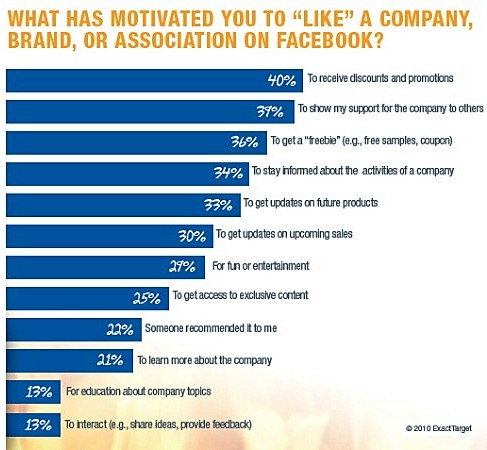
Now, what does this means for loyalty programs when we match these results with the latest survey by MarketingSherpa. The new web generation and prosumers love following brands as they expect savings, learning about specials and sales as the top motivation to friend and/or follow a brand online. If companies are aware of this fact and learn from it, why not replacing the old loyalty card concept then?
The benefit of the fan and follower systemtic is quite obvious…
- You become a fan and/or follower when a brand becomes of interest for YOU as a customer
- You become a fan and/or follower of your favorite brand when YOU are in a purchase process
- You can check status updates on sales, discounts and promotions when YOU need them (not when the company wants to sell more products)
OK, thinking of business intelligence and data mining sales cycle topics, it might become difficult for companies to track purchase processes as good as now. But, isn’t the customer king with the rise of social media? And companies could save money for print mailings and their plastic card production, right?
Spot On!
Some weeks ago, I have thought about Twitter as a sales tool and with this post, I am trying to take this idea a bit further. It shall illustrate how much a company’s sales and customer service strategy gets influenced by a new social web strategy where the customer holds the power of interest in promotions.
So, let us know what you think about the idea that Facebook fan pages, Twitter company accounts or corporate LinkedIn groups could replace loyalty programs in the future? A dream, a vision or a stupid idea?
News Update – Best of the Day
21.01.2010 von Martin Meyer-Gossner
Kategorie Daily Top 3
Content strategy becomes more and more important as customers approach companies and get engaged in company buzz. In order to be prepared companies should have a good content strategy in place. Shay Howe writes about the relevant tactical steps involved in developing a content strategy and offers great case studies with it.
Marketers want to get insight in what kind of advertising are seen and what is not being noticed o the web. The book “Eyetracking Web Usability” offers some answers based on an eyetracking study. Only close to 36% notice ads on a web page. 52% look at purely textual ads, 52% view ads where image and text were separate, 51% of viewers noticed sponsored links on search engine pages. Ads carrying text on top of images is not very successful.
What is the formula of social media success? With Starbucks we have an interesting show case which was summarized by Ayelet Noff that highlight their powerful social media tactics and strategic motivation.
Neukundengeschäft in der Krise – Motivation im Sales gesucht
14.07.2009 von Martin Meyer-Gossner
Kategorie Featured Stories, Sales, Web 2.0
An der Aussage ist eigentlich nichts Neues. Dennoch ist sie aktueller denn je. Gerade in Zeiten der Wirtschaftskrise erscheint ein aktuelles Ergebnis einer Studie des Personalberatungshauses Xenagos wahrlich unfaßbar…
Für 80% der Unternehmen spielt die Neukundengewinnung offensichtlich keine Rolle.
Das Neukundengeschäft ist also ebenfalls in der Krise. Nicht einmal ein Viertel der Umsätze macht die Gewinnung von Neukunden aus, besagen die befragten Vertriebsspezialisten. Jeder Dritte der Befragten meint, dass sich dieser Anteil in 2009 sogar noch verringert hat – nur bei der Hälfte ist er gleich geblieben.
Motivation belebt den Erfolg-Kreislauf beim Neukundengeschäft
Jeder Vertriebsleiter weiß um die Wichtigkeit des Neukundengeschäftes zum Auf- und Ausbau des Business. Und dennoch fällt es den Salesmitarbeitern schwer, den Hörer in die Hand zu nehmen und mal schnell die Kaltakquise zu starten. Die Frage ist ‘Warum?’, wenn der “5-Sales-Stufen-Erfolgs-Kreislauf” doch jedem Kaufmann bewußt ist…
1. Je höher die Motivation des Salesteams ist, umso mehr Kaltakquise wird durchgeführt.
2. Je mehr Kaltakquise durchgeführt wird, umso schneller werden Neukunden gewonnen.
3. Je mehr Neukunden gewonnen werden, umso schneller entwickeln sich Bestandskunden.
4. Je mehr Bestandskunden das Business gewinnt, umso mehr Umsatz wird geschrieben.
5. Je mehr Umsatz das Business gewinnt, umso höher die Motivation Salesteams.
Eigene Erfahrung bestätigt…
Vor noch nicht einmal einem halben Jahr habe ich bei einem schwedischen Autohaus in München für eine Probefahrt meine Visitenkarte hinterlassen – klares Kaufinteresse wurde signalisiert. Die Visitenkarte mußte ich dem Verkäufer geradezu aufzwingen, da er gerade kurz vor einer Auslieferung stand, wie er mich wissen ließ. Statt Begeisterung sprach aus seinen Augen nichts als Streß, Unzufriedenheit und mangelnde Motivation. Auf den Rückruf warte ich bis heute. Ein ähnliches Beispiel erlebte ich vor einem Jahr bei einem der größten deutschen Autobauer.
Und dann höre ich vor ein paar Wochen, daß das schwedische Autohaus Insolvenz angemeldet hat. Wundert mich das noch? Die Neukundenakquise spielte offensichttich hier keine Rolle, oder doch? Dies ist sicherlich kein Einzelfall, bekommt aber in Zeiten der Autokrise noch höhere Bedeutung. Vermutlich gibt es unendliche viele solcher Beispiele.
Am Thema Motivation scheiden sich die Geister im Vertrieb. Das Glück des Unternehmens ist davon aber maßgeblich abhängig. Wenn ich mir nun die Worte meiner Freunde, Kollegen und Businesspartner vor Augen führe, so zeigt sich, daß genau hier die Wiege der Erfolgsspur in Salesteams liegt. In den letzten Jahren haben sich ein paar klare Motivationskiller herauskristallisiert, die nicht einmal auf dem alten Thema ‘zu hohe Ziele’ beruhen.
- Merger & Akquisitionen
- Überbelastung des Einzelnen
- Steigendes Qualitätsgefälle im Salesteam
- Streichung von motivierenden Sales-Incentives
- Streichung von Sales-Trainings und Coachings
- Unverständliche Kompetenzzuteilung
- Mangelhafte Führung durch Vorgesetzte
Aufgrund der oben beschriebenen veränderter Unternehmenssituationen, sinkt die Motivation proportional zur Begeisterung und Kompetenz, Kaltakquise überhaupt durchführen zu können.
Spot On!
In meinen Augen kommt das Thema Motivation in vielen Salesteams zu kurz, was sich natürlich auf die Neukundenakquise auswirkt. Die Frustration eines nicht erfolgreichen Kaltakquise Calls ist hoch und wer läßt sich schon gerne auf so schnellem Weg demotivieren. Wenn die Stimmung im Team dann nicht stimmt, ist der Weg zum Bestandskunden dann der einfache – und bequem. Während der Xenagos Geschäftsführer Christopher Funk die Ressourcen-Frage -vermutlich nicht ganz uneigennützig- mit der Suche nach Huntern begründet, so sehe ich die Lösung eher in der Wiedererlangung alter Tugenden, die ich mal auf einem Sales-Training bei CMP gehört habe…
Motiviere Deine Mannschaft als gutes Vorbild. Fordere mit einer hoch gehängten Karrotte, die gebührend belohnt wird. Nicht unbedingt mit Geld. Aktionen zur Förderung des Teamgedankens sind oft dienlicher. Das ist die Motivation der Zukunft.
Wie gehen Sie mit dem Thema Motivation um?
Study: How women use blogs and social networking…
13.05.2009 von Martin Meyer-Gossner
Kategorie English Content, Featured Stories, Social Media
A recent study Women in Social Media from BlogHer, iVillage and Compass Partners, shows that the motivation of women using blogs and social networking differs. Blogs for women follow the purpose to find the right information while social networking platforms have the ‘mere’ sense to connect.
The results state that US women are nearly twice as likely to use blogs than social networking sites. Blogs are seen especially valuable as a source of information (64%), advice and recommendations (43%), and opinion-sharing (55%). Social networking sites are more used to share their strong affinity to connect and to entertain themselves.
Women show much more interest and increase their activity in social media. So, women are turning to blogs (55%), social networks (75%) and online status updating (20%) to satisfy their interest.
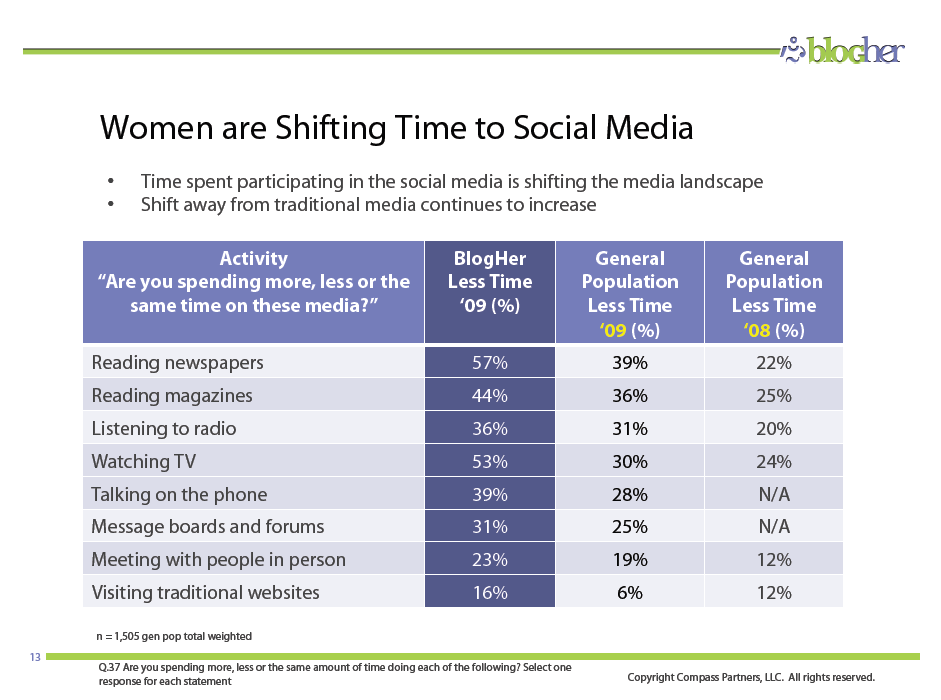
The new study found that women spend less and less time engaging in traditional media activities like watching TV, listening to the radio, or reading magazines or newspapers.
And for women blogs are becoming more and more important as a trendsetting and purchase sources of information. Seeing the influence of blogs on purchase decisions, the study makes clear that women are more likely to buy a product after reading a customer post or reports about the item. 45% of survey respondents bought a product after reading about it on a blog.
“The scale of social media usage among US women continues to grow, and blogs remain the go-to resource for those who want to gather information, share ideas and get reliable advice,” said Elisa Camahort Page, BlogHer co-founder and COO. “At a time when the economy is top-of-mind for more than 70% of these active social media participants, women who blog are turning to online resources, including blogs, to help them make their day-to-day purchasing decisions.”
Spot On!
The influence of blogs on purchase decisions shows the importance for companies to evaluate blogs as a new important part for their media plans. Reading about the habits and attitudes, the study revealed that half of the survey respondents participate in social media activity daily and weekly or more often. When we think of the 42 million women participating in social media weekly, 55% of women do some form of blogging activity; 75% participate in social networks (i.e. Facebook or MySpace) and 20% are using Twitter. The data provided shows the change in the media landscape. While traditional platform face a decrease of importance, social media is on an all time high. The time seems right to rethink traditional and digital media planning.
Studie: Twitter bei deutschen Jugendlichen unpopulär
15.04.2009 von Martin Meyer-Gossner
Kategorie Featured Stories, Social Media
Sie lieben SchülerVZ, Facebook, MySpace oder studiVZ – aber Twitter läuft bei der Web 2.0 Bewegung den Jugendlichen noch hinterher. Dies zeigt eine aktuelle, nicht repräsentative Studie aus Deutschland hinsichtlich neuer Trends bei der Webnutzung von Jugendlichen. Die Nutzung von Social Networks und Instant Messenger-Software steht im Vordergrund.
Eine aktuelle Online-Studie des Jugendreise-Veranstalters RUF Jugendreisen mit über 3400 jugendlichen
Teilnehmern zwischen 11 und 21 Jahren zeigt, daß bei mehr als 90% der deutschen Jugendlichen der Micro-Blogging Dienst Twitter unbekannt ist.
Zur Kommunikation genutzt werden von den meisten Jugendlichen im Internet ICQ, MSN und schülerVZ. Lediglich ein Prozent der Befragten nutzen laut der Befragung mit dem Micro-Blogging Dienst Twitter.
“Dass Twitter bisher überhaupt nicht bei den deutschen Jugendlichen angekommen ist, hat uns sehr erstaunt“, sagt Dirk Föste, Vertriebsleiter bei RUF Jugendreisen. “Wir hatten angenommen, dass die Kids als erstes auf den Zug aufspringen und Twitter vom Kommunikationsbedürfnis der jungen Leute profitiert“, so Föste.
Die Ergebnisse der Studie sollen in den nächsten Wochen veröffentlicht werden.
Spot On!
Interessant wäre es, diese Befragung mal aus dem Blickwinkel zu betrachten, warum Twittern Erwachsene überhaupt? Was ist die Motivation? Selbstdarstellung? Der Drang, Medienmacher sein zu wollen? Community Building für eigene Projekte? Bei mehr als 200 Followern ist das Folgen eh schon schweirig- und wenn die Jugendlichen die Zeit dafür nicht haben, warum sollten berufstätige Erwachsene diese haben?
News Update – Best of the Day
13.03.2009 von Martin Meyer-Gossner
Kategorie Daily Top 3
There are two guys that really do know what they are talking about in terms of our social media world: Guy Kawasaki and Chris Brogan. They have been ‘pretending’ to sit at a fireside chat, talking about VC’s, Twitter, Search & Content Marketing, Blogging and Responding to Criticism. I am really sharing Guy’s view on search ‘…SEO as “witchcraft,” and is first to admit that he doesn’t actually know anything about it.” Valuable content rules!
Did you know that via Facebook Ads there is an option to target ads by location and language? Sarah Perez explains how this new targeting process works.
Have you ever thought on how you are making money online. David Heinemeier Hansson (Ruby on Rails/37signals) has. And he shared his views with Start Up School 2008 reviewing the past from 2000 which is in everybody’s mind but it seems we all have forgotten about it. This is a great speech on the motivation to build a profitable business, not just a business for the sake of it…
Are social testimonials the future drivers for strong brands?
12.03.2009 von Martin Meyer-Gossner
Kategorie English Content, Featured Stories, Webstrategie
When BBDO Consulting came up with their latest ‘brand parity study‘ in Germany*, we could all learn that brands are ‘exchangeable for the consumer’. Although companies spend a fortune in brand building which are meant to raise emotions for purchase decisions, the direct implicitness of a ‘brand buy’ looses more and more its value. Today, the customers brain seems to resist this powerful and expensive approach.
“Companies need to upload brands with motivation and find the right benefits for the consumer in customer communication”, says Björn Sander, Managing Partner, BBDO Consulting.
So, we might ask the question: Is advertising via emotions still the driver of the consumer buying decision in the world of the future brand building? Or will strong brands be ‘tackling’ the money via word-of-mouth in the future through ‘brand-vangelists’? Let’s call those people ’social testimonials’ (or name it ’social model’ or rockstars if you like)…
An example. Imagine you think about buying a new mobile phone. In the shop you get offered a Nokia and a Blackberry. We all know what these brands stand for: Nokia as one of the first-time mover in connecting people away from home, Blackberry one of the top mobile business enablers for managers. Through the years we all were educated via different communication strategies that these brands, while positioned in the same market segment, are meant to serve these different purposes and benefits. But the knowledge around brands and their impact on consumers seems to be built via the same learning concept:
“People buying from people because people are relying on word-of-mouth from people they trust.”
Now, in terms of buying decisions, word-of-mouth has become an enormous influence on brands with web 2.0 (i.e. through rating, review, crowd-sourcing, etc.). In our case, some fellow ’social-testimonial’, a fellow worker, peer or friend, might argue correct saying: “Why should some construction worker need business features like email or sync functionality on a mobile?” The brand reward for his colleague’s need is deciding on the brand, not the emotion.
It is not that this person does not understand or rate the other product or it’s message. It is simply not paying the credit that his fellow, peer or friend needs. But the reward ‘Connecting people’ is exactly what this example of a construction worker wants – nothing more, nothing less. And this was the Nokia brand pitch on consumers right from the beginning of the brand building process: spreading word-of-mouth easy, fast and everywhere you are going. What a great reward, right?
Vision or Utopia: social testimonials enforcing future brands?
Let’s take this idea a bit further. In business everything turns around the reward concept: ‘What is the reward for selling something…?’ Now, as word-of-mouth is one of the biggest benefits of social influence today, why should not ‘everyday people’ (and not VIPs) get the option to be rewarded for becoming a social testimonial for a brand?
What if there was a kind of reward for using private social media tools (blogs, micro-blogging or even social networks profiles) as a personal tool to say and show online ‘Yes, these are my brands!’ Would this not change our behavior towards brands? Not in terms of writing (micro-)posts as people already do it. But in terms of ‘wearing and carrying around brands with your online presence, your online pictures, your personal digital dna, etc…
Generally speaking, if our ‘engagement’ in brands could be rewarded, a brand will have more visibility, our enthusiasm for that brands will increase and with it our word-of-mouth for the value of the brand and all it’s impact. Correct? Or is this against online reputation? Or are people not happy to being testimonials?
Spot On!
We all know that without any reward, there is limited commitment for brands. But what if we were showing our favorite brands open to everyone and avow ourselves to those we ‘adore’? Virtually speaking, companies could take us by the hand like advertising columns and reward us with a mechanism they see as appropriate? Are brand committed people not the best emotion drivers for their ‘followers’ (as the ‘Twitterati’ would say)? Would this not carry a brand’s word-of-mouth to a next all-time high? And in the end, would this not work in the favor of making brands more emotional and less exchangeable?
Open to discuss…