News Update – Best of the Day
03.06.2009 von Martin Meyer-Gossner
Kategorie Daily Top 3
What do you think is better: web-based learning or face-to-face? A recent study of Malaysian tertiary students reveals that ‘using web-based learning technologies showed only a slight improvement in performance over conventional face-to-face teaching methods’.
Is Twitter just another tool for the inner circle of social media activist? At least it seems that this might be the fact when we hear this: Harvard Business publishes some results (300,542 users, collected in May 2009) of a study that shows… 10% of the Twitterati make 90% of the Twitter traffic – an average man is almost twice more likely to follow another man than a woman.
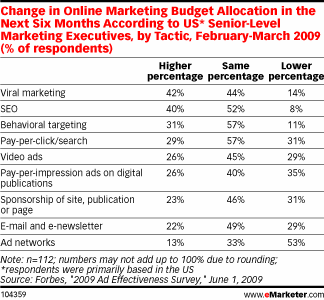
CMOs will change their attitude towards online marketing. According to a recent study “Ad Effectiveness Survey” released by Forbes, 53% of senior marketing executives plan to spend less on ad networks. The expectations are… Viral marketing and search engine optimization will increase in spending in the coming months, behavioral targeting spending remains steady.
“Ad network spending is all about demand fulfillment while direct-to-publisher display is much aligned with the traditional advertising goals of demand creation,” said Forbes.com president and CEO Jim Spanfeller. “It is interesting to see the shift of dollars toward demand creation as we see signs of life in the economy.”
News Update – Best of the Day
05.05.2009 von Martin Meyer-Gossner
Kategorie Daily Top 3
The AAAA leadership conference 2009 is over and reviewing the conference from an advertisers point of view gives you some interesting facts what the advertising industry is talking about today. Topics were…
- Trend towards online marketing is continuing. Mediavest says 50% of ad spending go to digital and interactive campaigns.
- Environmental advertising and why this is good for business…
- Can coffee companies become a retail bank? According to FT’s John Gapper this is possible for Starbucks…
- CEO of the 4As Nancy Hill on the podium talking about “incessantly negative adverbloggers.”
PS: Can great products ruin a relationships. Yes, this is possible. What a great Mino viral video Ad – and what a poor guy…
Study: Agencies moving to slow for consumers?
25.03.2009 von Martin Meyer-Gossner
Kategorie English Content, Featured Stories, Web Strategy
If we can believe in a recent study ‘Beyond advertising: Choosing a Strategic Path to the Digital Consumer‘ by IBM Institute for Business Value, then ad agencies are years behind in catching up to digitally savvy consumers – although consumers are moving their media consumption online more quickly than anybody could have expected.
Now, despite the difficult economic climate there are some good news for the digital industry: IBM’s study states that interactive, measurable formats will be expected to account for 20% of global ad spending by 2012. The interviewed CMOs said they will increase interactive and online marketing spending in 2009 while 63% while 65% will decrease on traditional advertising. Generally speaking, the same trend that we acknowledged from the latest CMO report.
So, what are further interesting findings? Between 2007 and 2008 the proportion of consumers answering they used social-networking tools went up to 60% (from 33%). It even doubled for for online and portable music services to 46% and almost tripled for mobile internet. And believe it or not, the access to mobile music and video quadrupled to 35%.
Seeing these numbers, it is surprising that 80% of the interviewed ad executives forecast the industry to be at least five years away from being able to deliver whatever might be necessary in terms of cross-platform advertising, encompassing sales, delivery, measurement and analysis.
The problem seems to be the agencies according to study co-author Saul Berman, IBM global leader, strategy and change consulting services. Agencies need to identify and keep pace with the value shift in order not to loose out the same way the music industry did, he summarizes.
“To succeed — especially in the current economic environment — media companies will need to develop a new set of capabilities to support the industry’s evolving demands which include micro targeting, real-time ROI measurement and cross-platform integration,” said Saul Berman, IBM Global Leader for Strategy and Change Consulting Services, and co-author of the new study. “Now is the time for companies to move quickly to become more effective with their assets and build for the future.”
Spot On!
Watching the last decade, companies and agencies followed their customer audience and pushed their budgets to more interactive, measurable formats such as the internet and mobile (gaining 20% of the overall spend). This is not surprising as digital advertising enables advertisers to measure more effectively campaign success to prove the value of their budgets.
In terms of platform owners it shows that these need to identify new opportunities to monetize new consumer experiences before it is too late like the music industry has shown. The options are obvious: value of content, visual goods sales, value-added services plus hardware or software offerings.
For this study IBM conducted 70 interview sessions with global industry execs and surveyed more than 2,800 consumers in Australia, Germany, India, Japan, the U.K. and the U.S.
CMO report: budgets better than expected
18.03.2009 von Martin Meyer-Gossner
Kategorie English Content, Featured Stories, Web Marketing
Chief Marketing Officer (CMO) Council’s Marketing Outlook 2009 states that CMO’s see their budgets stable. Almost half of all asked CMO’s (54,1%) say their budgets will increase or at least remain.
What is the value of a click? Obviously, the best deal is transforming a consumer into a customer. For 36% this seems to be the biggest issue: converting clicks to sales and finding the value of online marketing. Just 9% of the chief marketers argue about their online performance capability as being “excellent”.
The outlook in the recession is not too bad… The majority of top marketers answered their traditional marketing focus (print, outdoor and TV) remains the same, and especially digital advertising (also social media and search marketing) will increase. But it also has to me mentioned that 45.7% said their spending budgets will decrease.
“Senior marketers are looking to hold budgets steady and not make tremendous cuts in headcounts,” said Liz Miller, the council’s VP of programming and operations. “Instead, they’re reallocating both their budget and talent into those areas that better engage and communicate with core audiences and customers.”
Spot On!
The loyalty of customer becomes more and more an issue for marketers. Who would be surprised… Those who want to study as deep as possible how the customers thinks, don’t ‘owe’ the sovereignty on customer service and support issues, nor have they big influence on CRM, the survey says.
The question remains why the majority of marketers rely on old online measures (i.e. page views and registrations 64.6%) and not focusing on more modern online engagement opportunities which keeps the consumers with the brands. The most obvious options could be personalization and client first programs (i.e. client opinion platforms or community building) which could replace the old-school “watering cans” techniques. The more companies focus on the client, the ‘happier’ the revenue lines will show.
The report was co-sponsored by Deloitte, Jigsaw and Ad-ology and asked 650 worldwide marketers.
CeBIT 2009 – Webciety vs. Webciety
10.03.2009 von Martin Meyer-Gossner
Kategorie Featured Stories, Web Strategy
Die Messe CeBIT 2009 ist gelesen. Also, wollen wir eine kleinen Rückblick wagen…
Was hat die CeBIT 2009 ‘getrieben’?
Viel Hoffnung auf Wachstum, viele Visionen und viel Wunschdenken.
Was steht geschrieben?
25% weniger Aussteller (4300 Unternehmen), 20% weniger Besucher (rund 400.000) und einen Tag weniger CeBIT 2010.
Was ist geblieben?
Fragen, Fragen, Fragen… meistens zum Thema und Konzept der Webciety
Webciety – Was war das nochmal?
Der Veranstalter Deutsche Messe hat es zur Chefsache gemacht. Web-Visionäre nehmen es dankbar auf. Vor der Messe zelebrieren die beiden Parteien im Schulterschluß das Kunstwort ‘Webciety’. Sie sprechen vom wachsenden Einfluss des Internets (Web) auf sämtliche gesellschaftlichen und wirtschaftlichen Bereiche des Lebens (Society). Ein Trend, der grundsätzlich natürlich nachweisbar ist und von dem sich Unternehmen Erfolg versprechen.
In der Businesswelt der CeBIT scheint dieser allerdings nicht wirklich angekommen zu sein. Was virtuell zwar in den Köpfen der Businessmenschen 2.0 verankert, sah sich auf der CeBIT einer realen, schwarzen ‘Stand-Barriere’ gegenüber. Und selbst die Hauptdarsteller der Themen um Social Networks, Blogging und Co. Facebook, Twitter, MySpace und XING blieben der Webciety fern. Und die Oberen dieser Firmen sprachen bezeichnenderweise teilweise eher auf der Global Conference der CeBIT.
Die Halle 6: Ort der Gegensätze
Wer sich an den Rand der Halle 6 stellte, dem erschloss sich auch schnell die unüberwindliche Hürde zwischen IT und Internet. Oder besser: zwischen Businessentscheidung und Internetbegeisterung. Von ‘Internet is coming home’, Slogan der Webciety, konnte da nicht wirklich die Rede sein – auch wenn man noch so viel über die Zukunft des Internets diskutiert. Dem Schlipsträger, oder ‘Grauanzugträger‘, schien das Wabenkonzept der Webciety wie eine kleines ‘Schwarzes Loch’ vorzukommen, in das er besser nicht eintauchen wollte. Das ‘Schwarze Loch’ Internet, vor dem viele Business-Entscheider sich fürchten, kam in Form einer dunklen unwägbaren Fläche daher – mit seinen 24 vermieteten Mini-Ständen, welche sich von 130 weiteren Webunternehmen umringt fanden. Weder Besucher noch Aussteller nahmen so richtig Notiz von der Webciety.
Spielvarianten von Webciety
Den meisten Messebesucher vermutlich entgangen, ist die Tatsache, daß es in der Halle 4 einen weiteren Webciety Bereich auf dem SAP-Stand gab. In diesem eher wissenschaftlichen Webciety Bereich war der Researchbereiches der SAP zuhause, der sich auf der CeBIT mit demselben ‘Buzz-Word’ platzierte und an einem kleinen Nebenstand seine ‘Dienstleistungen im Internet der Zukunft’ zelebrierte. Diesem komplexen Ansatz eines ‘Mehrwert durch Vernetzten, Automatisieren und Personalisieren’ liegt die Initiative THESEUS-Programm des Wirtschaftsminiteriums zugrunde.
In einem Exklusiv-Gespräch erklärte mir Dr. Joachim Schaper, Vice President EMEA, die SAP Definition von ‘Webciety’.
Dem gegenüber steht der oben beschriebene CeBIT Auftritt der Webciety durch die Follower des ‘Web-Avantgardisten’ und CeBIT-Webciety Initiator Sascha Lobo. Den Erfolg seiner Webciety beschreibt Lobo mir gegenüber wie folgt…
Welcher Part nun die Zukunft des Business und das Business der Zukunft prägen wird, wird sich zeigen.
Spot On!
Der Webciety Gedanke war generell eine gute Idee hinsichtlich der Awareness Generierung ‘Pro-Internet im Business’ – gerichtet an den Kreis der budgetmächtigen Entscheider. Gewirkt hat das CeBIT-Model nicht, weil sich ein ‘Schwarzes Loch’ nicht gut vermarkten, verkaufen und verstehen lässt. Selbst der Schwerpunkt der ‘klassischen’ Internetfirmen zog es vor, lieber im lichten Flur der Halle 6 die altbewährte Variante des Messeauftritts zu wählen, wie z.B. CoreMedia, Imperia, Intershop, Infopark oder Open Text. Nicht mal ein konkurrenzlos günstiger 10.000 EUR Messestand war ein Argument, Teil der Webciety zu werden. Nach dem geringen Zuspruch durch Managementbesucher ist das Konzept in dieser Form zukünftig fragwürdig. Es sei denn, die Monetarisierung des Internets soll weiter ohne umsatzbringende Silberlinge vorankommen…
Der Messeveranstalter ist mit der Idee der Webciety dennoch zufrieden: “Wir haben diesen Unternehmen eine Heimstatt geboten, die sie vorher nicht hatten”, erklärte CeBIT-Chef Ernst Raue und ergänzt “Alle Aussteller haben bereits jetzt für die nächste CeBIT zugesagt”. Irgendwie erinnern einen diese Aussagen des Veranstalters an jene nach Abschluss der ‘letzten’ Online Marketing Düsseldorf (OMD) vor einem Jahr. Den Ausgang bildete ein neues Konzept. Es besteht also noch Hoffnung…
PS: Aber auch eine SAP muss sich fragen, ob man weiterhin zukunftsweisende Projekt an ein Buzz-Word anlehnen will, welches wenige Businessentscheider angenommen haben.
Studie: Langer Weg von Offline nach Online für Firmen
09.03.2009 von Martin Meyer-Gossner
Kategorie Featured Stories, Web Marketing
Eine aktuelle Marketing-Studie “Analyse vs. Aktion”, vom Marktforschungsinstitut Loudhouse Research im Auftrag von WebTrends, belegt den schwerfälligen Übergang von Offline zu Online. Auch wenn der Online-Kanal für Unternehmen zunehmend an Bedeutung als Absatz-, Marketing- und Kommunikationskanal gewinnt. Den Unternehmen fällt der Übergang weiterhin schwer.
Die Studie machte sich an der Frage fest: “Wie können die Produkte und Services online am besten vermarktet werden? Nur 41% aller befragten Unternehmen sind mit dem Übergang von Offline zu Online zufrieden. Dabei kristallisieren sich zwei Hauptaufgaben heraus: 53% der Manager sagen, daß ihnen die mit dem Online-Shift einhergehenden Veränderungen in den Geschäftsprozessen am meisten Kopfzerbrechen bereiten. 38% sehen die Aufgabe mit Online-Nachfrage und Anforderungen der Kunden Schritt zu halten als die zweitgrößte Herausforderung.
Die Online-Zielgruppe ist bekannt. Das Problem im Online-Bereich der Unternehmen ist das “Wie soll ich verkaufen?” 31% sehen das Maximum aus ihren Online-Verkaufsstrategien nicht ausgeschöpft, weil sie die komplexen Bedürfnisse und Ansprüche ihres Online-Publikums bislang nicht verstehen können. 47% der Befragten schätzen ihre Internet-Strategie als risikoreicher ein als ihr traditionelles Marketing – und nur 25% sehen ein geringeres Risiko.
“Obwohl das Internet einen immer wichtigeren Stellenwert als Businessplattform einnimmt, stehen Unternehmen beim Übergang zu Online vor einigen Herausforderungen”, erklärt Karl-Heinz Maier, Director Central Europe bei WebTrends. “Aber hier zeigt sich, dass Wissen ein erfolgsentscheidender Faktor ist: Mit fundierten Webanalyseinformationen können Unternehmen ihre Online-Kampagnen optimieren und Erfolge eindeutig nachweisen. Deutsche Unternehmen haben das Potenzial des Online-Kanals weitestgehend erkannt, jetzt gilt es nur noch, dieses gezielt voll auszuschöpfen!”
Spot On!
Wenn Großbritannien mit 56% die Liste im Bereich “Mehr Risiko” anführt, dann weil sich hier der größte Markt für Online-Werbung bietet und auch die höchste Prozentzahl an Breitbandverbindungen gegeben ist. In Ländern mit weniger Wissensstand ist die Angst vor einem Wagnis ‘Internet’ höher (z.B. Schweden oder Italien). In Deutschland sehen 38% ein höheres Risiko und 34% ein geringeres Wagnis. Im europäischen Vergleich läuft man bei der Verbreitung und Durchdringung von Online Marketing noch hinterher.
Die Studie wurde mit 300 Interviews bei Online Marketing Managern in Unternehmen mit mindestens 250 Mitarbeiternin in den Regionen Großbritannien, Deutschland, Frankreich, Italien, Schweden und Australien durchgeführt.
Social Media: nightmare or gift for customer service?
13.02.2009 von Martin Meyer-Gossner
Kategorie English Content, Featured Stories, Social Media
When we lived in the offline world 1.0, customer service was already a dangerous topic for companies – still a small one though. If you failed to meet customer expectations you risked to damage your company and product image but word-of-mouth was not at an adult stage.
With the rise of social media the risk of poor customer service quality increases drastically. And some of us already know of the benefit and costs that might arise. For those who don’t, take your time to read this post and try to become a change agent in the favor of customer service inside your company.
In our times of customer generated media, customer service will become the key element for a successful business. Especially when companies are taking into account that the customer rules the marketing communication process. The customer not only talks to peers, friends and relatives. With social media elements the customer becomes the ‘silent’ marketing and pr driver. Thus, the customer 2.0 turns the marketing communication process upside down and probably sometime in the near future will make customer service more important than marketing.
Let me tell you a story…
Some months ago, I bought a pocket camera. It showed a bug after 5 month of not even intense usage. The manufacturers customer service told me to send it to a reseller in order to get it done as quickly as possible. Three weeks later (!) the camera came back. Result: It did not work anymore. So, I addressed the online marketing manager who advised me to buy his product. He passed me on to customer service that send me an ‘urgent inquiry’ mail voucher for the reseller. This urgent voucher did not perform as an urgent customer care reply – but as a nightmare. After another 3 weeks (!) I still had not heard back of my camera. Again asking the online marketing manager via a business network ended in an email from customer support, telling me ‘as of illness… and difficult product availability …lalala… we could not send the camera back quicker’. The online marketing manager did not reply at all but clicked on my profile in the business network.
What do you think of that story? Take your time…
It definitely shows that this company does not know the rules of modern communication 2.0. Can companies apologize because they don’t have the resources to care about their customers? Or because they don’t have the right logistic that supports their resellers with service quantities? Definitely not – not even in the offline world 1.0. And sending an email through a third person is odd, is like having forgotten the value of a client, is like hiding behind the walls of customer service 1.0, right?
Companies need to start treating customer service as an investment rather than an expense if they want to see social media as a gift for customer service. With the rise of social media even more: A negative-minded customer is sometimes just a few words away from changing into a customer evangelist.
Seen form a superficial perspective, social media and customer service doesn’t make money in the beginning. In the long-run, we all know the power that it has in terms of word-of-mouth efficiency. This positively influences your image, your brands, your products, your sales, your customer loyalty, your employees and finally your share holders.
Social media as well as customer care is an investment in the future of communication. For this online marketing manager sites like eBay and amazon.com still seem to be in the focus of the sales process. Customer service is an ‘not very much loved’ alien department somewhere under ground floor level. And even if this marketing manager and his pr manager have great contacts to editors of publishing houses that could help protect and build up their image, customers would be doubtful after having read such stories. Social media is changing customer service rules and the way companies must monitor their image in the market. Just think about what I could have said…
‘They paid attention to me, they heard me, they showed me that I matter.’
What a success in terms of customer service for a company could that have been?
Spot On!
Social media will become the future customer service access point. Just take a look at a study in the US from end of last year showing the future of customer service and what clients want…
- Companies should use social networks to solve my problems (43%)
- Companies should solicit feedback on their products and services (41%)
- Companies should develop new ways for consumers to interact with their brand (37%)
Obviously, the customer 2.0 is the more uncomfortable customer for companies than in the offline world 1.0. But not if you invest properly in the modern communication process 2.0. Just imagine I had stated the company name in this post (as much as you will ask, this will not leave my word-of-mouth). Or if I had shared this story with the name on Twitter, Facebook, XING or LinkedIn? The reach that social media generates of some individuals 2.0 is massive and thinking about some of my followers, I do see loads of influential social medians with an even bigger reach – bigger than most of today’s well-known magazines. So, social media can become a nightmare. For those who see the options of the investment it will be a gift.
PS: The Bank of America already does combine social media and customer service with a Twitter Account.
About the survey… The 2008 Cone Business in Social Media Study presents the findings of an online survey conducted September 11-12, 2008 by Opinion Research Corporation among 1,092 adults comprising 525 men and 567 women 18 years of age and older. The margin of error associated with a sample of this size is ± 3%.
How to ‘online’ with school and college students
05.02.2009 von Martin Meyer-Gossner
Kategorie English Content, Featured Stories, Web Marketing
Yesterday, I got an email form a student saying: “I need some information for my high school exams. Do you have some good links? Can you help?” Well, I gave some advise, definitely. Which made me think about: How to address the modern student with online marketing communication? And surprisingly enough I found a quite new study…
The typical modern student writes, networks and chats social – but emails seem to be outdated. At least if we read what a recent study by eROI, an email marketing and interactive agency, states. The study focuses on how high school and college students and recent college graduates communicate digitally. According to a review published by the Center for Media Research:
The average students reads marketing emails “rarely to never” (61% of respondents). Just 16% are reading marketing emails frequently. Call to action works not for 66% of students on marketing emails.
It seems that company messages via email does not generate direct response effectively in catching their attention personally.
Let’s check the most relevant results…
- 81% got an email address for communicating with family and 52% for communicating with friends
- About one-quarter of students originally got an email address for social networking purposes
- 60% of students take action upon receiving an email only if they are interested in the product
- 47% take action if they are attracted to a special offer
- About 36% of students use email alerts to keep up to date on what’s happening on their social networks
If companies want to reach students they need to be active on social networks (even in business networks).
- 83% use Facebook,
- 65% use MySpace
- 21% use LinkedIn
The study identifies the channels are students using most. The preferred means of communication for college students are:
- 37% Text Messaging (SMS)
- 26% Email
- 15% Social Networking IM
- 12% Email on a mobile device
- 11% Instant Messaging
- 11% Social networking Email
Spot On!
The potential future ‘business elite’ is turning marketing communication upside down. The study shows that communication will not take place via inbox but via quicker and more ‘social’ communication technologies and tools. So, what the social media world tries to tell the present business elite has already touched base for college and school students.
Read the full report here.
News Update – Best of the Day
27.11.2008 von Martin Meyer-Gossner
Kategorie Daily Top 3
- Namensprobleme bei den führenden digitalen Konferenzen/Messen Deutschlands? Noch hat keine Messe stattgefunden und schon wurde der Name geändert: DMEX wird dmexco. dmexco steht für “Digital Marketing Exposition & Conference” und soll auch nach außen deutlich machen, dass die OMD-Konkurrenzveranstaltung eben mehr ist als eine Messe. Ob der Online Marketing Düsseldorf (OMD) auch eine Namensänderung bevorsteht: OMD ist bereits von einer weltweit agierenden Agentur belegt – Verwechslungen nicht ausgeschlossen…
- Video Reportage 2.0: Genialer Geniestreich von bild.de? Ein Medienhaus setzt auf den Videotrend und macht die Leser zu Kameramännern und -frauen. Fragen dennoch: Was hat man als Videoproduzent davon? Rechtfertigen sich 100 EUR? Oder refinanzieren die sich sogar durch Kickbacks von Bild? Infos hierzu waren auf die schnelle nicht zu erhalten…
- Online-Communities findet man überall. Wer sich über den Zustand der Gemeinschaftswelt 2.0 mal ein Bild verschaffen will, der kann das hier machen. Auch wenn die Businesswelt versucht die Dynamik und die Motivation zu ergründen, die eine Community zum Erfolg führt, letztendlich ist es für die meisten Menschen einfach nur Spass und Vergnügen…
Umfrage: OMD 2008 – was erwarten Aussteller und Manager?
17.09.2008 von Martin Meyer-Gossner
Kategorie Web Marketing, Webkommunikation
Vor ein paar Tagen stand in einem Blog, den man besser nicht zitieren möchte: “Wer als Onliner nicht auf der OMD 2008 ist, gehört nicht zur Internet Branche”.
Wow! Welch ein Ritterschlag für eine Messe. Aber irgendwie verständlich, wenn ein Konzept funktioniert und sich im nächsten Jahr erstmalig mit einem Mitbewerber in ‘ungeliebter’ Umgebung (Köln) konfrontiert sieht.
Wenn die Online Marketing Messe also wirklich so wichtig für die Internetbranche ist, dann muß man doch mal nachhaken bei Geschäftsführern, Managern und den zahlreichen Ausstellern…
Was erwarten Sie von der OMD 2008?
In der vergangenen Woche haben wir insgesamt über 150 ausgewählte Geschäftsführer und Abteilungsleiter von Ausstellern sowie Besucher befragt.
Das Ergebnis
Im Sinne einer Messe steht die offline-geführte Face-To-Face Kommunikation im Mittelpunkt. An die Generierung guter Businesskontakte (24%) und den erfolgreichen Austausch über und innerhalb der Branche (22%) werden die größten Erwartungen geknüpft.
Interessanterweise steht die Erwartung einer guten Party (17%) ebenfalls hoch im Kurs. Kein Wunder, ein Klassiker aller Messen… und angesichts der Diskussionen um Werberezession ein willkommenes Ablenkungsgeschenk. Da gerät der Wunsch nach zusätzlichem Umsatzpotential (14%) oder die Aussicht auf interessante Businessideen (12%) schonmal für zwei Tage ins Hintertreffen.
Obwohl das Web mit immer komplexer werdenden Möglichkeiten für Unternehmen aufwartet, scheinen unternehmerisch-strategische Themen wie neue Online-Taktiken (6%) und clevere Strategieansätze (5%) nicht wirklich die Erwartungen der Besucher und Aussteller zu treffen. Ist das Thema Internet in den Firmen also immer noch nicht ein business-kritisches Momentum?
Die Zukunft, oder der kommende Mitbewerb, werden zeigen, wo die Reise der OMD hingeht. Interessant wäre natürlich nach der OMD zu erfahren, ob die Messe den Erwartungen gerecht werden konnte.. .