Studie: Arbeitgeber wollen Arbeitnehmer nicht auf Facebook und Twitter sehen
06.10.2009 von Martin Meyer-Gossner
Kategorie Featured Stories, Webstrategie
In einem Jahr, in dem von Social Media Governance seit Jahresbeginn gesprochen wird, erscheint das nachfolgende Studienergebnis unglaublich. Aber offensichtlich haben diverse Arbeitgeber noch nicht in die neuste Datenbank für Social Media Governance geschaut – ein Wiki mit zahlreichen Varianten diverser Unternehmen und Organisationen.
Zurück zur Studie… Eigentlich muß man sich vor einem RT dieses Posts gut überlegen, ob und wann man diesen ‘tweeted’ – oder ob man davon nicht lieber absieht. Zumindest sollte man sich der Social Media Policies im Klaren sein.
Robert Half International hat eine aktuelle Studie herausgegeben und folgendes herausgefunden…
54% von 1.400 Chief Information Officer (CIO’s) verbieten die Nutzung von Social Networking Seiten während der Arbeitszeit. Und das gilt nicht nur bei Twitter und Facebook – nein auch für LinkedIn, was ja bekanntermassen ein Business-Netzwerk ist. Und für manche schon ein Roll-Ex bzw. ein Adressbuch ersetzt.
Immerhin kam auch heraus, daß dann doch 20% der befragten Unternehmen die Nutzung von Social Networking Seiten zu Businesszwecken erlauben. Persönliche Tweets sind in 16% der befragten Unternehmen genehmigt.
Für die Studie wurden nur Unternehmen mit 100 Mitarbietern und mehr per Telefon befragt. Robert Half gibt basierend auf der Studie folgende Tips zum Schutz der Online Reputation.
# Know what’s allowed. Make sure you understand and adhere to your company’s social networking policy.
# Use caution. Be familiar with each site’s privacy settings to ensure personal details or photos you post can be viewed only by people you choose.
# Keep it professional. Use social networking sites while at work to make connections with others in your field or follow industry news — not to catch up with family or friends.
# Stay positive. Avoid complaining about your manager and coworkers. Once you’ve hit submit or send, you can’t always take back your words — and there’s a chance they could be read by the very people you’re criticizing.
# Polish your image. Tweet or blog about a topic related to your profession. You’ll build a reputation as a subject matter expert, which could help you advance in your career.
# Monitor yourself. Even if your employer has a liberal policy about social networking, limit the time you spend checking your Facebook page or reading other people’s tweets to avoid a productivity drain.
Spot On!
Angesichts der Studienergebnisse und der Wünsche der Arbeitgeber kann man doch froh sein, wenn die beiden Business Netzwerke LinkedIn und XING sich zusammenschließen. Bei nur einem Business-Netzwerk geht weniger Zeit bei der Nutzung von Social Networks verloren. Oder liegen die Ängste der Arbeitgeber wo anders?
Online Reputation Management bleibt (zeit)aufwendig…
29.06.2009 von Martin Meyer-Gossner
Kategorie Featured Stories, Social Media
Als ich meine Vision des Personal Web Managers geschrieben habe, dachte ich, es wird sicherlich bald eine solche Dienstleistung des Reputation Coaches für aufstrebende Manager oder stark im Web aktive Persönlichkeiten geben. Derzeit ist interessant zu beobachten, wie sich dieser Plattform-Markt für persönliches Reputation Management in Position bringt.
Es steht eben viel auf dem Spiel: die Bewerbung einer Karriere, die für Nachhaltigkeit einer authentischen und erfolgreichen Persönlichkeit steht. Die Online Reputation wird dabei immer wichtiger für den nächsten Karriereschritt, aber ihr Management bleibt leider trotz unterstützender Plattformen zeitaufwendig. Ein kleiner Überblick…
Bisher galt der amerikanische Dienstleister Reputation Defender als der weltweite ‘Platzhirsch’ im Entfernen oder ‘Geradebiegen’ von bildlich belegbaren Fehltritten oder voreilig getroffenen Statements und Kommentaren, die im Web verewigt sind. Denn, wie wir alle inzwischen wissen sollten: Das Web vergißt nichts – teilweise nur, wenn wir entsprechend nachhelfen. Und so bietet Reputation Defender mit myChild ein Produkt an, das den Ruf und die Privatsphäre des Kindes schon von Kindesbeinen an online schützt.
In Deutschland ist mit my ON-ID eine sehr interessante Plattform am Start, die Online Reputation auf technischer Basis zu handeln, monitoren und optimieren anbietet. Die Web 2.0 Plattform offeriert sehr viele Optionen, das eigene Personal Brand als Visitenkarte (bzw. fast schon im Format eines Online CV aufzubauen (mit zahlreichen Schnittstellen und Widgetfunktionen zu anderen Social Networks).
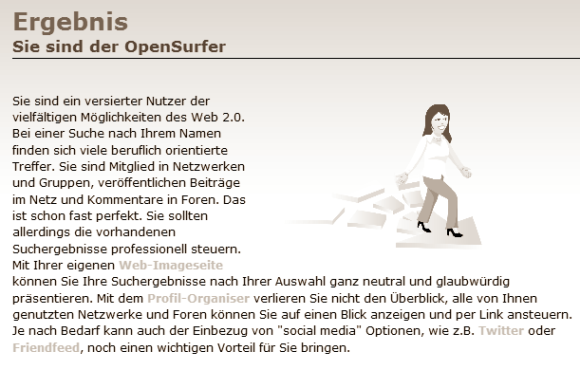
Am Wochenende erhielt ich nun die neuste Pressemitteilung von Dein Guter Ruf, die mir von meinem Ex-Kollegen Jannis Moutafis zugespielt wurde. Die Nachricht preist die ab sofort kostenlose Suche des (mir noch völlig unbekannten) Reputations-Dienstsleisters an, sowie die Option eine Web-Imageseite zu veröffentlichen. Als Gadget wird der Test „Welcher Online-Typ bin ich“ angeboten, der einem Tips zum persönlichen Reputation Management offeriert (mein Testergebnis siehe Bild).
Hintergrund des Tests: Der Profil Organiser wird hiermit promotet. Dort kann man seine Netzwerk-Profile eingeben und hat diese so im Schnellüberblick und -zugriff. Der vordergründige Vorteil der Übersichtlichkeit, läßt sich mit einem grundlegenden Tip entkräften…
Starte kein Profil in einem sozialen Netzwerk, wo Du nur einen kleinen Mehrwert siehst und evaluiere vorher, ob Du nur aus einer zeitweiligen Zugehörigkeit (Schule, Uni, etc.) oder aus zukünftiger Überlegung (Kontakte halten, Karrierebenefit, etc.) dieses nutzen wirst.
Die Dienstleistungen von Dein Guter Ruf erinnern mich dennoch stark an den Personal Web Manager, denn hier geht es offensichtlich wirklich um den strategischen Ansatz des Reputation Managements mit persönlicher PR-Betreuung. Man bietet vier verschiedene Versionen an: Basis-, Profi-, Premium- und VIP-Manager – von kostenlos bis 129,90 EUR pro Monat. Letztere verspricht sogar…
- Wir legen für Sie Profile in mit Ihnen abgestimmten Portalen an.
- Wir integrieren bereits vorhandene Inhalte in Foren, Blogs, Fachportalen.
- Wir prüfen monatlich Ihre Reputation und liefern für Sie geeignete Portal- und Themenvorschläge.
- Wir führen für Sie geeignete Online-PR Aktivitäten durch.
Insofern wirken die Preise vernünftig und erinnern an das Preismodell von Reputation Defender.
Kurztest: Dein Guter Ruf
Suche: Die Suche ist unbefriedigend. Bei 466.000 Googletreffern zu meinem Namen fand Dein Guter Ruf rund 70. Einige hatten überhaupt nichts mit mir zu tun. Zahlreiche positive, wie Interviews und Gastbeiträge von/mit mir, wurden gar nicht gefunden.
Image-Webseite: Ein Bild kann nicht gefunden, hochgeladen oder integriert werden (vielleicht in einer Bezahlversion?!). Der erste Eindruck eines Menschen zählt – und der Mensch verkauft sich in der Karrierebewerbung über ein persönliches Bild. Man verschickt ja auch keinen Lebenslauf ohne Foto.
Paid Services: Daß man für zahlreiche Funktionen (z.B. Kommentar eines Suchtreffers) im Web 2.0 Zeitlater bezahlen muß, ist irgendwie Web 1.0 Welt. Zumal my ON-ID hier schon diese Funktion ohne Aufpreis anbietet.
Fazit. Unspektakulär, nüchtern, sachlich, nicht personalisierbar – aber vielleicht ist die Form genau das, was zukünftig für das Personalwesen die nachhaltige Bewerbung ist. Wer weiß…
Spot On!
Neben my ON-ID macht sich mit Dein Guter Ruf ein weiterer Anbieter auf, unsere individuelle Online Reputation im Auge zu behalten und zu professionalisieren. Mein Urteil bleibt dennoch kritisch. Die Idee Reputation Management mit persönlicher PR-Strategie zu verknüpfen, gefällt mir gut (schon wegen seiner Nähe zu ‘meinem’ Personal Web Manager). Man müsste es fast einmal einem Test unterziehen, um zu sehen, wie erfolgreich sich die Arbeit für das Personal Branding zeigt (Erfahrungsberichte bitte an mich schicken). my ON-ID ist dennoch derzeit einen ganzen Schritt voraus und bietet die spannendere und zielgenauere Lösung das Online Reputation in der Spur zu halten. Reputation Management bleibt weiterhin aufwendig, vor allem zeitaufwendig, denn am besten wird sie derzeit noch von jedem Einzelnen kritisch beäugt, bewacht und bewertet.
Personal Branding – how to build your career 3.0
24.06.2009 von Martin Meyer-Gossner
Kategorie English Content, Featured Stories, Internetuser, Visionen, Web 2.0, Webstrategie
Personal branding is the way to stand out of the crowd and being noticed in some special way in the business world which makes you unique. It is your value proposition for the future of your career. In a session at the webinale09 I held a speech about ‘Career 3.0 – split between personal branding and productivity’ and gave some projections on the relevance of social media activities and how these affect your career development.
Today, we want to learn from Dwight Cribb, founder of his successful recruitment agency, what professional recruiters think about personal branding and what is the relevance for personal branding. You can follow his offline and online thoughts via his Twitter account.
Q: What is the first thing you do when somebody is being suggested as a perfect candidate?
Dwight Cribb Of course I will first probe what the relationship between the candidate and the person suggesting him is. Supposing that the recommendation is made during a phone conversation, I will in parallel check the candidate’s profile on Xing. If that does not provide the information I require I will probe deeper with people search engines.
Q: Let’s imagine somebody is not doing anything for personal branding. This person is not blogging, micro-blogging or social networking. Does this have a positive or negative impact on your perception of that person?
Dwight Cribb This largely depends on the type of position I am recruiting for, both in terms of seniority and discipline. I would normally expect someone in a directly client facing role or someone who communicates directly on behalf of a division or company to have at least some presence on the web. It is, however, true that not being on a social networking site is today more of statement than being on one. A few years ago one could be forgiven for thinking of people who had not yet discovered Xing, LinkedIn and facebook as being somewhat backward or conservative. As it is today largely impossible to not have noticed these networks flourish, we must assume that those not on them have shunned them on purpose. This may be a good strategy if one relies on others to communicate with clients and the public, especially as a senior manager. A C-Level executive will through his utterances on social networks have a severe impact on the brand communication, it thus needs to be 100% in line with the other communication, if not it will cause at best confusion and at worst it will undermine the credibility of the brand.
As for blogging, I think that is a very personal decision and I would never think badly of anyone who did not blog. I may, however, think badly of someone who blogs badly or in a manner inappropriate to his or her position. So overall it would not reflect badly if I found out nothing about a person online, it would just peak my interest and make me more curious to receive other information in the form of a CV or a recommendation from a third party.
Q: Will personal branding and the individual online reputation replace the traditional CV some day?
Dwight Cribb I doubt whether it will replace the CV, it is more likely that it will continue to augment the CV. Online reputation is a fantasy product. We each spin our profiles in a manner which we feel supports the image we want to convey. It is self marketing. A CV is more strongly based in chronological fact and provides a picture which comes closer to the reality than the pictures which get drawn in communities.
Q: If everybody has a strong personal brand, don’t companies fear these people could get chased by some competitor and recruiters? Or that employees just work for their own career purpose?
Dwight Cribb Most successful employees work for the own career advancement. But in the long term they will only achieve this by delivering results to their employers, because people are very good at spotting meaningless self marketing and will not fall for it for long. Good employees have always had a strong personal brand (also called reputation). It has been true in all areas and across the ages, if you do something well you will be admired by your peers and your reputation will spread. This means that others will try and employ your services, sometimes via a recruiter.
Q: What is your advice on how companies have to handle personal branding of the employees in the future?
Dwight Cribb Let people define themselves what they are comfortable with. Give them a clear guideline what company resources and what company information they can use to build their reputation and to what extent they must make clear what is their opinion what the company’s.
Q: What do you think of the personal web managers vision?
Dwight Cribb There are instances where this makes perfect sense, but I belive they are far and few between. This is a role which has precedence in the offline world, many high-profile business people, politicians and celebrities employ someone with this brief. Whether they do their job online, offline or in both really does not make much difference. We have come to expect that the picture we get presented of these people has been scripted and planned in detail. We even often admire the way in which they craftily manipulate their image. But I think we would be less inclined to condone or accept this level of abstraction in communication in our closer environment of colleagues, family and friends. A facebook status update from a friend loses relevance if I know that it was posted his or her personal web consultant, who was busy making them be liked by their friends and acquaintances.
Q: Give us 3 tips how to create a personal brand, please.
Dwight Cribb Be yourself, be honest, laugh at times.
Thank you for your time and your advice, Mr. Cribb.
Monetizing Social Media: Social Medians have to set a trend…
10.06.2009 von Martin Meyer-Gossner
Kategorie English Content, Featured Stories, Webmarketing
Having worked twelve years monetizing media platforms (offline and online) I follow with great interest the latest talk and buzz on monetizing the social media economy. The time has come to make a point after some famous blogs in Germany (medienlese.com and rivva.com) were about to be closed down. Being a blogger and a social median, I thought about this in a guest post on Digital-Conversation and received some interesting feedback. So, I would like to share my thoughts also with the international social media community.
In my post, I stated that it must be possible to monetize personal social media activities. Not in any kind of classical way of web monetization but in an unconventional way – as unconventional as web 2.0 has revolutionized the world of communication. The reason and necessity for this thought is that, in my personal view, social media activity needs to monetize for the individual as a good (online) reputation is not going to feed ‘hungry holes’. No, all this work costs a lot of time and effort. Does really nobody want to hear this?
So, we do need a new concept, in every kind of respect – as a combined concept of monetizing social medians in particular – not social media in general. And in my eyes, we won’t be successful in marketing millions of individual blogs, micro-blogs or social networking profiles. No, the complete picture of an individual counts… here needs to be the access for future ideas and concepts. The individual personal branding is key…
A vision – mental acrobatics
Let’s imagine a new web world and turn the present concepts upside down. Just as a kind of mental acrobatics, or vision, how we could be marketing the individual social median.
Let’s call it the ‘3 at one blow’ idea – and don’t tear this concept into pieces – it only counts as one full picture…
Blogs…
Just allow brands you prefer to be a partner of your blog
If bloggers don’t want to follow the footsteps of the classical web 1.0 publishing branch, then blogs need to find an accepted standard ad format – a similar one web 1.0 started with (the full-size banner it was those days). Maybe the 125×125 Button could be the one which seems to have established itself at the leading blogs not only in America? Bloggers don’t want and need 20 ad spaces. No, blogs need a maximum of four ad spaces in my eyes, as we don’t want to have the right hand frame like a blinking advertising column for ‘everybody’s brand’. No, ideally, bloggers want to decide themselves which brands gets space, and which doesn’t. Bloggers should just give their self-preferred brands the option to be visible on the individual blogs. Bloggers should not write branded or sponsored posts (the Trigami modell) which pay out their business, blog or the areas of companies interest. Bloggers are doing enough for the world, they don’t need more work to do…
Micro-Blogs…
Just offer brands you ‘adore’ to sponsor your profile or background picture
Some micro-blogging platforms offer the option to create the profile and the back-ground picture in a way the social median likes it to be seen. Why do only some social medians use this as ad space? Is this working against your glory as a social median? Against the online reputation (and editorial integrity as we called it in the publishing industry some years ago)? Or will there be problems coming up with my employer when I suddenly integrate a logo into my profile picture, or my background picture? Again: If there was some kind of uniform standard, the problems could be solved quickly. Cut out a piece and make us serve our favorite brand!
Social Networks…
And finally, just offer one or two brands you prefer to sponsor your profile picture
The best and only valid ad space on social networking profiles in my eyes is… the profile picture. For, what is the first and most powerful asset you sell with? Yes, you, yourself. And what is the first thing we look at when watching social media profiles? Right, the face. So, why don’t we see profile pictures, in which ’social medians’ stand for their preferred brands? The way, we have seen this at Twitter lately, where some people promote the events they will be attending in the near future. OK, I can imagine that the employers could be asking, why there is a logo on the profile picture. But if it was standard, and going hand in hand with the blog and the micro-blog, it would not be a problem anymore.
Let’s summarize this idea…
What if…
- you could monetize your pesonal branding by being sponsored from your favorite brands?
- you could define three to four brands you prefer to sponsor you as a social median?
- you could escape the discussion on media reach with the ‘3 in one blow’ power monetization idea?
Somehow the social media scene seems to be stranded given shrinking or not existing budgets for online media. Isn’t this the right time for a change to find a new monetization model for social media? But in my eyes, either the social medians don’t want, or they cannot face this issue. Thus, although companies want to be present on social median’s activities.
In general, the social median has to ask himself/herself three questions in the future…
- Do I want to make money with my personal branding?
- Do I want to continue post my knowledge for free for a better personal branding?
- Or ‘live’ with a small online reputation and just have a microblog profile as of a lack of time?
“Free things always hurt” is the saying of the salesmen. Isn’t it better to show the value proposition of your content, combined with your personal branding, and market this according to your preferences?
The classical ways of monetization (Bannering, Affiliate and Google Adsense) cannot be the future of social media monetization. The problem is obvious: a small reach (compared to huge media platforms or ad networks) offers no chance for a payback or break-even point. The big online platforms have experienced for years that an increased cost-recovery is not to be achieved with these monetization models. Do social medians really want to continue playing along the odd old game?
And what I really cannot understand… Why do bloggers and their ad networks still try to make money with the old cpx models (cpm, cpa or cpo), following IAB standards. Don’t we all know that this cannot be the future of web monetization? At least not, if the quality of the platforms is not meant to suffer…?!
Social medians have to set a good example and find a new moentization strategy which is not depending on sophisticated IAB social media metrics. This way is too complex and I would not even find the time, or even see the necessity, to do the reporting based on this definition. Selling, optimizing and reporting cpx models already was difficult enough. So, why not make processes easier and give companies what they want…
Identifying and positioning next to social medians – but the social median is to decided on the partners.
Spot On!
Let’s imagine we could commit a maximum of four brands for one, two or three years to become partner with us. We would be so called ’sponsored social median VIP’s’ (obviously not everyone in the world could reach such a status). Only those companies will get our valuable ad spaces that have been defined by us as our ‘favorite brands’ for a certain time-period. Isn’t this a worthwhile aim of monetizing a social median? Social medians are trendsetters. They are facing the signs for a change – and know about their powerful personal branding.
Looking forward to hearing your views on this monetization model ‘Only my favorite brands can partner with me’ (without writing sponsored posts!).
PS: Performance is nice for companies, but not at all costs for social medians. Or does the world really want to see the freedom of opinion with high-quality content dying before it has even started big way? Just because it cannot be monetized? The social median does not want to become rich, but she/he should make his value proposition clear to the world, right?
Das erste Jahr – von Personal Branding und Produktivität
05.06.2009 von Martin Meyer-Gossner
Kategorie Featured Stories, Webstrategie
Geschafft! Das erste Jahr als aktiver ‘Social Median’ liegt hinter mir…
Lange habe ich überlegt, wie ich zum Geburtstag meines Blogs ‘The Strategy Web’ in die Retrospektive gehe. Die Ereignisse der letzten Tage haben mir die Entscheidung abgenommen. Es wird vorwiegend eine Zusammenfassung der letzten zwei Wochen, sozusagen exemplarisch zum Thema: Personal Branding und Produktivität.
Denn um diese Themen geht es meiner Meinung nach vorwiegend in dieser schönen Social Media Welt…
Ein paar statistische Werte des ersten Jahres…
- 486 Beiträge 
- 280 Kommentare
- 1.600+ Twitter Follower
- 7.000 Unique User und 10.500 Page Impressions (Durchschnitt der letzten 6 Monate)
- tolle neue Kontakte weltweit, die das Blog mit wertvollem Feedback bedachten
…und ja, ich habe zahlreiche Stunden am Personal Branding in weiteren Social Networks (siehe Buttons unten) gearbeitet und bin noch lange nicht fertig, meine Digital DNA zu vollenden. Sprich… ob ich produktiv im Sinne eines ‘Social Median’ war? Sieht ganz so aus…
Gehen wir mal ein wenig auf die Ergebnisse ein…
Die Karriere 3.0 entscheidet sich im Web
So ähnlich wie die Überschrift klang auch mein Vortrag auf der Webinale im sagenumworbenen Telekom-Szeneladen 4010, die Anfang letzter Woche stattfand. Unter dem Titel ‘Karriere 3.0 – Spagat zwischen Personal Branding und Produktivität’ habe ich den Zuhörern meine Vision zukünftiger Karriereschritte im Web erläutert. Das ist ein Erfolg meines Blogs, denn ohne diese Arbeit, wäre ich bei der Webinale nicht aufgetreten.
Die aktuellen LinkedIn Nutzerdaten bestätigen meine dort vertretenen Ansichten: Social Network Profile werden verstärkt zu unsere digitalen Lebensläufe, die klassischen CVs verlieren an Wichtigkeit und Online Reputation bestimmt unsere Karriere 3.0. Beispielhaft sein hier Nutzerzahlen des ersten Quartals 2009 genannt: Bewerbungen auf LinkedIn gingen um 49% nach oben, ebenso die durchschnittliche Anzahl an Bewerbungen pro Stellenanzeige (43%). Zudem streben die User vermehrt nach Empfehlungen (Steigerung um 34%). Die Online Reputation bekommt zunehmend mehr Relevanz für die Arbeitswelt, wie Jobvite erst kürzlich in einer Studie berichtete.
Warum ist Personal Branding wichtig?
Firmen investieren Milliarden in Branding, um den USP, den Wiedererkennungswert und die Einzigartigkeit von Produkten und Services beim Konsumenten zu stärken. Der ‘Social Median’ wird sich zukünftig als Marke begreifen lernen und da ist die Notwendigkeit nicht fern, sich selbst aktiv in Position zu bringen. Er/Sie investiert zukünftig eben Zeit, in Profile auf Social Networks, ein eigenes Blog, einen ‘Micro-Blogging-Stream’, oder wo es auch immer Sinn macht.
Das alles kostet zwar fast kein Geld, aber Zeit – die wertvollste Resource unseres Jahrhunderts.
Dementsprechend wird der von mir propagierte Personal Web Manager zukünftig von großer Bedeutung für engagierte Manager 2.0 oder 3.0 werden. Sonst zahlt sich der Invest in das Personal Branding wohl nur schwer aus – und wie sich der Personal Web Manager finanziert, steht in meiner nachhaltigsten Vision aus meinem ersten Jahr als Blogger.
Zwei positive Wochen für mein Personal Branding
Zurück zur Webinale… Unmittelbar nach meinem Vortrag erschien ein Interview mit mir auf Sian-Ru Lai’s Blog von European Venture Fund GmbH, welches sich meiner privaten Personal Branding Orientierung widmet. Mit Sian habe ich zudem ein paar Worte zum Inhalt des Vortrags, Erfolgskriterien für Start-Ups und Web-Investoren gewechselt. Wenn mein geistiger Output unproduktiven Wert hat, werdet Ihr es mich wissen lassen, liebe ‘Follower’ – oder sagt man Leser oder Community-User?
Ebenfalls letzte Woche erschien auch ein Video-Interview mit mir – aber zu meinem alltäglichen Berufsfeld: Marketing, Sales und Medien. Vor ein paar Wochen habe ich den Web 2.0 Kongress in München besucht und dort zwischen interessanten Vorträgen, selbst initiierten Gesprächen z.B. mit John Della Volpe und einem mit mir geführten Interview ‘geswitcht’. Christian Schmitt von Media-Treff hat mich zu Marketingstrategien und Chancen im Marketing in der Krise vor die Kamera geholt. Das Ergebnis ist hoffentlich produktiv, aber meinem Personal Branding hat es geholfen. Im Sommer soll ein Webinar zum Thema Lead Generation folgen – zu Gunsten der Produktivität der Marketiers und Salesleiter.
Um meinen Input ins Web 2.0 und somit meine Online Reputation besser monitoren und aggregieren zu können, habe ich inzwischen auf Anregung von Mario Grobholz, Gründer von myON-ID, mein Profil dort mit dem Personal Branding meines Twitter-Account versehen. Auch dies hat Zeit gekostet – ebenso wie ein Interview auf dem myON-ID Blog. Ob das myON-ID Profil produktiv ist oder nicht, wird sich zeigen, wenn sich die Plattform als Web 2.0 ‘Reputation-Visitenkarte’ durchsetzt.
Beendet habe ich die zwei Wochen mit einem Gastbeitrag zum Thema Vermarktung von Social Networks: Social Medians müssen Zeichen setzen auf dem Social Media Vordenker-Blog von David Nelles und Nils Maier, letzterer hat interessanterweise sein Twitter Branding wiederum dem ihres Blogs angepasst.
Als Sales- und Marketingexperte frage ich mich immer noch, ob wir unsere Social Media Aktivitäten auch zukünftig für unseren ‘guten Ruf’ machen (müssen), oder ob ‘Social Medians’ ihre Online Reputation irgendwann mal nach meiner Idee oder einem ähnlichen Konzept monetarisieren werden, z.B. um den Personal Web Manager selbst bezahlen zu können.
Denn um Profit geht es in der Social Media Welt nicht. Eher darum, noch mehr Produktivität für ein optimaleres Personal Branding herauszuholen – ohne der Notwendigkeit eines 36 Stunden Tages.
Spot On!
Ein Jahr Personal Branding mit zahlreichem Output – daraus die letzten beiden Wochen exemplarisch. Produktiv für Euch? Für meine Zukunft…? In meinen Augen: Ja! Diverse Einladung zu Events, Workshops, Seminaren und Interviews haben mir dies gezeigt. Und Spaß gemacht hat es auf jeden Fall.
Und allen, die meinen Input oder Output schätzen, möchte ich hiermit für Euren Input und Output danken. Und freue mich auch weiterhin auf Euer Feedback hierzu…
Candidate 2.0: Did you find a new job using social media?
15.05.2009 von Martin Meyer-Gossner
Kategorie English Content, Featured Stories, Webstrategie
This week, there has been the Careerbuilder example on how using social media might effect your career in a negative way, and also on how to restore it. This post is meant to turn this topic into a positive point of view scenario.
Isn’t it a better idea to look for positive examples on how candidates 2.0 were successful finding a new job with their social media activities? And how they did it, or what they actually did?
We all love success stories, don’t we? That is the reason why this post was created…
So, if you were interested in online reputation this week…, you could come across another two interesting posts concerning how to influence your career with social media. Both were meant as a positive advice, although one had a negative connotation. One, on how to promote your personal brand via social media, and another one on 30 examples how Twitter can ruin your career.
Some examples of the second post definitely show a quite amateur behavior and these people probably got themselves into serious trouble. Still, the question remains if those people really need to be fired immediately, or just criticized, or are we not all becoming cooler with the future use of social media world in terms of career aspects… and don’t take every word with a pinch of salt.
Having written that, I am still waiting for the first relevant study on how many recruiters use social media as a pre-selection tool for potential candidates. We probably all agree that recruiters and hr managers use social media in an intense way, and increasingly for their research – but we do not know how or in which way.
A friend of mine, who is a recruiter for one of the big worldwide recruitment agencies told me that there was not one job applicant that has not been screened via social media tools or platforms in 2009. So, there is a need for people to know what is happening and a study could do people some good.
Today, I have even seen that we already have a Social Recruiting Summit. If this topic is evolving in the recruitment arena, then it definitely makes sense to ask some questions. So, coming back to my headline…
Who can say he/she has found a job using social media?
And to give this topic more relevance and transparency for the future, I would appreciate if you could take part in our following poll …
Spot On!
Now, one thing is for sure: If you are applying for a new job (or even evaluate doing it), there are definitely some reasons to choose your words wisely in communities, social networks or (micro-)blogs.
But isn’t this what we all knew before? Was this not written in our employment contracts? Don’t talk about internal stuff… Your voice becomes public in communities, once it goes live on the web – and the push factor in communities might be massive. Not only because people like to ‘tweet’ and ‘re-tweet’ things. This is not a Twitter phenomenon – status updates are also on Facebook, Friendfeed, XING, etc…
Online Reputation – Social Networking und Lebensläufe
07.05.2009 von Martin Meyer-Gossner
Kategorie Featured Stories, Social Media
Soziale Netzwerke haben unser Leben, und damit unsere klassischen Lebensläufe (CVs), revolutioniert. Was irgendwo digital in einem Netzwerk über das Leben einer Person geschrieben steht, ergibt ein komplexes und detailliertes Karrierebild einer Person. Und dieses Social Networking Auftreten kann so dienlich sein für die weitere Karriere…
Ob das Profil nun auf Linked, XING, Facebook, Twitter oder sonstigen Social Networks ist, immer wieder gibt es Einzelheiten der Persönlichkeit hinsichtlich des Werdegangs wieder – von Erfahrung und Wissensstand über Interessen und Fähigkeiten. Im privaten Netzwerk -egal ob digital oder offline- sind diese Daten nicht neu.
In der Berufswelt entscheiden diese Fakten zunehmend über die Karriere jedes Einzelnen. Manchmal stellt man sich die Frage, welche Relevanz klassische Lebenslauf-Formate überhaupt noch bei der Jobvergabe von gehobenen Positionen haben, oder ob die Betrachtung der Bestandteile einer Digitalen DNA durch Personalverantwortliche oder Personalberater nicht bereits mehr ins Gewicht fällt.
Alle Social Networks wollen bei der Registrierung so viel wie möglich über die Persönlichkeit erfahren… was natürlich später ‘public’ wird, sobald das Profil freigeschaltet wird. Und ‘public’ heißt, es geht ins Netz, ins Web und ist damit weltweit einsehbar. Eine große Chance, aber auch ein mögliches Karriere-Risiko…
So empfiehlt sich, und das sollte im Interesse eines jeden Menschen mit Social Media Profilen sein, bei diesen Profilen ein gutes Bild abzugeben. Mein Credo als Empfehlung lautet kurzgefasst…
“Bleibe die digitale Persönlichkeit, die Du auch in der realen Welt repräsentierst. Erfolgreich wirst Du Social Networks nutzen, wenn Du Deine Individualität in der vernetzten Kommunikation informativ, authentisch und qualifiziert abbildest.”
Detailliert lässt sich dieses Credo mit folgenden drei Tips zur Darstellung der eigenen Biographie in Social Networks zusammenfassen.
Wirke informativ.
Speziell bei Suchmaschinen und Twitter liegt die Würze in der Kürze. Man muss nicht unbedingt die komplette angebotenen Länge des Profiles ausnutzen (in Suchmaschinen werden die Profile als Suchergebnisse meist nur kurz angerissen). Je länger das Text-Profil, umso treffender sollten die Worte gewählt werden. Basisdaten müssen aussagekräftig sein. Was müssen die Leute über meine Person in diesem speziellen Social Network unbedingt wissen? Dann folgen persönliche USPs, mit denen sie sich von der Masse differenzieren, Interesse kreieren oder Besonderheiten fokussieren.
Spreche authentisch.
Wer sich online verstellt, sich in den Vordergrund stellt oder sich exponiert durch besondere Qualifikationen, muss den Beweis erbringen können. Beim ersten Offline-Meeting wird man sonst schnell entlarvt werden. Persönliche Qualifikationen, die aufgemacht sind, müssen bewiesen und erworben werden im realen Leben. Wer den Nachweis nicht erbringen kann, sollte nach dem Motto leben: Reden ist Silber, Schweigen ist Gold. Bei privaten Fotos hingegen ist generell vorsicht bei der Veröffentlichung geboten. Man kann inzwischen auch nach persönlichen Fotos im Web suchen, von denen man gar nicht weiß, daß sie dort existieren. Sehr interessant vor allem, wenn diese nicht authentisch sind…
Vernetze strategisch.
Qualität der Kontakte in Business-Netzwerken geht vor Quantität – es geht nicht darum, mit ‘Hinz und Kunz’ vernetzt zu sein, sondern mit Vordenkern, Meinungsführern, Querdenkern, Mitdenkern und natürlich (verantwortlichen) Kollegen. Nicht jedes Social Network adressiert denselben Typus an Leuten. Dementsprechend sollten die biographischen Details und auch die Status-Updates nicht 1-zu-1 in allen Networks inhaltlich gleich erscheinen. Eine mögliche Business-Strategie für die biographische Darstellung im sozialen Business-Web könnte sein: XING für die deutsche berufliche Reputation, LinkedIn für die internationale professionelle Reputation und Facebook für Bekannte, Freunde oder wertvolle internationale Business-Socializing Kontakte. Kontakte in verschiedenen Netzwerken zu segmentieren, erleichtert die Pflege und Organisation der Kontakte ungemein und macht die Notwendigkeit der biographischen Detailangaben bedeutend spannender und aussagekräftiger.
Innerhalb der Netzwerke gilt grundsätzlich die Prämisse: Wer, welche Daten einsehen kann, wird unbedingt über die Einstellungen festgelegt.
Spot On!
Die digitale Biographie ist ihr persönliches Kapital, ihr einzigartiges individuelles Wertversprechen für die Offlinewelt. Und es wird täglich für ihre Karriere wichtiger. Behandeln Sie sie auch entsprechend, vor allem im Social Networks. Mittels sozialer Netzwerke kann die individuelle Anerkennung als Experten eines Themenbereichs (z.B. in Gruppen) steigen, die Glaubwürdigkeit und das Selbstbewußtsein gestärkt werden, und letztendlich die Karriere ‘katalysiert’ werden. Neue Dienste wie KnowEm können übrigens bei der Registrierung und Organisation und my ON-ID beim Monitoring von Online Reputation hilfreich sein.
Je höher man die Karriereleiter aufsteigen will, umso besser sollte man seine Profile pflegen. Niemand weiß, welche Kontakte unter den Hunderten, die man hat, sich mal als neuer Arbeitgeber zeigen könnte. Manche Details des digitalen Lebenslaufes kann man positiv beeinflussen, manche nur bedingt – teilweise mit externer Hilfe von Institutionen wie ReputationDefender – oder zukünftig vielleicht mal dem Personal Web Manager.
Was ist Euer Credo? Was findet Ihr essentiell für eine Social Network Biographie? Freue ich auf Eure Kommentare.
PS: Der Artikel ist aufgrund meiner Teilnahme an der Panel-Diskussion ‘Persönlichkeit im Netz – Identität und Reputation’ auf dem Medientreffpunkt in Leipzig entstanden.
News Update – Best of the Day
29.04.2009 von Martin Meyer-Gossner
Kategorie Daily Top 3
Online Reputation is becoming more and more important for brands and for the individual – but how can you have an overview where you are registered and where you should be registered. Brian Solis explains a new tool for brand management and online reputation called knowem, and explains the special service it offers for brand managers. And we are all brand managers, aren’t we? And if it’s only about branding ourselves in persona…
Now, online reputation from an individuals point of view is going hand in hand with personal branding. Dan Schwabel, who has written the popular book on personal branding Me 2.0, was speaking about his special topic at the Social Media Breakfast in Puma City on Monday. Listen and learn from him…
Good commenting is not easy when there is the personal wish to establish a strong online reputation. Brett Borders has thought about it and comes up with some great advice for efficient tools and how to build an effective comment strategy.
Are social testimonials the future drivers for strong brands?
12.03.2009 von Martin Meyer-Gossner
Kategorie English Content, Featured Stories, Webstrategie
When BBDO Consulting came up with their latest ‘brand parity study‘ in Germany*, we could all learn that brands are ‘exchangeable for the consumer’. Although companies spend a fortune in brand building which are meant to raise emotions for purchase decisions, the direct implicitness of a ‘brand buy’ looses more and more its value. Today, the customers brain seems to resist this powerful and expensive approach.
“Companies need to upload brands with motivation and find the right benefits for the consumer in customer communication”, says Björn Sander, Managing Partner, BBDO Consulting.
So, we might ask the question: Is advertising via emotions still the driver of the consumer buying decision in the world of the future brand building? Or will strong brands be ‘tackling’ the money via word-of-mouth in the future through ‘brand-vangelists’? Let’s call those people ’social testimonials’ (or name it ’social model’ or rockstars if you like)…
An example. Imagine you think about buying a new mobile phone. In the shop you get offered a Nokia and a Blackberry. We all know what these brands stand for: Nokia as one of the first-time mover in connecting people away from home, Blackberry one of the top mobile business enablers for managers. Through the years we all were educated via different communication strategies that these brands, while positioned in the same market segment, are meant to serve these different purposes and benefits. But the knowledge around brands and their impact on consumers seems to be built via the same learning concept:
“People buying from people because people are relying on word-of-mouth from people they trust.”
Now, in terms of buying decisions, word-of-mouth has become an enormous influence on brands with web 2.0 (i.e. through rating, review, crowd-sourcing, etc.). In our case, some fellow ’social-testimonial’, a fellow worker, peer or friend, might argue correct saying: “Why should some construction worker need business features like email or sync functionality on a mobile?” The brand reward for his colleague’s need is deciding on the brand, not the emotion.
It is not that this person does not understand or rate the other product or it’s message. It is simply not paying the credit that his fellow, peer or friend needs. But the reward ‘Connecting people’ is exactly what this example of a construction worker wants – nothing more, nothing less. And this was the Nokia brand pitch on consumers right from the beginning of the brand building process: spreading word-of-mouth easy, fast and everywhere you are going. What a great reward, right?
Vision or Utopia: social testimonials enforcing future brands?
Let’s take this idea a bit further. In business everything turns around the reward concept: ‘What is the reward for selling something…?’ Now, as word-of-mouth is one of the biggest benefits of social influence today, why should not ‘everyday people’ (and not VIPs) get the option to be rewarded for becoming a social testimonial for a brand?
What if there was a kind of reward for using private social media tools (blogs, micro-blogging or even social networks profiles) as a personal tool to say and show online ‘Yes, these are my brands!’ Would this not change our behavior towards brands? Not in terms of writing (micro-)posts as people already do it. But in terms of ‘wearing and carrying around brands with your online presence, your online pictures, your personal digital dna, etc…
Generally speaking, if our ‘engagement’ in brands could be rewarded, a brand will have more visibility, our enthusiasm for that brands will increase and with it our word-of-mouth for the value of the brand and all it’s impact. Correct? Or is this against online reputation? Or are people not happy to being testimonials?
Spot On!
We all know that without any reward, there is limited commitment for brands. But what if we were showing our favorite brands open to everyone and avow ourselves to those we ‘adore’? Virtually speaking, companies could take us by the hand like advertising columns and reward us with a mechanism they see as appropriate? Are brand committed people not the best emotion drivers for their ‘followers’ (as the ‘Twitterati’ would say)? Would this not carry a brand’s word-of-mouth to a next all-time high? And in the end, would this not work in the favor of making brands more emotional and less exchangeable?
Open to discuss…
*BBDO Consulting has only a German version of the study.
Digital DNA – define your personal branding
09.02.2009 von Martin Meyer-Gossner
Kategorie English Content, Featured Stories, Sales, Visionen
Human beings, in a biological sense, get their uniqueness defined by their dna. By chromosomes that show the personal uniqueness in tiny details. Now, what does a unique digital dna contain? It’s getting defined when endless pieces of web activity, of engagement, of usage, of content or other defining elements are being generated by a human being 2.0.
Using web 2.0 platforms we all get the urge to self-expression which results in defining our digital dna by adding personal details, details, details. People spend endless hours on browsing the web while creating and leveraging their digital personality. Just like global companies invest a fortune in brand building every year in the pursuit of sustaining their powerful brands. Some people know about the value and the risk of personal online branding, some don’t. Online branding, some call it online reputation, is influenced by loads of factors: publishing, commenting, sharing, micro-blogging, reviewing, networking, communitying or just engaging in your personal interests on relevant sites. All part of a process that define the personal digital dna.
Creating a digital dna blueprint is not easy. This is just a blueprint of the most influential technologies, platforms, communities and networks – probably one of the most powerful blueprints for a digital dna on todays web – in terms of audience reach, variety of interest and quality of network options. This picture of a digital dna is an idea on what are the most leveraging web chromosomes that define your unique personality. Imagine how influential your digital dna might be when elaborated precisely according to this blueprint.
What purpose do these web chromosomes serve? They enable, define, aggregate, control and brand your web ID. So, the personal digital dna is the system that creates a unique personal branding by using web standards, technologies, social networks, communities and special interest sites.
In our world of social media and social networking we are leaving more and more information on the web, pushing personal data through portals of companies, and creating individual profiles which are all investments in our personal brand building. All pieces of information that lead to a UNIQUE digital dna that in the future will be your online CV, your web ID and your unique selling point (USP) for your career.
Last week there was a post on the new German IBM Blog called ‘Your Digital Shadow’. An idea which actually was created by Stephen Ashley who writes on his blog…
“Digital Shadow” is, all the digital information generated about the average person on a daily basis – which now surpasses the amount of digital information individuals actually create themselves.
Now, digital shadow is a nice metaphor for the average internet user. The digital dna is the sun that creates this shadow. And we want to spot on the modern brand building individual. The career-orientated, ambitious and ‘web social’ ones who actively push their personality via the digital way …and maybe in some years these people have the ability to turn around company brands with their unique online brand – better than any magazine, newspaper or news site does today.
Personal branding in our modern web world becomes more, more and more important for our successful individuality for obvious reasons. The web globalizes as well as forces the ambitious human being 2.0 to build a strong, recognizable personal brand on the web. This personal brand can catalyze your career in a way no other offline possibility does (i.e. speaker opportunity, client meetings, fair visits, etc.). It does not replace those options, but it adds to the extent of a highly-rated online (and offline!) reputation, resulting in a strong personality ratio.
We should all be aware which platforms we use, which pay in and which don’t, and which are of lasting value for brand building. BRAND YOUr personal digital dna.
Spot On!
Pushing personal branding via this digital dna idea seems to me an intelligent option as it is resulting in a great audience reach you might never achieve in the offline world. Managers you might never become acquainted with might ’stumble upon’ your digital dna. And you might find peers in mind and friends in visions. It can expand your personality globally, spread your thoughts and ideas faster and get more recognized in times where social bookmarking, micro-blogging and networking become the gatekeeper of your personality brand creation. Maybe you think this is quite philosophical, maybe visionary, maybe too abstract. Some see a world where online personalities create, control and change company brands – or become social vips for brands. Think about what you have done for yourself to create a strong branded digital dna around your personality. Is it a unique footprint on the web? Can you see your digital dna clearly in front of you on the screen? As you can see from the micro-buttons below on the blog, I am still working on it.
Looking forward to hear about your views on digital dna…
(Picture Source: National Human Genome Research Institute)