Reloaded – Personal Web Manager

One of my most popular posts was my vision of the personal web manager. Most of my friends or business cotacts even thought that my next business follows this idea and invitations to next web generation events followed.

And yes, I still think and know from C-level executives that it would solve one of their biggest problems when getting engaged in the social web: Having more time when they need it in the future while staying in contact and up to date in the social web world!

Now the vision of the personal web manager is reloaded. Gina Trapani tries to “work against” the idea in her post Work Smart: Mastering Your Social Media Life with a new solution named “funneling”. And thus, she brings the value of my personal web manager vision back to live. Most comments go against her vision and obviously, I have to disagree as well.

Nevertheless, watch the video and maybe rate her funneling against the personal web manager…

The problem of personal productivity versus being a “perfect” social median remains unsolved. Vision are there, the world wants this problem to be solved and someone will realize the personal web manager business model in the future. Don’t you think?

Online Reputation Management bleibt (zeit)aufwendig…

Als ich meine Vision des Personal Web Managers geschrieben habe, dachte ich, es wird sicherlich bald eine solche Dienstleistung des Reputation Coaches für aufstrebende Manager oder stark im Web aktive Persönlichkeiten geben. Derzeit ist interessant zu beobachten, wie sich dieser Plattform-Markt für persönliches Reputation Management in Position bringt.

Es steht eben viel auf dem Spiel: die Bewerbung einer Karriere, die für Nachhaltigkeit einer authentischen und erfolgreichen Persönlichkeit steht. Die Online Reputation wird dabei immer wichtiger für den nächsten Karriereschritt, aber ihr Management bleibt leider trotz unterstützender Plattformen zeitaufwendig. Ein kleiner Überblick…

Bisher galt der amerikanische Dienstleister Reputation Defender als der weltweite ‘Platzhirsch’ im Entfernen oder ‘Geradebiegen’ von bildlich belegbaren Fehltritten oder voreilig getroffenen Statements und Kommentaren, die im Web verewigt sind. Denn, wie wir alle inzwischen wissen sollten: Das Web vergißt nichts – teilweise nur, wenn wir entsprechend nachhelfen. Und so bietet Reputation Defender mit myChild ein Produkt an, das den Ruf und die Privatsphäre des Kindes schon von Kindesbeinen an online schützt.

In Deutschland ist mit my ON-ID eine sehr interessante Plattform am Start, die Online Reputation auf technischer Basis zu handeln, monitoren und optimieren anbietet. Die Web 2.0 Plattform offeriert sehr viele Optionen, das eigene Personal Brand als Visitenkarte (bzw. fast schon im Format eines Online CV aufzubauen (mit zahlreichen Schnittstellen und Widgetfunktionen zu anderen Social Networks).

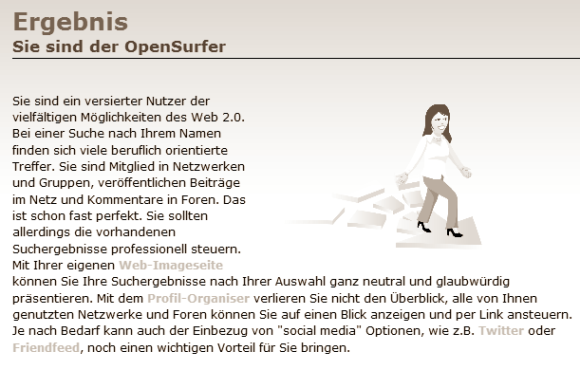
Am Wochenende erhielt ich nun die neuste Pressemitteilung von Dein Guter Ruf, die mir von meinem Ex-Kollegen Jannis Moutafis zugespielt wurde. Die Nachricht preist die ab sofort kostenlose Suche des (mir noch völlig unbekannten) Reputations-Dienstsleisters an, sowie die Option eine Web-Imageseite zu veröffentlichen. Als Gadget wird der Test „Welcher Online-Typ bin ich“ angeboten, der einem Tips zum persönlichen Reputation Management offeriert (mein Testergebnis siehe Bild).

Hintergrund des Tests: Der Profil Organiser wird hiermit promotet. Dort kann man seine Netzwerk-Profile eingeben und hat diese so im Schnellüberblick und -zugriff. Der vordergründige Vorteil der Übersichtlichkeit, läßt sich mit einem grundlegenden Tip entkräften…

Starte kein Profil in einem sozialen Netzwerk, wo Du nur einen kleinen Mehrwert siehst und evaluiere vorher, ob Du nur aus einer zeitweiligen Zugehörigkeit (Schule, Uni, etc.) oder aus zukünftiger Überlegung (Kontakte halten, Karrierebenefit, etc.) dieses nutzen wirst.

Die Dienstleistungen von Dein Guter Ruf erinnern mich dennoch stark an den Personal Web Manager, denn hier geht es offensichtlich wirklich um den strategischen Ansatz des Reputation Managements mit persönlicher PR-Betreuung. Man bietet vier verschiedene Versionen an: Basis-, Profi-, Premium- und VIP-Manager – von kostenlos bis 129,90 EUR pro Monat. Letztere verspricht sogar…

- Wir legen für Sie Profile in mit Ihnen abgestimmten Portalen an.
- Wir integrieren bereits vorhandene Inhalte in Foren, Blogs, Fachportalen.
- Wir prüfen monatlich Ihre Reputation und liefern für Sie geeignete Portal- und Themenvorschläge.
- Wir führen für Sie geeignete Online-PR Aktivitäten durch.

Insofern wirken die Preise vernünftig und erinnern an das Preismodell von Reputation Defender.

Kurztest: Dein Guter Ruf
Suche: Die Suche ist unbefriedigend. Bei 466.000 Googletreffern zu meinem Namen fand Dein Guter Ruf rund 70. Einige hatten überhaupt nichts mit mir zu tun. Zahlreiche positive, wie Interviews und Gastbeiträge von/mit mir, wurden gar nicht gefunden.
Image-Webseite: Ein Bild kann nicht gefunden, hochgeladen oder integriert werden (vielleicht in einer Bezahlversion?!). Der erste Eindruck eines Menschen zählt – und der Mensch verkauft sich in der Karrierebewerbung über ein persönliches Bild. Man verschickt ja auch keinen Lebenslauf ohne Foto.
Paid Services: Daß man für zahlreiche Funktionen (z.B. Kommentar eines Suchtreffers) im Web 2.0 Zeitlater bezahlen muß, ist irgendwie Web 1.0 Welt. Zumal my ON-ID hier schon diese Funktion ohne Aufpreis anbietet.
Fazit. Unspektakulär, nüchtern, sachlich, nicht personalisierbar – aber vielleicht ist die Form genau das, was zukünftig für das Personalwesen die nachhaltige Bewerbung ist. Wer weiß…

Spot On!
Neben my ON-ID macht sich mit Dein Guter Ruf ein weiterer Anbieter auf, unsere individuelle Online Reputation im Auge zu behalten und zu professionalisieren. Mein Urteil bleibt dennoch kritisch. Die Idee Reputation Management mit persönlicher PR-Strategie zu verknüpfen, gefällt mir gut (schon wegen seiner Nähe zu ‘meinem’ Personal Web Manager). Man müsste es fast einmal einem Test unterziehen, um zu sehen, wie erfolgreich sich die Arbeit für das Personal Branding zeigt (Erfahrungsberichte bitte an mich schicken). my ON-ID ist dennoch derzeit einen ganzen Schritt voraus und bietet die spannendere und zielgenauere Lösung das Online Reputation in der Spur zu halten. Reputation Management bleibt weiterhin aufwendig, vor allem zeitaufwendig, denn am besten wird sie derzeit noch von jedem Einzelnen kritisch beäugt, bewacht und bewertet.

Personal Branding – how to build your career 3.0

Personal branding is the way to stand out of the crowd and being noticed in some special way in the business world which makes you unique. It is your value proposition for the future of your career. In a session at the webinale09 I held a speech about ‘Career 3.0 – split between personal branding and productivity’ and gave some projections on the relevance of social media activities and how these affect your career development.

Today, we want to learn from Dwight Cribb, founder of his successful recruitment agency, what professional recruiters think about personal branding and what is the relevance for personal branding. You can follow his offline and online thoughts via his Twitter account.

Q: What is the first thing you do when somebody is being suggested as a perfect candidate?
Dwight Cribb Of course I will first probe what the relationship between the candidate and the person suggesting him is. Supposing that the recommendation is made during a phone conversation, I will in parallel check the candidate’s profile on Xing. If that does not provide the information I require I will probe deeper with people search engines.

Q: Let’s imagine somebody is not doing anything for personal branding. This person is not blogging, micro-blogging or social networking. Does this have a positive or negative impact on your perception of that person?
Dwight Cribb This largely depends on the type of position I am recruiting for, both in terms of seniority and discipline. I would normally expect someone in a directly client facing role or someone who communicates directly on behalf of a division or company to have at least some presence on the web. It is, however, true that not being on a social networking site is today more of statement than being on one. A few years ago one could be forgiven for thinking of people who had not yet discovered Xing, LinkedIn and facebook as being somewhat backward or conservative. As it is today largely impossible to not have noticed these networks flourish, we must assume that those not on them have shunned them on purpose. This may be a good strategy if one relies on others to communicate with clients and the public, especially as a senior manager. A C-Level executive will through his utterances on social networks have a severe impact on the brand communication, it thus needs to be 100% in line with the other communication, if not it will cause at best confusion and at worst it will undermine the credibility of the brand.

As for blogging, I think that is a very personal decision and I would never think badly of anyone who did not blog. I may, however, think badly of someone who blogs badly or in a manner inappropriate to his or her position. So overall it would not reflect badly if I found out nothing about a person online, it would just peak my interest and make me more curious to receive other information in the form of a CV or a recommendation from a third party.

Q: Will personal branding and the individual online reputation replace the traditional CV some day?
Dwight Cribb I doubt whether it will replace the CV, it is more likely that it will continue to augment the CV. Online reputation is a fantasy product. We each spin our profiles in a manner which we feel supports the image we want to convey. It is self marketing. A CV is more strongly based in chronological fact and provides a picture which comes closer to the reality than the pictures which get drawn in communities.

Q: If everybody has a strong personal brand, don’t companies fear these people could get chased by some competitor and recruiters? Or that employees just work for their own career purpose?
Dwight Cribb Most successful employees work for the own career advancement. But in the long term they will only achieve this by delivering results to their employers, because people are very good at spotting meaningless self marketing and will not fall for it for long. Good employees have always had a strong personal brand (also called reputation). It has been true in all areas and across the ages, if you do something well you will be admired by your peers and your reputation will spread. This means that others will try and employ your services, sometimes via a recruiter.

Q: What is your advice on how companies have to handle personal branding of the employees in the future?
Dwight Cribb Let people define themselves what they are comfortable with. Give them a clear guideline what company resources and what company information they can use to build their reputation and to what extent they must make clear what is their opinion what the company’s.

Q: What do you think of the personal web managers vision?
Dwight Cribb There are instances where this makes perfect sense, but I belive they are far and few between. This is a role which has precedence in the offline world, many high-profile business people, politicians and celebrities employ someone with this brief. Whether they do their job online, offline or in both really does not make much difference. We have come to expect that the picture we get presented of these people has been scripted and planned in detail. We even often admire the way in which they craftily manipulate their image. But I think we would be less inclined to condone or accept this level of abstraction in communication in our closer environment of colleagues, family and friends. A facebook status update from a friend loses relevance if I know that it was posted his or her personal web consultant, who was busy making them be liked by their friends and acquaintances.

Q: Give us 3 tips how to create a personal brand, please.
Dwight Cribb Be yourself, be honest, laugh at times.

Thank you for your time and your advice, Mr. Cribb.

Das erste Jahr – von Personal Branding und Produktivität

Geschafft! Das erste Jahr als aktiver ‘Social Median’ liegt hinter mir…

Lange habe ich überlegt, wie ich zum Geburtstag meines Blogs ‘The Strategy Web’ in die Retrospektive gehe. Die Ereignisse der letzten Tage haben mir die Entscheidung abgenommen. Es wird vorwiegend eine Zusammenfassung der letzten zwei Wochen, sozusagen exemplarisch zum Thema: Personal Branding und Produktivität.

Denn um diese Themen geht es meiner Meinung nach vorwiegend in dieser schönen Social Media Welt…

Ein paar statistische Werte des ersten Jahres…
- 486 Beiträge
- 280 Kommentare
- 1.600+ Twitter Follower
- 7.000 Unique User und 10.500 Page Impressions (Durchschnitt der letzten 6 Monate)
- tolle neue Kontakte weltweit, die das Blog mit wertvollem Feedback bedachten
…und ja, ich habe zahlreiche Stunden am Personal Branding in weiteren Social Networks (siehe Buttons unten) gearbeitet und bin noch lange nicht fertig, meine Digital DNA zu vollenden. Sprich… ob ich produktiv im Sinne eines ‘Social Median’ war? Sieht ganz so aus…

Gehen wir mal ein wenig auf die Ergebnisse ein…

Die Karriere 3.0 entscheidet sich im Web
So ähnlich wie die Überschrift klang auch mein Vortrag auf der Webinale im sagenumworbenen Telekom-Szeneladen 4010, die Anfang letzter Woche stattfand. Unter dem Titel ‘Karriere 3.0 – Spagat zwischen Personal Branding und Produktivität’ habe ich den Zuhörern meine Vision zukünftiger Karriereschritte im Web erläutert. Das ist ein Erfolg meines Blogs, denn ohne diese Arbeit, wäre ich bei der Webinale nicht aufgetreten.

Die aktuellen LinkedIn Nutzerdaten bestätigen meine dort vertretenen Ansichten: Social Network Profile werden verstärkt zu unsere digitalen Lebensläufe, die klassischen CVs verlieren an Wichtigkeit und Online Reputation bestimmt unsere Karriere 3.0. Beispielhaft sein hier Nutzerzahlen des ersten Quartals 2009 genannt: Bewerbungen auf LinkedIn gingen um 49% nach oben, ebenso die durchschnittliche Anzahl an Bewerbungen pro Stellenanzeige (43%). Zudem streben die User vermehrt nach Empfehlungen (Steigerung um 34%). Die Online Reputation bekommt zunehmend mehr Relevanz für die Arbeitswelt, wie Jobvite erst kürzlich in einer Studie berichtete.

Warum ist Personal Branding wichtig?
Firmen investieren Milliarden in Branding, um den USP, den Wiedererkennungswert und die Einzigartigkeit von Produkten und Services beim Konsumenten zu stärken. Der ‘Social Median’ wird sich zukünftig als Marke begreifen lernen und da ist die Notwendigkeit nicht fern, sich selbst aktiv in Position zu bringen. Er/Sie investiert zukünftig eben Zeit, in Profile auf Social Networks, ein eigenes Blog, einen ‘Micro-Blogging-Stream’, oder wo es auch immer Sinn macht.

Das alles kostet zwar fast kein Geld, aber Zeit – die wertvollste Resource unseres Jahrhunderts.

Dementsprechend wird der von mir propagierte Personal Web Manager zukünftig von großer Bedeutung für engagierte Manager 2.0 oder 3.0 werden. Sonst zahlt sich der Invest in das Personal Branding wohl nur schwer aus – und wie sich der Personal Web Manager finanziert, steht in meiner nachhaltigsten Vision aus meinem ersten Jahr als Blogger.

Zwei positive Wochen für mein Personal Branding
Zurück zur Webinale… Unmittelbar nach meinem Vortrag erschien ein Interview mit mir auf Sian-Ru Lai’s Blog von European Venture Fund GmbH, welches sich meiner privaten Personal Branding Orientierung widmet. Mit Sian habe ich zudem ein paar Worte zum Inhalt des Vortrags, Erfolgskriterien für Start-Ups und Web-Investoren gewechselt. Wenn mein geistiger Output unproduktiven Wert hat, werdet Ihr es mich wissen lassen, liebe ‘Follower’ – oder sagt man Leser oder Community-User?

Ebenfalls letzte Woche erschien auch ein Video-Interview mit mir – aber zu meinem alltäglichen Berufsfeld: Marketing, Sales und Medien. Vor ein paar Wochen habe ich den Web 2.0 Kongress in München besucht und dort zwischen interessanten Vorträgen, selbst initiierten Gesprächen z.B. mit John Della Volpe und einem mit mir geführten Interview ‘geswitcht’. Christian Schmitt von Media-Treff hat mich zu Marketingstrategien und Chancen im Marketing in der Krise vor die Kamera geholt. Das Ergebnis ist hoffentlich produktiv, aber meinem Personal Branding hat es geholfen. Im Sommer soll ein Webinar zum Thema Lead Generation folgen – zu Gunsten der Produktivität der Marketiers und Salesleiter.

Um meinen Input ins Web 2.0 und somit meine Online Reputation besser monitoren und aggregieren zu können, habe ich inzwischen auf Anregung von Mario Grobholz, Gründer von myON-ID, mein Profil dort mit dem Personal Branding meines Twitter-Account versehen. Auch dies hat Zeit gekostet – ebenso wie ein Interview auf dem myON-ID Blog. Ob das myON-ID Profil produktiv ist oder nicht, wird sich zeigen, wenn sich die Plattform als Web 2.0 ‘Reputation-Visitenkarte’ durchsetzt.

Beendet habe ich die zwei Wochen mit einem Gastbeitrag zum Thema Vermarktung von Social Networks: Social Medians müssen Zeichen setzen auf dem Social Media Vordenker-Blog von David Nelles und Nils Maier, letzterer hat interessanterweise sein Twitter Branding wiederum dem ihres Blogs angepasst.

Als Sales- und Marketingexperte frage ich mich immer noch, ob wir unsere Social Media Aktivitäten auch zukünftig für unseren ‘guten Ruf’ machen (müssen), oder ob ‘Social Medians’ ihre Online Reputation irgendwann mal nach meiner Idee oder einem ähnlichen Konzept monetarisieren werden, z.B. um den Personal Web Manager selbst bezahlen zu können.

Denn um Profit geht es in der Social Media Welt nicht. Eher darum, noch mehr Produktivität für ein optimaleres Personal Branding herauszuholen – ohne der Notwendigkeit eines 36 Stunden Tages.

Spot On!
Ein Jahr Personal Branding mit zahlreichem Output – daraus die letzten beiden Wochen exemplarisch. Produktiv für Euch? Für meine Zukunft…? In meinen Augen: Ja! Diverse Einladung zu Events, Workshops, Seminaren und Interviews haben mir dies gezeigt. Und Spaß gemacht hat es auf jeden Fall.

Und allen, die meinen Input oder Output schätzen, möchte ich hiermit für Euren Input und Output danken. Und freue mich auch weiterhin auf Euer Feedback hierzu…

Studies: Using social networking at work

We all use them, we all use them on a daily basis and who has had success getting engaged loves them: social networks. Now, Deloitte comes up with some interesting insight in the view CEO’s use social networking for their companies reputation. According to the third annual Deloitte LLP Ethics & Workplace survey, 60% of business executives believe they have a right to know how employees portray themselves and their organizations in online social networks. Yes, a lot of us know the importance of social networks on our business, … and for our personal branding today. But not all…

What strikes about the results is that only 17% of executives surveyed say they have programs in place to monitor. 55% of executives admitted that their companies do not have an official policy for social networks. 22% would like to use social networks, but don’t know how. Seems unbelievable but we all have to understand that the use and benefit of social networks might differ from industry sector to industry sector.

Having heard this in some conversations with companies in the last months, I tweeted the Intel social media guidelines for companies that have not yet seen an example of how to handle employees that engage in social media or social networking. It’s for those who ‘participate in social media on behalf of Intel to be trained, to understand and to follow these guidelines.’ And yes, this is a short and easy to read and understand version. The IBM guidelines read a bit more complex but should be understandable for every executive.

On the other hand the study shows that nearly half of the surveyed employees (49%) indicate concrete guidelines will not have any influence on their behavior online. And they disagree that the company should be looking in their social networking activities intensely (53%). Especially the young employees in companies between 18–34 years think employers should not be monitoring their online activity (63%).

Deloitte’s Sharon Allen, chairman of the board, makes clear that using social networks bears also a risk for employees and employers.

“While the decision to post videos, pictures, thoughts, experiences and observations is personal, a single act can create far reaching ethical consequences for individuals as well as employers. Therefore, it is important for executives to be mindful of the implications of this connected world and to elevate the discussion about the risks associated with it to the highest levels of leadership.”

Spot On!
Personal branding becomes more important for employees and goes hand-in-hand with companies having a close eye on it in the future. Especially from an human resources perspective as we could see this week in the research results by Jobvite. So, employees should be aware of the point that employers will be monitoring social networking activities in the future more than in the past. It seems that there is some valid reason for my personal web manager vision.

“One-third of employees surveyed never consider what their boss or customers might think before posting material online,” states Sharon Allen, chairman of the board, Deloitte LLP. “This fact alone reinforces how vulnerable brands are as a result of the increased use of social networks. As business leaders, it is critical that we continue to foster solid values-based cultures that encourage employees to behave ethically regardless of the venue.”

The US telephone survey was conducted by Opinion Research on behalf of Deloitte LLP among 2,008 employed adults (1,000 men and 1,008 women 18 years of age and older).

Online Reputation – Social Networking und Lebensläufe

Soziale Netzwerke haben unser Leben, und damit unsere klassischen Lebensläufe (CVs), revolutioniert. Was irgendwo digital in einem Netzwerk über das Leben einer Person geschrieben steht, ergibt ein komplexes und detailliertes Karrierebild einer Person. Und dieses Social Networking Auftreten kann so dienlich sein für die weitere Karriere…

Ob das Profil nun auf Linked, XING, Facebook, Twitter oder sonstigen Social Networks ist, immer wieder gibt es Einzelheiten der Persönlichkeit hinsichtlich des Werdegangs wieder – von Erfahrung und Wissensstand über Interessen und Fähigkeiten. Im privaten Netzwerk -egal ob digital oder offline- sind diese Daten nicht neu.

In der Berufswelt entscheiden diese Fakten zunehmend über die Karriere jedes Einzelnen. Manchmal stellt man sich die Frage, welche Relevanz klassische Lebenslauf-Formate überhaupt noch bei der Jobvergabe von gehobenen Positionen haben, oder ob die Betrachtung der Bestandteile einer Digitalen DNA durch Personalverantwortliche oder Personalberater nicht bereits mehr ins Gewicht fällt.

Alle Social Networks wollen bei der Registrierung so viel wie möglich über die Persönlichkeit erfahren… was natürlich später ‘public’ wird, sobald das Profil freigeschaltet wird. Und ‘public’ heißt, es geht ins Netz, ins Web und ist damit weltweit einsehbar. Eine große Chance, aber auch ein mögliches Karriere-Risiko…

So empfiehlt sich, und das sollte im Interesse eines jeden Menschen mit Social Media Profilen sein, bei diesen Profilen ein gutes Bild abzugeben. Mein Credo als Empfehlung lautet kurzgefasst…

“Bleibe die digitale Persönlichkeit, die Du auch in der realen Welt repräsentierst. Erfolgreich wirst Du Social Networks nutzen, wenn Du Deine Individualität in der vernetzten Kommunikation informativ, authentisch und qualifiziert abbildest.”

Detailliert lässt sich dieses Credo mit folgenden drei Tips zur Darstellung der eigenen Biographie in Social Networks zusammenfassen.

Wirke informativ.
Speziell bei Suchmaschinen und Twitter liegt die Würze in der Kürze. Man muss nicht unbedingt die komplette angebotenen Länge des Profiles ausnutzen (in Suchmaschinen werden die Profile als Suchergebnisse meist nur kurz angerissen). Je länger das Text-Profil, umso treffender sollten die Worte gewählt werden. Basisdaten müssen aussagekräftig sein. Was müssen die Leute über meine Person in diesem speziellen Social Network unbedingt wissen? Dann folgen persönliche USPs, mit denen sie sich von der Masse differenzieren, Interesse kreieren oder Besonderheiten fokussieren.

Spreche authentisch.
Wer sich online verstellt, sich in den Vordergrund stellt oder sich exponiert durch besondere Qualifikationen, muss den Beweis erbringen können. Beim ersten Offline-Meeting wird man sonst schnell entlarvt werden. Persönliche Qualifikationen, die aufgemacht sind, müssen bewiesen und erworben werden im realen Leben. Wer den Nachweis nicht erbringen kann, sollte nach dem Motto leben: Reden ist Silber, Schweigen ist Gold. Bei privaten Fotos hingegen ist generell vorsicht bei der Veröffentlichung geboten. Man kann inzwischen auch nach persönlichen Fotos im Web suchen, von denen man gar nicht weiß, daß sie dort existieren. Sehr interessant vor allem, wenn diese nicht authentisch sind…

Vernetze strategisch.
Qualität der Kontakte in Business-Netzwerken geht vor Quantität – es geht nicht darum, mit ‘Hinz und Kunz’ vernetzt zu sein, sondern mit Vordenkern, Meinungsführern, Querdenkern, Mitdenkern und natürlich (verantwortlichen) Kollegen. Nicht jedes Social Network adressiert denselben Typus an Leuten. Dementsprechend sollten die biographischen Details und auch die Status-Updates nicht 1-zu-1 in allen Networks inhaltlich gleich erscheinen. Eine mögliche Business-Strategie für die biographische Darstellung im sozialen Business-Web könnte sein: XING für die deutsche berufliche Reputation, LinkedIn für die internationale professionelle Reputation und Facebook für Bekannte, Freunde oder wertvolle internationale Business-Socializing Kontakte. Kontakte in verschiedenen Netzwerken zu segmentieren, erleichtert die Pflege und Organisation der Kontakte ungemein und macht die Notwendigkeit der biographischen Detailangaben bedeutend spannender und aussagekräftiger.

Innerhalb der Netzwerke gilt grundsätzlich die Prämisse: Wer, welche Daten einsehen kann, wird unbedingt über die Einstellungen festgelegt.

Spot On!
Die digitale Biographie ist ihr persönliches Kapital, ihr einzigartiges individuelles Wertversprechen für die Offlinewelt. Und es wird täglich für ihre Karriere wichtiger. Behandeln Sie sie auch entsprechend, vor allem im Social Networks. Mittels sozialer Netzwerke kann die individuelle Anerkennung als Experten eines Themenbereichs (z.B. in Gruppen) steigen, die Glaubwürdigkeit und das Selbstbewußtsein gestärkt werden, und letztendlich die Karriere ‘katalysiert’ werden. Neue Dienste wie KnowEm können übrigens bei der Registrierung und Organisation und my ON-ID beim Monitoring von Online Reputation hilfreich sein.

Je höher man die Karriereleiter aufsteigen will, umso besser sollte man seine Profile pflegen. Niemand weiß, welche Kontakte unter den Hunderten, die man hat, sich mal als neuer Arbeitgeber zeigen könnte. Manche Details des digitalen Lebenslaufes kann man positiv beeinflussen, manche nur bedingt – teilweise mit externer Hilfe von Institutionen wie ReputationDefender – oder zukünftig vielleicht mal dem Personal Web Manager.

Was ist Euer Credo? Was findet Ihr essentiell für eine Social Network Biographie? Freue ich auf Eure Kommentare.

PS: Der Artikel ist aufgrund meiner Teilnahme an der Panel-Diskussion ‘Persönlichkeit im Netz – Identität und Reputation’ auf dem Medientreffpunkt in Leipzig entstanden.

News Update – Best of the Day

If you have a vision for some trend or future business, it makes you happy to see that people pick up similar thoughts and spread them on the web. When I had the idea of creating the personal web manager, I thought this will be ‘utopia’. Now, Virgina Heffernan writes about the ‘necessity’ of Twitter and finalizes…

“I wish I was rich and had personal assistants.” Right on. And those assistants, presumably, could do our Twitterwork for us.

Thank you Virgina, this is just what I want to see. The New York Times blog supporting my vision… ace.

Internet Protocol TV (IP TV) is winning in recession times in the States. Sites like Hulu, iTunes, Amazon Video and TV.com are on the rise and changing the common world of the television industry. AdAge interviewed Verizon CMO John Stratton on the future of TV – and asking if IP TV is a threat for the old TV industry.

Will Internet users be paying for content in the future? Chris Poley throws in a thought that the web world will not touch – but definitely should focus on in the future.

“The economy has forced the Internet’s hand to act as a serious business, with all the responsibilities that go with success. For us as end users, it will take some getting used to, buying the milk when the cow was once free. But in these troubled times, we have little choice but to accept the inevitable. As President Obama’s chief of staff is credited with saying, “Never let a serious crisis go to waste.”

PS: This reminds me of my ‘The Social Globe‘ idea…

News Update – Best of the Day

Some month ago, I thought about combining social media and business, and concluded that the personal web manager might be a great solution for future business. But before you hire one, read in addition to this some valuable thoughts by Tinu AbayomiPaul on ‘How to Tell If Facebook Is Worthwhile For Your Business or a Waste of Time’.

Forrester published a new survey which claims that ‘Despite Recession, More Than 50% of Marketers Increase Spending on Social Media’, writes Sarah Perez. And if companies don’t know the value of social media, here is the Forrester recommendation: ‘…marketers start with a listening platform and then integrate social media marketing metrics like share of voice and engagement to demonstrate the value of these new tools’.

Yes, IBM does Social Media and there is some great backgound by Robin Fray Carey on ‘Employee-Centered Social Media’ and the idea of the corporate newsletter going social…

Social media IBM study jalam THE CORPORATE NEWSLETTER GOES SOCIAL: IBM AND EMPLOYEE-CENTERED SOCIAL MEDIA

Publish at Scribd or explore others: Academic Work Internet & Technolog social media

The business network netiquette

About four month ago, I wrote a post on the XING Netiquette which made its way to the XING experts blog. The reason was that some of my colleagues, relatives and friends realized the unfriendly and unprofessional style of communication with business contacts on business networks such as XING or LinkedIn. This was also some development that the XING expert experienced, Joachim Rumohr, who added the post to his professional blog. And, as this post was read very often in German, I decided to write also an English version about the topic: business network netiquette.

We all know from management trainings and media that the first impression counts to the highest degree. So, if we are reaching out for new contacts, or looking to kick off interesting partnerships, or just doing some ‘investigation’, we should all be aware of the actions and reactions this might cause.

Why? Every single web activity might affect our online (and offline) reputation. There are several people already focusing on this personal branding topic as a business model in terms of ‘creating’ books or blog posts, or reputation ID networks or they are just ‘visionering’ about this topic.

In terms of business networks such as XING or LinkedIn, the stumbling block is not the contacts that we are linked or connected with. Normally, people know how to behave and interact there as they know each other. It becomes more difficult when contacting an unknown business user in an online business network. In this case, it does not matter if you are contacting somebody or if some business person is addressing you. Although the networks advise with ‘FAQ’s’ and ‘Help’ sites on how to ‘meet online’ with somebody on a business level, these websites are quite often well-hidden and enlighten only some parts of this special topic called ‘netiquette’.

Let’s have a close look at some general principles which are definitely necessary and have to be taken into account when contacting somebody on LinkedIn or XING (or any other business network).

The business network netiquette

When you are contacting some business person…
a) Send a message: Be friendly. Keep your message short. Refer directly to your request.
Why are you approaching this special person? Be aware that the contacted person you are referring to might not have very much time for online networking – especially if this person has a high level of responsibility and credibility inside his company. Although all these people would love to have a personal web manager in order to spend more time for online networking, they actually don’t have any.

Be prepared to get some feedback. This feedback might be completely different from what you think and wish to achieve. Nevertheless, respond to this person no matter how the feedback ‘sounds’ in your ears.

b) Via direct connection: If you have had no contact before (online or offline), it is advisable not to contact these people directly without having addressed these people in an email, spoken on the phone or in persona before. Obviously not, when you are just a collector and hunter…

If you contact somebody, give this person the opportunity to communicate with you offline and online straight away. In some business networks you can also activate the contact details without being linked with somebody. Never stay incognito!

When you are being contacted…
a) Receive a message: In the ‘unlikely’ event of receiving an email with some business network member contacting you, this person definitely has a very serious and valid business reason to address you…. and it is you, you, you! If somebody has chosen to contact you (and no-one else!), this is an honor – please look upon this action favorably.

b) Via direct connection: If you had no contact at all before somebody is contacting you (offline or online), please evaluate whether you accept this contact. Having tones of contacts looks nice (as does having lot of followers on Twitter) but does it serve your purpose? Caring about all of your contacts is difficult and becomes unprofitable quite quickly.

If you think this person is beneficial (in private or for your job), then there is no reason not accepting this contact. Don’t be afraid of denying irrelevant contact offerings though. BUT: Definitely use the ‘Add’ or ‘Deny’ button and don’t leave this person desperately waiting for an answer in your folder ‘Inbox’ or ‘Contacts to Add’.

In any case, if somebody is getting in touch with you via business networks, it is an ‘unwritten’ duty to respond with an answer – no matter if long or short, positive or negative or if you have some business interest in this person. Even if this request is in your eyes uninteresting, boring or not fitting
your profile details. Everybody has deserved to get an answer.

Let’s take an example from the offline world… If an employee or some partner has a business idea that he wants to share with you, you are not just turning away, saying nothing, right? The same applies to the online world. And, premium-user do see and know more or less everything in business networks – also that you have been looking at the profile of the person that has send you a mail via the business network.

The above mentioned advice is also applicable for all group activity in business networks and for common email communication, too. Be friendly, offer the dialogue and be authentic.

Spot On!
Be the virtual person that you are in the offline world! This is the only way being authentic and successful. Contacts know easily by monitoring who you are, what you do and why you will be interesting – they might know your digital dna without even checking it for negative examples.

Always imagine you are joining a big business card party and you ignore somebody who might be introduced to you 5 minutes later. Remember… You always meet twice in life! In a digital networking world, when being a virtual person with a business network profile this might happen quicker than you maybe want it to happen…

News Update – Best of the Day

09.02.2009 von  
Kategorie Daily Top 3

- Das Business-Netzwerk LinkedIn hat seinen Einstieg in den deutschen Markt offiziell verkündet. Den Angriff auf XING startete Reid erstmal mit einer PR-Tour. Oliver Voss (Wirtschaftswoche) hat mit dem Gründer von LinkedIn Reid Hoffman ein Interview geführt. Darin sagt der LinkedIn Chef, warum es zwei Jahre dauern wird, bis XING die Folgen spürt und er gibt Tipps, wie Unternehmen durch die Krise kommen. Und Dorothee Fricke (Handelsblatt) gegenüber erklärt Reid im Interview, warum er gerne Barack Obama wäre.

- Es gibt viele Studien, die einem die Zukunft weisen. Manchmal muss man aber auch einfach mal seinem Bauchgefühl vertrauen. Das funktioniert nämlich. Glauben Sie nicht? Ist aber bewiesen. Lesen Sie selbst die Meldung zu einer Studie, die das Nature Neuroscience veröffentlicht hat.

“We may actually know more than we think we know in everyday situations, too,” said Ken Paller, professor of psychology at Northwestern University and co-researcher on the study. “Unconscious memory may come into play, for example, in recognizing the face of a perpetrator of a crime or the correct answer on a test. Or the choice from a horde of consumer products may be driven by memories that are quite alive on an unconscious level.”

- Der Tag wird kürzer, die Ablenkungen nehmen zu – ob technisches Spielzeug oder Internet- und Handykommunikation, ach ja und auf Business-Events und soziale Treffen sollte man auch nicht verzichten, usw. Wem das alles zuviel wird, schafft sich entweder seinen Personal Web Manager an oder orientiert sich an David Allens Buch Wie ich die Dinge geregelt kriege – Selbstmanagement im Alltag. Und wer sich das Buch gut einteilen will, der folgt Oliver Gassner, der das Buch in 14 Wochen als ‘Taktgeber’ und Art Moderator gemeinsam mit seinen Lesern durchgehen will. Interessanter Ansatz zur Leserbindung…

PS: Die BILD ist übrigens Online Milliardär

« Vorherige SeiteNächste Seite »