BrightEdge recently uncovered with a research project that social profiles of most leading brands don’t rank well in Google. Although many companies still invest a lot of their budgets in SEM/SEO activities, most of them forget to increase their social media presence from a search results perspective.
The research reviewed 200 of the world’s top brands for their social media presence. Most of the those brands, nearly 100%, stay on top or near the top ranks for their brand names on the SERP’s. However, a high percentage of 71% did not have their Facebook pages in the top 20 results. For Twitter it showed more or less the same result: 68% of the brands surveyed were not amoungst the top 20 results of the Google SERP’s.
“Brands today are pouring countless resources into social media channels and are creating great content that will help them engage with consumers, optimizing these for SEO purposes is a crucial way to drive exposure. Brands may be missing critical customer connection points if consumers can’t easily discover their social media pages in search.” Jim Yu, CEO, BrightEdge
Interestingly enough, there seems to be no necessary correlation between the number of friends and followers and SERP rankings according to the analysis of various social media pages that the BrightEdge surveyed. For example, the Facebook page of a leading photography brand did not perform in the top 20 search results, although more than 160,000 were fans of their Facebook page. On the other hand, a leading auto manufacturer with only 17,307 fans had a Facebook page that ranked in the top 10 of search results.
The least effective brands at optimizing Social Networking sites are coming from the finance and insurance sector. Only three of the top 43 companies had their Facebook pages rank in the top 20 search results. In comparison, retailers were much more successful: 13 out of the top 23 retailers surveyed were found in the top 20 search results.
Spot On!
Brands could argue it is more important to find your homepage or branded pages for products or services in the top search results. Social Media experts might see this different as some of the main brands invest a lot of their branding activities in the leading Social Media sites at the moment. Especially, under the aspect from last year’s report that some big brands reported to loose their traffic on corporate websites to Facebook, the search impact for brands might become more and more important in the future. Would you agree?
https://thestrategyweb.com/wp-content/uploads/2017/11/strategywebLogo-300x139.png00The Strategy Webhttps://thestrategyweb.com/wp-content/uploads/2017/11/strategywebLogo-300x139.pngThe Strategy Web2011-04-27 19:02:592011-04-27 19:02:59Study: 70% of Facebook and Twitter Pages from brands don't rank in Google
One thing leads to another. Today we could transfer this quote to: One search leads to another social activity, and vice versa. And this interconnection of web-strategy tactics amplifies the user’s purchase decisions.
A new study from GroupM and comScore states that 40% of consumers who search for products to purchase are taking a social activity as a next step to finalize their buying decision. And the activity can be seen from the other direction as well: 46% of consumers who use social media are searching for products to expand the basis on a product range to take a decision.
58% of users begin their journey to purchase with search. Company websites come in at 24% and social media by 18%. The opinion of “friends” on the purchase decision is highly rated in social networks and cannot be underestimated these days from brands and retailers any longer.
The study reveals interesting insights in the time period that make the essential change in the buying decision process. The “late kick” comes 30 days prior to purchase when brands and companies have to engage with their audience – and can leave search tactics behind. A difficult topic to handle in the B2C industry but for B2B very helpful.
“There are still many brands who haven’t figured out why they’re in social media. We still talk to brands that are trying to determine if they should be in social media. The data suggests the two most important subsets in social are user reviews and category blogs, rather than sites like Facebook, Twitter and YouTube.” Chris Copeland, CEO, GroupM Search
Some important findings on how social and search are linked together…
– 86% see search engines important in buying decisions – Consumers use search in buying cycle as a pricing tool (research products and select purchase location)
– 45% use search throughout the buying cycle
– 26% use search at the beginning of their research and shopping process
– Social is essential in the consideration process
– 30% use social media to create a shopping short-list
– 28% say social media has a valuable impact in creating awareness for brands and products
Spot On!
The study shows the impact that the combination of social and search have on the purchase decision. The challenge for companies will be to understand in which way to balance their tactics between search and social in reference to seasonal sales timing, marketing opportunities while not destroying maximum margin, and customer loyalty programs to amplify brand buzz. Another study by econsultancy also illustrates how undervalued social media and search are from a sales perspective. The study says that Social Media “gets eight times less credit for its direct contribution to sales than it should” and “Generic SEO gets credited for 14 times less sales than it deserves”.
What comes first when you take buying decisions? Search or Social? And how does it amplify your buying process? Interested in your thoughts…
https://thestrategyweb.com/wp-content/uploads/2017/11/strategywebLogo-300x139.png00The Strategy Webhttps://thestrategyweb.com/wp-content/uploads/2017/11/strategywebLogo-300x139.pngThe Strategy Web2011-03-03 00:42:562011-03-03 00:42:56Study: Search and Social amplify purchase decisions
When somebody used to work for Google there is a lot of knowedge to be shared. And I thought, I could learn more about SEO techniques and tactics. Vanessa Fox did work for Google (apart from inventing Webmaster Central), and so I thought, I need to read the book Marketing in the Age of Google. As a web-strategist I should know the secrets of ranking high on Google for my clients.
Getting Vanessa’s inside view on how Google and their search technology operates, gives an aggregated insight on the evolution of search topics. It is saving time and presumingly more efficient than following or reading many SEO experts thoughts. And then let’s help clients to optimize their site fropm a SEO point of view.
To write a review is a challenge. As I follow some of the most interesting SEO cracks, I knew some content topics already. But there is much more quality thoughts and knowledge in it that makes the book worth reading. If companies want to optimize their top rankings, the book offers good tactical approaches and a clear structure how to start and evolve your content strategy as well as how to conquer the top positions in Google.
Having said this, the book is based on the theory of having a web-strategy in place that is aligned to the company’s business strategy. If your company has the consumer approach understanding the needs, desires and motivation why consumers go online to evaluate products and services, then the book is a must read.
The way people used search engines has changed in the last years as the web has become mature from an information platform to a consumer generated content base. It is not about what the company spreads but what the users are looking for and the content they share and create. People hear something about a person, a brand or a campaign and instandly start going to search for more information. Not seldomly they are finding consumer input. And often the initial search entry point starts with offline marketing, PR or customer service conversation – in print ads, TV commercials or an wallpapers.
Business that know how to connect offline and online efforts will succeed in the future. Happy that this was my main claim when I started this blog and thus gets now backed up by a Google specialist… Thanks Vanessa!
Spot On!
The amount of input the book Marketing in the Age of Google offers is probably only handable for a SEO specialist. And this person has to have the buy in from the C-level to manage the online strategy accordingly. A lot of the strategy is based on content creation and content framework which is a PR, marketing, HR, R&D and Customer Service topic in the future in my eyes. These departments need to learn how to place content effectively in the search world. It will affect the way peope perceive the business strategy of a company and the way the companies and brands interact with their clients, partners and employees. What I missed was the effect taxonomies and social tagging might have on search in the future but maybe this comes with the next update.
https://thestrategyweb.com/wp-content/uploads/2017/11/strategywebLogo-300x139.png00The Strategy Webhttps://thestrategyweb.com/wp-content/uploads/2017/11/strategywebLogo-300x139.pngThe Strategy Web2010-11-19 09:59:462018-01-26 11:56:38Book Review – Marketing in the Age of Google
The search engine for the future is Facebook. Or let’s say social media. Sanjay Metha discusses “What is a search engine? and comes to an easy result: From a users perspective it is a platform where I can quickly get relevant results for whatever I am looking for. And his result is that social media owns the future as our friends offer more relevanceto our questions…
A luxury hotel in Mykonos has used social media for a campaign which was designed to work according to the organization’s objectives. Dimitris Zotos shares with us the actions and the goals of a real life example that can help us understand how social media can be used in order to promote a brand.
CWS knows how to kill a perfect night for chic and glamour girls. They say no to drugs! Funny commercial…
https://thestrategyweb.com/wp-content/uploads/2017/11/strategywebLogo-300x139.png00The Strategy Webhttps://thestrategyweb.com/wp-content/uploads/2017/11/strategywebLogo-300x139.pngThe Strategy Web2010-09-06 07:41:482018-01-26 11:58:37News Update – Best of the Day
Can social media have a psychological influence on your customers? According to Dr. Rachna Jain it can if we see it from a perspective of spreading content the viral way. This, she shows seven strategies companies can employ to help their content succeed.
Ever wondered how search results (SEO) and your input in the social web support your web-strategy? Adam Singer explains 10 reasons why social should enforce your future SEO strategy… and he underlines his theory with a nice and convincing graphic.
Twitter is on an all-time high at the moment. Nobody can see the end of this hype. But don’t forget that Twitter is not everything in your life, your content strategy, and for your web-strategy. Lean back and enjoy a collection of 40 funny Twitter comics that Yogesh Mankani collected. My favorite is this one as it tells us not to mix up offline and online situations. The Cluetrain manifest should not get access to your personal life…
https://thestrategyweb.com/wp-content/uploads/2017/11/strategywebLogo-300x139.png00The Strategy Webhttps://thestrategyweb.com/wp-content/uploads/2017/11/strategywebLogo-300x139.pngThe Strategy Web2010-05-11 09:24:442018-01-26 12:00:31News Update – Best of the Day
In the last four weeks, some of the users of The Strategy Web might have seen a small icon on the right hand side of my blog called ‘SocialSpace’. You might have wondered what it is. Or how to use it. Here comes the answer. Now, that the team around the eblizz founders, Jeanette Okwu and Martin Wawrusch, has completed the integration of the social software tool, I will introduce you to a technology that I would call the next social shopping extension for future business.
Social networks are on an all-time high. Corporate websites and shops loose out on traffic and referential linking as people start talking, connecting and linking via social networks like Facebook, Twitter or other social networks. SEO doesn’t work here as closed front doors don’t allow access for SEO tactics. And with the massive rise of social networks, especially Facebook, the question comes up how to bridge the lack of a connection between social networks and homepages or shops.
eblizz offers this solution. It brings social networks and brands together. In a way that social Networks become an integral part of brand websites – be it homepages, shops or blogs. For now, eblizz starts with Facebook – but Martin told me, other networks will follow.
With eblizz users can interact with their social networks without leaving branded sites. Content can be shared with friends on Facebook. Users can immediately comment from the website they are on. Or store products visually in ‘The Shoebox’ and keep it for later purpose or use. Content can be, or as eblizz calls it, has to be ‘liberated’
What is the benefit of eblizz? Business perspective Think about it. Prosumers create masses of content on the social web. Consuming that content, prosumers realize that brands become more and more exchangable. This causes problems for companies. They need to increase efforts to make their brand get heard. So ideally, companies make use of recommendation marketing to use the buzz of their brand fans.
User perspective Consumers often find things like nice products in online-shops. Or great music. Or funny videos. Or great pictures. And they want to recommend this to friends they are connected with on social networks. Today, it is impossible to take your friends from homepage to homepage, and easily share that content via a social network with one click.
Imagine your Facebook friends follow you from website to website. And, when you want to recommend something to them, you don’t have to change browser windows. You don’t have to cut-and-paste content. You just drag and drop it to the relevant person. Watch the short explanation and tell me if this isn’t really cool…
Companies pay a fee to get their websites eblizzed – no matter if it is a shop, a homepage or a blog. Their sites will be defragmented like a cake. This makes it easy for prosumers to share and recommend relevant pieces of content of a website: videos, links, pictures, etc.
Once a site is eblizzed, users find a button called SocialSpace – the button I started talking about at the beginning. The user logs in with on the question-marked face with their social network account. The SocialSpace opens up in a small picture on the website they are on. The users see their profile, the friends and updates immediately. They can also search for friends. And, they can immediately interact with their social network friends.
Users can even ‘bookmark’ interesting content in their Shoe-Box. The Shoe-Box is a place for personal content belongings. Here the users keep very special things in their SocialSpace. Maybe to recomment or remember a product or present for a Christmas or birthday in the future.
eblizz offers a next generation website customer service. eblizz integrates social network interaction in companies websites. And eblizz will become the driver of social commerce efforts by enabling engagement and brand buzz.
“Prosumers” create masses of content on the internet, including blog posts, product reviews and ratings. Producing all that content, prosumers begin to blur the lines between brands, making them more interchangeable. Not good for individual brands. That’s why companies need to increase efforts to distinguish their brand from all the rest. One way is to capitalize on “recommendation marketing” — build the buzz created by their brand fans. eblizz can help.
And here is how it works…
Consumers often discover products that they love online. And great music, funny videos and awesome pictures. They want to recommend them to their social-network friends. Today, it is impossible to take social-network friends from homepage to homepage, and easily share that content via a social network with one click. This is a universal social web problem!
So, imagine your Facebook friends follow you from website to website. And, when you want to recommend something to them, you don’t have to change browser windows. You don’t have to cut-and-paste content. You just drag and drop it to the relevant person.
eblizz was created to make things easier for anyone who wants to recommend content, product and services to any or all of their social-network friends. Websites and blogs sign up to get “eblizzed”. The fee seems very reasonable. Once a site is eblizzed, a button appears on the site’s homepage called “SocialSpace.” When a user logs in with their social network account information, Facebook for example, the SocialSpace opens up into a small picture that displays the user’s Facebook profile, Facebook friends (and their pictures!) and updates that are happening on facebook right from the website the user is on. The user can then drag and drop anything from the website right onto the Facebook page of any or all of their Facebook friends.
The user can also ‘bookmark’ interesting content from the website by dragging into their “ShoeBox.” This content stays in the Shoe Box for the user’s later use, can be edited and also shared.
Spot On!
So for me, the reason for a website to get “eblizzed” is simple. eblizz integrates social network interaction for all the users who visit a website, making it easy for them to recommend and share the website’s content. That’s how eblizz helps companies distinguish their brands. What is your take on it? Maybe you want to test it with my eblizz SocialSpace button? Drag and drop me your best videos on advertisement, funny pictures, shopping tips or cool texts. Looking forward to it!
And sure, let me know what you think about eblizz…
https://thestrategyweb.com/wp-content/uploads/2017/11/strategywebLogo-300x139.png00The Strategy Webhttps://thestrategyweb.com/wp-content/uploads/2017/11/strategywebLogo-300x139.pngThe Strategy Web2010-03-29 08:14:002018-01-26 12:07:20eblizz – the next social shopping extension
A recent study by Irbtrax, a SEO Internet Marketing firm, tries to determine which platform is the best fit for a particular business application or niche. So, the results of the study is not saying the one or the other is better, but the results give some good basic orientation for marketeers.
Category 1: Traffic ranking and user metrics
Traffic Ranking US and Global traffic ranking:
Facebook 2 – 7 day average daily time on site by users: 32.2 minutes
Twitter 12 – 7 day average daily time on site by users: 7.8 minutes
Facebook has the lead due to its sheer size, traffic volume, and time on site.
Category 2: Online destination for potential clients in the B2C market
Facebook offers more potential as of the option to include photos, detailed information, multiple outbound links, videos, and other business to consumer apps. The study states it is easier to build a larger network of followers in the shortest amount of time to help market a consumer product or service.
Category 3: Online destination for potential clients in the B2B market
The advantage is on Twitter as it provides more viral marketing flexibility while requiring less followers. Viral Marketing is a core business to business social media application for service recognition and other benefits. Popular industry related tweets are redistributed creating a domino effect even if you don’t have thousands of followers.
Category 4: market research benefits
Again Twitter shows more potential. Its search features can be efficiently used to monitor what people are saying about a company, service, product and competitors. Increasing or declining trends can be tracked effectively as well.
Category 5: internal viral marketing benefits
Facebook is top as it’s much easier to build a larger following. Plus, Facebook ‘wall’ feature is much more interactive than Twitter’s internal communication features.
Category 6: external viral marketing benefits
Twitter offers a greater external internet reach – no front door. Google’s ‘Real Time’ search feature often streams live tweets. A comparison of the number of tweets an independent article/release receives verse the number times they are shared by Facebook accounts appears to strongly favor Twitter.
Category 7: Use of each platform for direct internet communication
Facebook offers an instant message feature which allows you to communicate with other users globally.
Spot On!
The study concludes that in order to maximize your social media marketing results companies ideally create a presence on both. And I am happy that a study mentions this: Which platform a company engages first, or where to spend the most amount of available time or budget depends on your customers!!! Businesses should be checking their web-analytic metrics to apply the findings to your target group, and evaluate the potential and strengths of each platform.
How can you find a lot of users for your business blog?
Is there a secret, why corporate blogs and business blogs have more success than traditional corporate websites? Is it the modern architecture of blogging systems? Is it the exiting and exhilarant spelling style of bloggers? Or is a conspiracy of the digital natives against the internet retirees?
Nothing of it! Blogs and bloggers are simply using some very effective methods to attract visitors.
The 10 most important visitor resources for blogs:
Feeds – Blogs are read via feed reader predominantly, not via browsers any longer. Well-known blogs have more than 100.000 feed reader per day. On a normal day in Germany, there are some blogs with more than 10.000 feed reader. Highlight your RSS feed on your blog and take advantage of a feed service like Feedburner
Google – Visitors through search engines are the second largest visitor group of blogs. Bloggers use always methods of search engine optimization (SEO) in order to achieve good rankings with important key words. Write in a search engine friendly way. Use Google’s Webmaster Tools and install a SEO plug-in like wpSEO!
Pingbacks and Trackbacks – Links don’t just offer a value-add for your own users but also backlinks and numerous new users. Link all directions as often as possible and learn to use trackbacks in a proper way.
Twitter – with the micro-blogging service you can approach users faster than with your blog. News with real add-on information are spread via Twitter the “viral” way very fast. Work on broadening your Twitter follower base. Promote your Twitter account on your blog and vice versa. Twitter your blog postings at the right time!
Social Networks – Promote your important blog postings on XING, Facebook or LinkedIn.
Forums – Are you an accredited expert, for example a wine blogger? If you see in a forum the question: What are the most expensive wines or the 10 most dry French ones? Write a posting on your blog and post only the link in the forum.
Blog directors and RSS feed directories – Just some selected directories (Technorati, Blogoscoop, Bloggerei, Wikio) generate new visitors. Especially, if you are ranking well in these directories.
Your comments on other blogs – Make yourself heard on other blogs as a constructive business partner – far and foremost in not well-known blogs. This will result in new visitors. Beware the free of sense comments! This will damage your own blog reputation in the long term.
Comments of others on your blog – This is the secret of well-visited blogs: Be responsive to comments – You will win permanent visitors!
Guest writers – Invite readers/users, other bloggers or “VIP’s” from the offline and online world to write guest posts. Every guest author will be talking to others about it or link directly to this post. Your creativity has no limits: travel agents blog about journeys of their customers, hotel managers animate guests to write about their vacation resort, … Your customers don’t want that? Ask them if they want to publish some of their holiday pictures on your homepage! You will be surprised seeing the reaction…
Did I forget something? Is your ranking of visitor resources different? Where do you see options to attract more visitors for your blog? Looking forward reading your comments and reading your ideas and thoughts!
Guest writer Karl-Heinz Wenzlaff is the German expert and consultant for business blogging. He knows the useful tips and tricks, and is specialized on professional company blogs, product blogs or employee blogs. Some month ago, he helped me migrating from Blogger to WordPress in order to set up a magazine theme.
Thank you for being one of my guest writers, Karl-Heinz.
https://thestrategyweb.com/wp-content/uploads/2017/11/strategywebLogo-300x139.png00The Strategy Webhttps://thestrategyweb.com/wp-content/uploads/2017/11/strategywebLogo-300x139.pngThe Strategy Web2009-07-10 08:37:152018-01-26 12:16:41How to attract more visitors – The 10 most important visitor resources for blogs
Sometimes you read a study and think: “Ah, this is interesting information”. So, you write about it in a News Update.
And then, you stumble upon it again, and think twice about the research. This happened to me with the ‘Ad Effectiveness study’ conducted by Forbes. And browsing through it again, my feeling was that the title of this eMarketer article reflected the result, but the study itself mixes apples and eggs in some way…
Still, the main statement of the study remains an important trend in online marketing, and is an even more important praise for the work of online publishers (yes, probably a bit self-referential for Forbes).
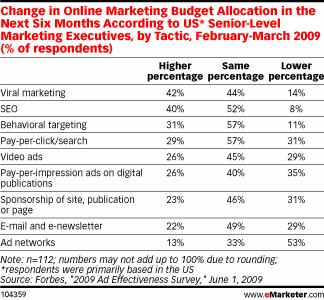
“Respondents were by far the least happy with ad networks, with half saying that the results did not meet expectations” (…) “Ad network spending is all about demand fulfillment while direct-to-publisher display is much aligned with the traditional advertising goals of demand creation,” said Forbes.com president and CEO Jim Spanfeller.
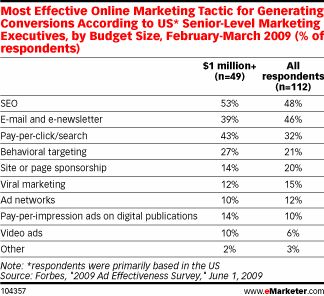
However, it has to be said that ‘ad networks’ is not a tactic for generating conversion. It is a supplier that offers ‘cheap space’ by bundling platforms into offers in most cases. Platform owners have a much deeper understanding of their target group and can definitely do a better consulting in terms of converting their target group into potentials for their clients. Absolutely, I agree with that statement, having done this for years…
BUT: Taking my view on the study, the set up of the study is in some way irritating. When the marketing executives were asked on budget allocations the results were these…
…and what they see as most effective tactics for generating conversion? Site or page sponsorship and SEO were considered the most effective ways online.
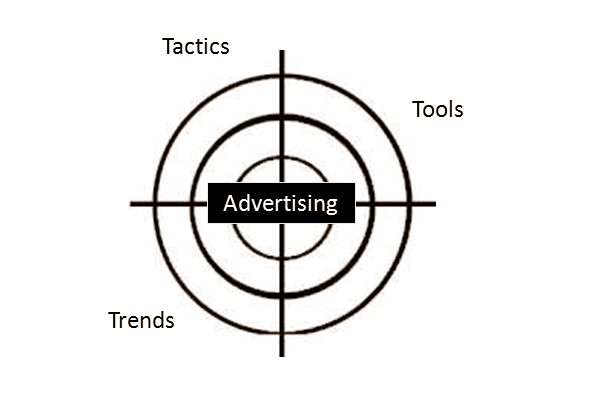
Thinking about the answering options (and bearing in mind my brand theme ‘tools, tactics, trends’) that were given to the responding marketers though, these options need to be separated from each other…
The question, I was asking myself is… Is viral marketing really an ad tactic? In my eyes it is not. It is a strategic communication tactic which integrates viral ads as some relevant online marketing tool.
So, this study set up seems to be a comparison of apple and eggs. Viral marketing is done in social networks. It is the way in which brand awareness other marketing objectives can be increased. Viral ads is the tool that may be spread like a computer virus by the users. It cannot be influenced like banner or text ads. Nor can it be bought. So, it is a modern marketing trend with little historical definition or proven success.
And, maybe such a study should think about: What can be bought by marketers, and what cannot in our times of social media.
Spot on!
The following summary is meant to make clear what steps have to be done first by marketers to create the conversation results their bosses appreciate… and it is a guideline for the chronology of setting up an online marketing strategy.
1.) Tactics
At first, marketers have to think about the tactics they can choose from…
SEO, e-mail and e-newsletter, site and page sponsorship, corporate web TV or viral marketing.
2.) Tools
Then, they have to decide on the tools that can be used to make these tactics efficient… good texts (I am missing this most interesting option), banners, or viral ads.
3.) Trends
And finally, we have options that might create powerful conversion…
The use of ad networks, behavioral targeting and pay per ‘x’ models (x=impression, unique user, sales, click etc.)
If the online industry continues to publish studies that mix apples and eggs, it is no wonder that 57% of respondents said they still spend less than 25% of their marketing budgets online.
It is still early days in online marketing, it seems…
https://thestrategyweb.com/wp-content/uploads/2017/11/strategywebLogo-300x139.png00The Strategy Webhttps://thestrategyweb.com/wp-content/uploads/2017/11/strategywebLogo-300x139.pngThe Strategy Web2009-04-16 00:51:082018-01-26 12:17:33News Update – Best of the Day

 BrightEdge recently uncovered with a research project that social profiles of most leading brands don’t rank well in Google. Although many companies still invest a lot of their budgets in SEM/SEO activities, most of them forget to increase their social media presence from a search results perspective.
 One thing leads to another. Today we could transfer this quote to: One search leads to another social activity, and vice versa. And this interconnection of web-strategy tactics amplifies the user’s purchase decisions.