Study: Social Business is critical to future success
30.06.2011 von Martin Meyer-Gossner
Kategorie: CEO, English Content, Featured Stories
Jive Software recently published a study that unveils how social software is increasingly perceived as a strategic executive imperative in the enterprise. Surprise? No. Jive is a provider of social business technology and commissioned the study, which was conducted by Penn Schoen Berland and asked 902 U.S.-based knowledge workers.
The three key finding can be summarized as…
- Social strategy will be critical to the future success of businesses.
- App Stores are gaining traction in the enterprise
- Email usage is growing but is not solving communication challenges in the enterprise
So, what are essential facts from the study…?
Enthusiasm for social software in enterprise is high according to the study. 96% stated that social software adds value to at least one key performance indicator with 67% claiming it would improve customer engagement. 57% even believing it would increase sales or revenue. Two-thirds (66%) of executives responded social software represents a fundamental shift in how companies work and engage with customers.
However, only 17% of the same executives reported being ahead of the curve in this area. So, obviously web business strategy is not where executives think corporate culture should be. And that is although 83% of executives leverage at least one social network for work use.
Reference marketing is becoming essential and social software will play a big role in the future of purchase decisions. 54% of millennials said that they are more likely to rely on and make purchase decisions from information shared via personal contacts in online communities versus 33% more likely to use information from “official” company sources.
Obviously the study also finds that mobile is growing. App stores are gaining tracion in the enterprise and 74% of executives are indicating interest. The reason i salso mentioned in the study. 92% of executives and 82% of millennials believe that work-related web-based apps greatly or somewhat increased their productivity.
As a final finding, the study states the growing use of email which the bloggosphere is evaluating as a weak collaboration tool for a while. The study agrees here. 89% of executives, 88% of millennials and 76% of general knowledge workers believe that they and their teams would be more productive if they could dramatically reduce the time spent writing and reading emails. Seventy-three percent of executives, 73 percent of millennials and 64 percent of general knowledge workers agree that social platforms will fundamentally change the way people share, connect and learn at work and with companies.
Spot On!
The study obviously favors the benefits of social software (it is a Jive USP). Some weeks ago, an IBM study took a step ahead and looked at the way executives have to challenge SocialCRM in the future and what their main fields of activity are at the moment.

So, if knowledge management in companies via social software is seen to have client engagement potential to improve business objectives, executives should have a close look at the following numbers and think about how (and how long to wait) to implement social software in their business processes: 73% of execs and millennials and 64% of general knowledge workers agree that social platforms will fundamentally change the way people share, connect and learn at work and with companies.
SEO study: Measurable results are key, but without strategy…
30.06.2011 von Martin Meyer-Gossner
Kategorie: English Content, Featured Stories, SEO
Would you like to know what tactics B2B and B2C marketers use to achieve a powerful Search Engine Optimization (SEO) strategy? Well, then you should read the latest MarketingSherpa „2012 Search Marketing Benchmark Report – SEO Edition“. But only if you have time to read a 202-page paper. If not, find the latest insights in brief on SEO habits and effectiveness according to more than 1.500 respondents.
Although SEO is one of the main topics in meetings with clients these days, marketing decision makers tend to ignore the strategic approach. The study shows the discrepancy between what marketers want and are willing to invest…
- Developing a SEO strategy is a top challenge but ranks as bottom objective
- Organic SEO via Content creation is a winner but costs many resources
- Established SEO processes generate future investments in SEO
- Incremental SEO improvements add up to large profits
- Local business listings tactics are underutilized
Many organisations are not challenging a strategic plan. The tactical approach still rules the daily business with clear focus on fast tactical objective turnarounds (i.e. leveraging website traffic, lead generation and measurable ROI). Understanding and evaluating digital assets from a SEO point of view is still not a strategic topic in businesses. Only 27% of companies surveyed responded they consider planning an effective SEO strategy an important objective.
However, companies put massive importance on measurable results. The study claims the benefit of Inbound Marketing by some helpful numbers…
- Use Social Media – Revenue goes up 114% and Leads 30%
- Find and test niche content: Organic traffic increased by 40%
- Revamp and optimize web content – Doubles lead conversions
The graphic below illustrates the value if various tactics and how to position them for your strategic efforts.

Spot On!
The above numbers sound as if SEO needs to become a strategic focus of your web strategy – and yes, it should. However, content marketing as an inbound marketing tactic stays a challenge for marketers, especially if it shall be authentic, story-telling and benefitial for users. No wonder it is one of the most difficult processes. BUT it is still considered to gain best returns. Nevertheless, the best SEO strategy needs to have the right approach from data capture to generating leads through to good landing pages, leverage mobile and finally do lead nurturing. And it needs to take into account the right follow up process from customer service and sales to complete a SEO strategy.
Google Plus – When the leaders chase the leader’s strategy…
29.06.2011 von Martin Meyer-Gossner
Kategorie: English Content, Web Strategy
As Facebook and Twitter are becoming stronger and stronger, the search giant Google had to do something about it. Especially, after Google Buzz did not really take off. Google more or less had to announce some new social networking tool as a leading technology company.

Now the baby is born. It is called Google Plus… So we are going from Google Buzz to Google Plus. Sounds similar, doesn’t it? However, it isn’t…
With Google Plus the brand wants to “make sharing on the web more like sharing in real life”. A video explains how Google Plus works and you can decide if this is for the classic user, or just for the advanced web nerds…
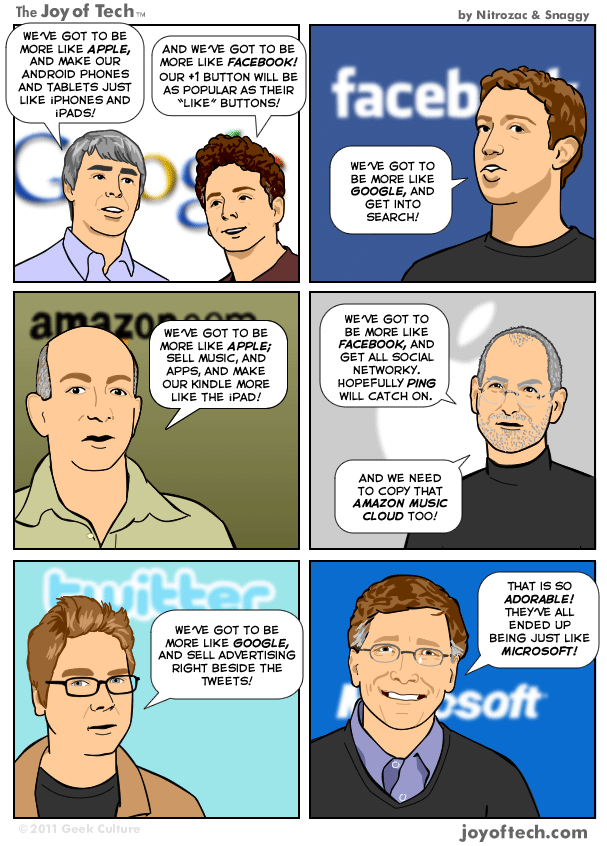
This example illustrates how leading tech brands are challenging the success of other leaders from leading tech companies. It looks as if they cannot afford to miss out on a leading trend, need to start and copy, and then create their own “Me too” product or solution. However, the challenge is to create the simplicity, design, user friendliness and fascination around that new platform. And if a companies strength is technology and development of software, then it will become difficult to challenge a leader’s strategy that relies on the ease of human behavior, their conversations and interactions… and vice versa.
Still, they all do…
Spot On!
Google Plus offers a bundle of exciting and interesting features that other platforms don’t have in that evolved technological perfection (yet). The technology is good, no doubt. It has great functionality. OK. However, the question will remain if it will become a killer for Facebook as another challenging social network platform? Google’s leaders will definitely chase the strategy and tactical efforts of the Facebook & Co. to be part of the social networking game in the future. Nevertheless Bruce Lee once said: “Simplicity is the key to brilliance”. From a strategic business perspective, I would add: If simplicity of a Me Too product cannot trump the leader, ask yourself if the users will benefit from it. For Google Plus, I personally doubt it…
News Update – Best of the Day
28.06.2011 von Martin Meyer-Gossner
Kategorie: Daily Top 3
Does social media activity during work distract employees from productivity? Shel Holtz knows why blocking social networking (48% of companies still prevent people from using Facebook and Twitter at work), is less distractive than email processing and switching windows (for further reading have a look at Social Engagement & Jobs). He quotes that email or answering a cell phone call account for 83% of in-meeting interruptions which I think is even worth, when you see people in meetings being engaged on their iPhones and Blackberries.
“There are issues with the study as well, which reports that the hour spent each day on distractions accounts for “$10,375 of wasted productivity per person annually,” which translates to $10 million per year for a 1,000-employee company. (…) It’s worth noting that today’s productivity levels are considerably higher, and that studies like the one from the University of Melbourne prove that unobtrusive breaks increase productivity by up to 9%.”
In the last three years, I have told many managers why productivity won’t get lost if employees use the Social Web during work. Just think about how much loss in productivity you have with Football World Cups, people smoking or chating during work. Well, I would rather prefer finding the eager Gen Y and Z generation, and having them engaged as brandvangelists in conversations…
Ever thought about the value of a fan? Of course you have as your bosses want toknow what ROI metrics your Facebook brings to the retail activities your business is engaged in. A study by Hitwise tells us…“1 Facebook fan = 20 additional visits to your website over the course of one year”. What sounds good for retailers, still does not mean that all Facebook Fanpage sites can rely and profit like those companies covered by the study. It is important to understand the metrics behind the figures, so you better read carefully before you start spending on advertising straight away…
If you think wireless technology is critical to our health, while music is good, then watch out for The Human Jukebox by Pause in Stockholm. No pain, no gain? Or just a great idea…?
Update 2011: Social Media Revolution Version 3
27.06.2011 von Martin Meyer-Gossner
Kategorie: Daily Top 3
It has become a classic for all social web evangelists in the last three years. Now, we have version number 3. I am talking about the videos called Social Media Revolution (versions number 2is here). Those videos that tell us the story how the social web changes and takes over our offline world. If you believe it or not…
Last week, I have written about how fast the social web is changing the world in only 60 seconds. With this video we get some more data. And again, I will be raising the question if we understand the challenge of reading infographics properly from a business perspective. However, I am sure I will see this video again in many presentations in the next months.
This latest version contains the data and statistics as of June 2011. All Social Media Revolution videos were created by Eric Qualman from Socialnomics.
What happens in 60 seconds on the Social Web? A comparison and the value of “infographics”…
20.06.2011 von Martin Meyer-Gossner
Kategorie: English Content, Featured Stories, Web Marketing
There are different ways to illustrate how fast the Social Web is growing these days. For two years my favorite “real-time” resource -based on studies and research data- was Gary Hayes Social Media Count. And I am sure, you have all seen this great little widget already…
However, we also have to keep up with the pace and realize that -although people already hate them- infographics are sometimes a nice way to grab facts quick and easy. The Shanghai Web Designers created an infographic which illustrates how fast conversations, comments and content are produced on social networking and online platforms in only 60 seconds.

Infographic by- Shanghai Web Designers
Now, although I honor the work of the Shanghai Web Designers, it lacks some information on where the data was generated from. Gary Hayes explains nicely how the app data was put together and how actual it is (having said that I think Gary needs to refresh his links as I found links ending in 404′s).
A comparison could be interesting, I thought. Why not compare the 60 seconds data from the Shanghai Web Designers (SWD) versus a “one-minute-momentum” of Gary Hayes (GH) counter…? I started the counter and waited 60 seconds, and there you go. Here are the results…

The comparison will just focus on the essentials Google, Email, Facebook, Twitter and Youtube. You can still do your own comparison afterwards…
Google
Search queries: 694,445 (SWD) versus 1,393,519 (GH)
Emails
Emails sent: 168,000,000 (SWD) versus 204,255,455 (GH)
Facebook
Status Updates: 695,000 (SWD) versus 696,758 (GH)
Comments: 510,040 (SWD) versus 512,100 (GH)
Twitter
New accounts: 320 (SWD) versus 208 (GH)
Tweets published: 98,000 (SWD) versus 62,707 (GH)
YouTube
Hours of content uploaded: 25+ hours (SWD) verus 36 hours (GH)
LinkedIn
New members: 100 (SWD) versus 60 (GH)
Spot On!
The comparison makes clear that the Facebook figures are similar whereas for the rest of the figures there is a massive discrepancy in numbers. Facebook is sharing their latest actual figures, for the other technology platforms the data probably comes from third party sources (or at least as far as I can see). If all platform and technology owners would share their latest data, those discrepancies won’t happen. The lack of source information from Shanghai Web Designers makes it difficult to argue which data is the latest, where the differences in the comparison are coming from, and so on. Maybe this is the reason why some experts don’t like infographics any more. “Don’t like…” might be wrong when I see how many people have shared the infographic in the last days. They appear very nice and compelling in social networking accounts and “illustrate” thought-leadership in presentations. Right…?!
82% of word of mouth conversations are face-to-face
19.06.2011 von Martin Meyer-Gossner
Kategorie: English Content, Featured Stories, Web Marketing
The word of mouth and research company Keller Fay Group and Google have collaborated to understand the effects of the Internet and Internet enabled devices on word of mouth conversations about brands – and the Google Business Youtube channel published some findings now in a video.
In the US there are 2.4 billion conversations involving brands on a day, and the question is what role do various types of media play in this process? The study -based on 3.000 responding adults- comes to the conclusion that the vast majority of word of mouth conversations still happens face-to-face (82%).

However, the internet is the leading source of information motivating conversations. TV is already number two media to trigger word of mouth conversations. Google searches directly inform 146 million brand conversations a day, says the video. Are we surprised? Well, I wasn’t…
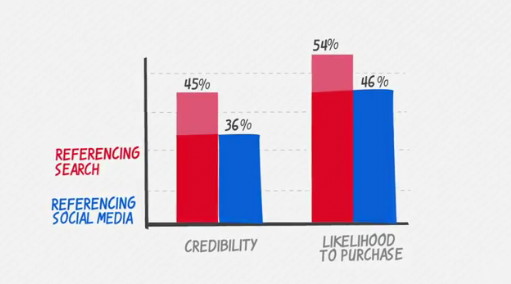
Obviously, Google would not publish it, if search wasn’t the main initiator in conversations as the study claims. According to the study, search is also said to outperform social media when it comes to credibility and likelihood to purchase decisions.

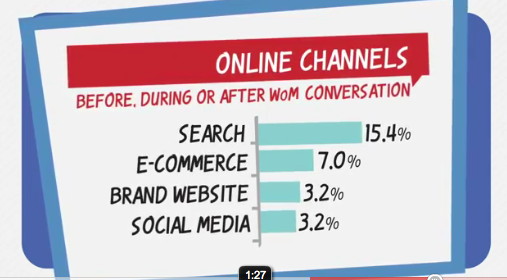
The study video concludes to mention the importance of search which is the leading source that inspires and informs, and thus triggers word of mouth brand conversations, followed by e-commerce with 7%. Social Media and branded websites are coming in at the same level.

Spot On!
The findings illustrate the importance to connect offline and online brand activities. Although search definitely has a major impact on our purchase behavior these days, and especially Google with all their opportunities and different service offerings, I would definitely stress that brand advocates also have a major impact on word of mouth conversations when using them to empower social media capabilities. The study did not use these special people as “online channels” of course. However, think about brand advocates and how you could leverage your brand with them.
PS: The full video can be seen here…
Workspace 1.0 versus Workspace 3.0
17.06.2011 von Martin Meyer-Gossner
Kategorie: Daily Top 3
Is this be a workspace 1.0 versus 3.0 software tool? Or just remain a downloadable app for PC and MAC? Or just a brilliant marketing, or should I say buzz branding idea…?
Some people are worries their bosses might catch them “facebooking” at work. Some people might jut not be able to work with Facebook, or get adapted to getting their brains around working with Facebook. With Excel they know how to do their job. Diesel presents Excellbook. This app is masking FB as an excel chart. Fantastic or best stupid at work?
Will it blend? What is going to become famous? The app, the technology or the brand? Or the workspace 3.0? If the later, then tell me what it looks like, this workspace 3.0!
You decide…!
Oldies but Goldies – Corporate Twitter (cartoon)
17.06.2011 von Martin Meyer-Gossner
Kategorie: Daily Top 3
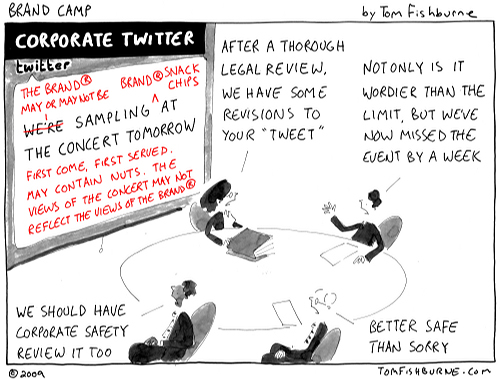
Sometimes realtime business communication gets into the mainstream of daily business, daily decision making and daily spontaneous conversation that keeps our business alive and our tactics up to speed. It’s weekend, so let’s have a meeting to think about our next tweets, discuss them and have a laugh…

Thanks to Lee Bryant who reminded me of this great cartoon by Tom Fishburn.
Study: CEOs say that marketers lack business credibility
16.06.2011 von Martin Meyer-Gossner
Kategorie: English Content, Featured Stories, Web Marketing
It is a harsh statement. It is a statement that undermines the value of leading marketers in the world. But it comes from their bosses: CEOs.
A majority of CEO’s believe that marketers lack business credibility. And it is not only that… Marketers are not the business growth generators they should be and are not focused enough on effectiveness. This is the key findings of a recent report “2011 Global Marketing Effectiveness Porgram” by Fournaise Marketing Group. The report interviewed over 600 large corporation and SMB CEOs and decision makers in Asia, Australia, Europe, and the US.
Nearly three quarter (73%) of CEOs believe marketers are not able to demonstrate how their cross-channel marketing strategies and campaigns help to increase their organisations’ top line in terms of more customer demand, sales, prospects, conversions and market share.
However these findings sound like a slap in the face of marketers, the study makes also clear that vertical metric set-ups are still a challenge for companies. 77% of respondents admitted that they cannot connect EBIT, market valuation or revenues to marketing facts like brand equity, brand values or other marketing ROI metrics.
The study claims that 74% marketers rely too much on the creative element of their job, ‘arty’ and ‘fluffy’ thoughts and too much on their ad agencies to come up with the next big idea. I would like to add that very often publishers make up a lot of these ideas but appear to stay in second line to the client. Just a quick hint to CEO’s…
In some of my latest projects in the last five years, I have seen marketers asking for many and very detailed reportings. The interesting thing is that 70% of CEOs see marketing data marketers provide is hardly useful, or relate to or mean anything for their company’s P&L. Obviously, 69% of marketers say that their campaigns and strategies have an impact on business – but cannot precisely quantify.
“Until marketers start speaking the P&L language of their CEOs and stakeholders, and until they start tracking the business effectiveness of their strategies and campaigns to prove they generate incremental customer demand, they will continue to lack credibility in the eyes of their CEOs and will continue to be seen more as a cost centre than as an asset.”
Jerome Fontaine, CEO, Fournaise
Spot On!
For me one of the main interesting topics is that 74% of CEO’s find that marketers focus too much on the latest marketing hypes (i.e. social media 74%) without explaining the real value it brings to the business. In order to generate ROI, very often marketers are starting discussions with third parties or agencies about latest trends and then jumping on them immediately without even thinking about the ROI it might bring to the business – instead of focussing on where main revenue streams are coming from.
Now, the funny thing is that probably most of marketers won’t comment on these findings, I assume. Although it would help all marketers to start discussing now…