From online to offline with a smile…

We love living digital. We love being online. We love taking our mobiles with us. Anywhere, anytime, any place. However, sometimes people might make fools of us, out of our new digital reality.

In the summer the English National Opera picked up the social networking habits of Twitter and Facebook and created a great commercial that promoted their latest act, transfering our online attitudes to offline. As we all tend to pretend to be friends these days, we sometimes might loose our focus and just make our world seem to be “friendly” and “social”.

And friendly does not mean to make shopping online be easy. Many customer where I have been speaking and doing some consulting business, forget to find out and regularly double-check where their customers are “checking out”. A trend that with Google Analytics picked up with a lovely commercial that illustrates how difficult online shopping might be in the real world. Just think about the annoying digital experiences you have had in the last years, and then transfer them into our offline world. That’s what Google has done.

And it was only a loaf of bread he wanted to buy. It made me smile… And you?

Productivity squared? Future productivity vision 2011 (video)

Many of us web techies have seen the 2009 version of Microsoft’s productivity vision. In their video, Microsoft offered an outlook on how technology could “transform the way we get things done at school, at work, and in the home over the next 5 to 10 years”. Some things have become real in their vision…

Many companies fear that productivity might get lost with the advent of Millenials working in companies in the future. And one things is for sure, screens will change our productivity and our daily working habits in the future.

Also, in their latest version 2011 we can find visions that seem to be not too far away from us, not even visions any more. The video gives still some interesting aspects to think about on how future technology could make our time more efficient to focus our attention on productivity. Now, whether this really strenghtens our relationships when we do different things at the same time, needs to be seen.

Watch it and tell us if this is how you would like to see your productivity squared, and if this is to become real in your future…?!

Is this how Google affects our memory? (infographic)

23.10.2011 von  
Kategorie: English Content, SEO

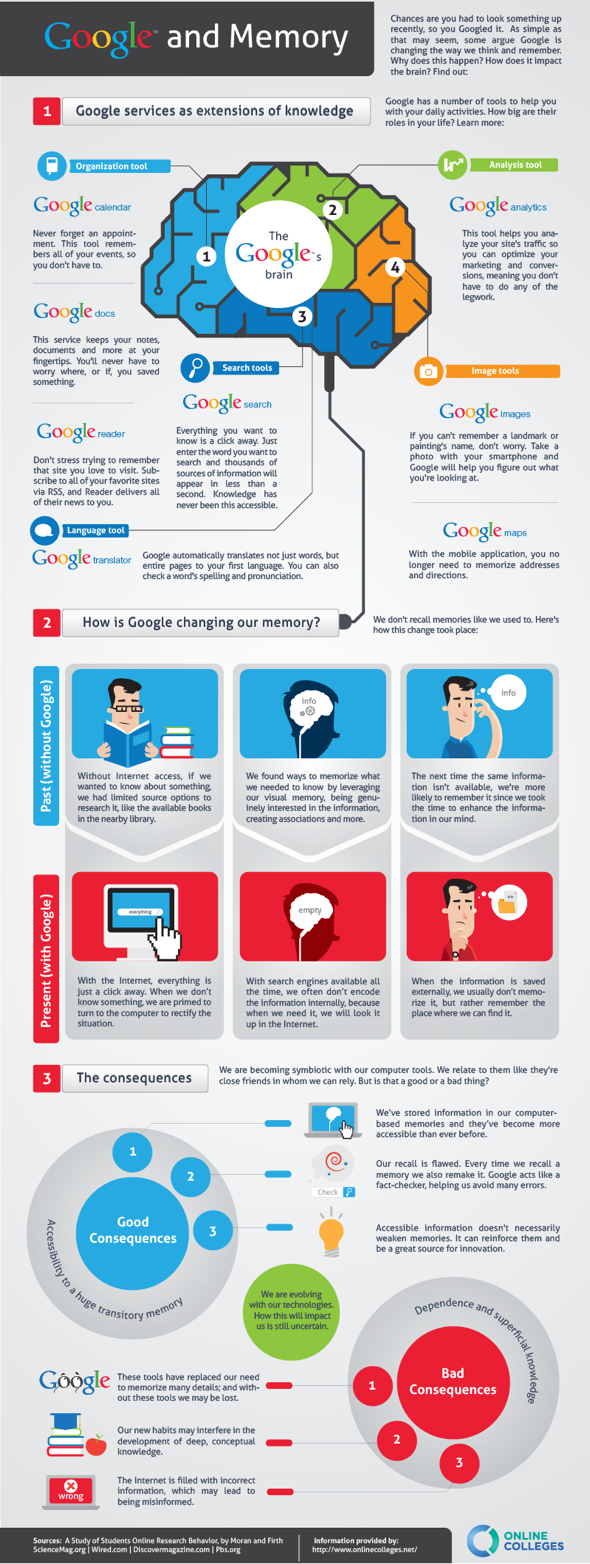
We all rely on Google search to find the truth on our current questions, right? Isn’t it scary in some way? Is Google becoming our brain in the future? What if you cannot find the answer on Google? We all use Google – and not only search. But do we use it too much? Could Google become an intelligence pitfall?

An interesting infographic by Onlinecollege.net on “Google and Memory” explains the impact Google has had and will have in our daily life in the future, especially on our collective memories. The infographic is well created as it separates “The Google’s Brain” into four separate quadrants. And all of us who use Google can see what effect this has on our habits… We don’t need our brain anymore it seems. Google give us all information: “just a click away”, “available all the time” and makes us remember where we stored the information we needed.

Will we forget to memorize? Will we lose conceptual thinking? Will we be misinformed?

1 in 3 of 18-34s will do mobile shopping this christmas

Harald Wanetschka/pixelio.de

Are you going shopping in stores to find some christmas presents? Or will you be doing your shopping tour via mobile? Well, if you use your mobile you are not alone…

According to a UK survey by marketing community site UTalkMarketing and online survey platform Toluna. 32% of 18-34-year-olds will use their mobile to buy Christmas presents this year.

However, this might sound as if only the young generation is shopping via their mobiles, the study makes clear that also older age groups are purchasing mobile with an increasing amount: 14% of 35-54 year-olds and 9% of over 55s year-olds also plan to get their presents for Christmas by using their mobile.

“The fact that a third of young adults are planning to buy their Christmas gifts via their mobile device is proof that the year of mobile-commerce is finally upon us. The fact that most mobile shoppers will do so directly via a retailer’s app is also strong proof that brands wishing to contend in the mobile-commerce arena must do more than simply provide a mobile optimised website,” says Melanie McKinney, Publisher, UTalkMarketing.

The survey questioned 1,300 UK consumers and found that iPhone users are the most likely to make a Christmas purchase via their device. 42% said they will make a Christmas purchase via their iPhone devices. 31% of those that say they will make a Christmas purchase via their mobile will use a BlackBerry and 27% will do so via an Android phone.

However, the advent of HTML 5 is near, apps are the retail channels of choice for the survey’s respondents. 88% of mobile shoppers will only make a purchase this Christmas if their retailer of choice has a transactional app. Only 12% of mobile shoppers will make a purchase directly from a retailer’s mobile-optimised website.

“The results of this survey are a clear indication that retailers cannot ignore the mobile-commerce wave. They need to adapt to and embrace the changing ways consumers now shop,” states McKinney.

Spot On!
Poor shops on the streets… The study is a good proof that mobile commerce is on it’s way towards mainstream. Also, the tablet movement, especially with the increasing use of iPads these days, will change consumer habits to go shopping in the future. Another YouGov survey released earlier this week suggests that 84% of consumers will buy at least one gift online this year with a third saying they will buy all of their gifts online. However, marketers have to be clear about the fact that more than a quarter of consumers (26%) are concerned about privacy issues when it comes to shopping via mobile according to the uTalkMarketing survey.

The 3 R’s of Social Consumers

In the last weeks, I came across the same issue in many meetings with clients. Social consumers increase their use of Social Media and social networks to state their opinion about a company, brand or service. Sometimes to rate the way companies make use of Social Media, or how they engage with them in campaigns or branded social hubs. Sometimes to complain about incredible customer service, or the quality of products. Sometimes just to link or share some content piece that attracted their attention.

The input described above by consumers can be summarized under the 3R’s: ratings, reviews and recommendations. These 3 R’s will challenge companies and brands in the future. Companies know that they have to find a way to deal with all the content published, as well as to establish ways to make use of it in the context of their business.

Ratings
Years ago, we would have seen ratings on Amazon, eBay or rating platforms Ciao. Today, there are external and internal rating opportunities for customers. Most modern content management systems have implemented rating systems. Content and shopping pages have their 5-star systems, percentage scales or „thumbs-up-and-down“ to evaluate the quality of the content or product provided. Facebook, Twitter and other social sharing buttons act in the same way, reach out and distribute ratings to a wider audience to name just some options the social consumer has here.

Reviews
While the chance to find yourself as a brand in a Twitterstorm was low in the past, the tables have turned. Companies like H&M, Motrin or BMW have become victims of reviews in the last years. Whether through crowdsourcing or blogging, reviews could leverage or damage your business success in a day’s time. The question remains the same for brands. Most consumers don’t differentiate between the trusted and personal reviews. In which reviews can they trust, what not, and what could end in a brand nightmare? The list of review sites is long, the one of personal blogs, social networking accounts, etc. even longer, and getting intense the more people review their personal views. And then, organizations have to bear in mind that 97% of purchase decisions are based on digital experiences.

Recommendations
Probably, the most dynamic part of the 3R’s is the recommendations part. In social networks (Facebook, Twitter, Youtube, LinkedIn) people hint, share and forward quick opinions about a film, a hotel or a show in minutes – and forget about it. Companies and brands need to take a position on these recommendations, or clear up the damage as best as they can. Well, if they find them and have the processes, people and resources in place to react. Some recommendations are still in the stealth mode as of semantic detection issues, or as they are only shared within the social graph of a person. And some recommendations are not even recommendations. They get catalyzed through social banner opportunities with Googe Plus buttons inside Google ads or via recommended people of the personal social graph in Facebook ads. And some will stay invisible for brands – most offline spoken words.

Spot On!
The challenge for companies in the future will be to educate social consumers on their way to social purchase. Social consumers often don’t pay attention to who said what, their gender, habits, age and preferences. Customers tend to be affected by a negative scale although it may be positive. 97% is not 100%, 4 start is not 5 star, the last opinion that was the only one negative, and so on. Most consumers don’t check who or how many people have rated the hotel on tripadvisor or booking.com. So, what is better? One rating in the 100% range, or 5 ratings getting 95%? A review where companies can react and improve the quality of their service? Or a recommendation that they could use as a statement to their blog? In my eyes, we will need to have seal of quality buttons that tell people to be aware of the fact that the 3 R’s are a good orientation for quality but not the final truth. And marketers should think about the best alternative to straigthen and strengthen their brands whatever effective the 3 R’s might be for their business.

Would you agree…?

AddThis: Sharing trends based on last 5 years (Infographic)

A while ago, ShareThis shared their insights why people share content. And also this year, bit.ly stated in a research they did that the half life of a link is approximately three hours.

Now, AddThis (1.2bn monthly users) is following their approach with an infographic on their 5th birthday to visualise user behaviour around Social Media sharing trends across the social web.

If you plan your next viral campaign you might consider time and day: 9:30am and Wednesday are said to be the best peaks for shareable content. Most users share content within the first 2 minutes. And 75% of shared content occur within the first day of a share. Interesting though is the fact that cut and paste sharing can still be up to 10x more used than the well-known social sharing tools.

PS: The average Twitter user shares half a tweet per day, according to Twitter CEO Dick Costolo

Study: Social Media & Workplace? Are policies a must…?

Credits: Gerd Altmann / pixelio.de

The conversation around the value of Social Media at the workplace was always based on the topic productivity and policies. Shall a company live an open door policy for “social” websites? Shall they allow access to Facebook and Twitter? Shall they rely on them in terms of knowing how to achieve their business targets while being available during working hours for all of their friends, fans and followers?

The question is… Are Social Media guidelines necessary or are employment contract not offering enough guidelines for the use of Social Media at work, too?

For companies it is a challenge to manage employee’s use of Social Media. A new study by DLA Piper now found that one third of employers have disciplined employees for something posted on a Social Media site. It also states that 21% of employers have given warnings for posting something derogatory about a colleague or the business.

Although I would have thought that most employees today know the relevance and impact of Social Media, the study makes clear that companies need Social Media policies. However, it also found that three quarters don’t have any Social Media policies.

Some key findings of the study illustrate some negative development where many of us might think, people should be clever enough to understand the meaning and reach of their words on the Social Web. Some use Social Media too often, some inappropriate, some unclever…

- 31% of employers have taken disciplinary proceedings because of information an employee has displayed on a social media site about the organization
– 30% of employers have taken disciplinary proceedings because of the level of usage of social media sites while at work
- 25% of employers have taken disciplinary proceedings because of information an employee has displayed on a social media site about their activities at work
- 21% of employers have taken disciplinary proceedings because of information an employee has displayed on a social media site about another employee

Some further findings also show that people need training on how to manage the relationsship and converations they have during working hours and with colleagues. Employees who use Social Media for personal use…
- 39% have befriended a colleague or business contact in Facebook
- 39% have connected to a colleague or business contact on LinkedIn
- 28% have posted photos of colleagues or business activities
- 22% posted a status update or tweeted about a colleague
- 14% have posted a status update or tweeted about work issues
- 1% have posted confidential business information

Spot On!
The business world is changing. Colleagues connect with each other on different social platforms – no matter if for private or business use. Having a personal Social media strategy where people might not connect with colleagues on Facebook but prefer LinkedIn might become a problem as they might loose out on conversations and information between the lines. On the other hand, people might use it too often to connect with them. Whatever people do, they might use Social Media wrong… in the eyes of employers… at the workplace. Thus, companies will need to have Social Media policies in the future (see international database of Social Media policies). And employees need to find a way to deal with them… Or do you see some other opportunity?

European Study – iPad becomes most popular internet device at home

In America, the iPad is the driving more traffic than smartphones already. But how are Europeans using the iPad? Sanoma has carried out a study in six countries in Europe (Netherlands, Finland, Russia, Hungary, Belgium and Germany) and surveyed 3,673 users. The average respondent was 39 years, and has high educational levels, with professional and academic qualifications.

The research illustrates that the iPad is a family device, and in second place used on holiday and when traveling. It replaces the importance of laptops and desktops, and becomes the primary computer at home. 73% of respondents use their laptop or desktop computer less, and 38% even their mobile phones.

People use the iPad predominantly in the evening (83%) and in the mornings (70%). 94% use their iPad several times per day with half of these spending between 30 minutes and 2 hours on it. Around one-third of respondents have downloaded more than 50 apps.

Germany (54%) and Hungary (41%) have the most users with more than 50 apps. Over half the respondents have paid for more than 6 apps. In general, women download fewer apps than men. Surprisingly enough, women play more games than men.

The iPad is a must have in Russia. Some households in Russians even own four devices. Whereas in Finland the iPad is more often used on the move, in Russia and Hungary it becomes the main computer at work twice as much as in other countries. And Germany even makes it to 4 hours usage time or more a day.

Spot On!
The owner is by no means the only user. More than half (67%) of the iPads are actively used by other persons (over 30% children!). This must be a nightmare message for marketers. Just think about what this means to targeting advertising to an iPad user…

CMO’s studies: Yes, Social Media is key! – Can someone gimme a plan on “Social”…?

CMO’s and marketers all over the world and across industries understand the increasing value of Social Media in (their) business. However, I sometimes wonder whether they really recognize how to use Social Capital and Social Business effectively.

How did I get this view…?

Well, studies show me the reality… and many seminars and webinars open eyes. Today, I came across two studies which might illustrate what marketers and CMO’s need to get their heads around. If they are good, they create brand advocate programs, if they act badly consumers will see brands as boring, poor, and even worse… not obeying the rules of social business. And today brands cannot miss out on “Social”. That is a fact, CMO’s understand…

Market Research vs. Social Research
In one of the latest IBM studies of 1,700 chief marketing officers from 64 countries and across 19 industries, 82% of CMOs stated that they will increase their use (or budgets?) of Social Media over the next three to five years. The flipside is that just 26% are currently tracking blogs, 42% are tracking third-party reviews and 48% are tracking the consumer reviews which might help change their market positioning, their marketing insights, their marketing programs. Let’s take the qualitative aspect of Social Research first.

From a quantitative research perspective, 80% rely on market research and corporate benchmarking to rely on as their primary sources for market insights. Obviously, most companies also obey other “non-social” monitoring tools to value the development of their business: 68% use sales campaign analysis for strategic decision making.

In the end, it comes down to numbers. 63% of CMOs believe the ROI on their marketing invest will be the primary measure of effectiveness by 2015. However, almost half of respondents don’t feel prepared to satisfy those business figure aspects. The reason is obvious: CMOs often don’t have enough influence on radical company-wide change processes. Over half of responding CMOs stated they have no impact on pricing process and even less have any impact on new product development or retail channel selection.

Community and Brand Reputation
On the other hand, another new Weber Shandwick study found out how companies understand and plan their social efforts. So, why are some marketers more social than others?

The challenge is to find the key tactics with best possible metric efficiency. Most marketers know about the impact of the 3 “r’s”… reviews, ratings, recommendations on their business efforts. 52% attribute their brand reputation to their online social presence. And even more, 65% project online sociability will boost their reputation in the next three years. However, I would doubt if they act accordingly.

Today, Social Media is part of CMOs marketing mix. The question is, why only 16% consider their efforts as “world class”. This study also makes clear that marketers have trouble establishing clear goals for their social media strategy. Finding the right KPIs is essential. No wonder, companies state they are not well-prepared for the social future in terms of effectiveness. Most o fhtese companies don’t really integrate their social engagement into their enterprise processes.

Spot On!
CMO’s and marketers need to get insights beyond traditional market sources like page impresions, click-throughs and superficial numbers like fans and follower. The good spot is that 54% of global executives experience rewards to outweigh risks – versus 23% the other way round, and some European bosses even focus their attention preferably on Twitter. Although, C-level often does not know how to leverage Social efficiency. The community gives input on the value of products, services and preferrences. When did we have that years ago?

Somehow, marketers are in a poor position as they are working in the transition period. Top down target-group thinking is out, community centric thinking is the future. In some day, we will publish a new strategic theory on this at the IBM JamCamp. Nice coincidence…

Study: The Social Customer – How consumer get influenced by reviews and recommendations…

We all know that we get influenced by the 3 R’s that people publish on the Social Web: reviews, recommendations and ratings. Now, there is some more proof with the study “2011 Cone Online Influence Trend Tracker” by Cone Communications. Positive and negative information found on the Social Web have the same massive impact on how people change their minds after having received purchase recommendations.

The study shows that more than 80% of users change their minds after reading reviews whether positive or negative.

Positive reviews confirm the process of consumer decision making. 87% of the repondents were agreeing a favorable review has confirmed their decision to purchase. Still, negative recommendation can also turn down a recommended purchase. Interesting for me was that blogs get tracktion as a credible source of information when researching products and services online – an increase by 20% to 2010.

In terms of trustworthy information source, people respect the fact that somebody has used the product or service in the first place (69%). Obviously, recognized experts with product or service expertise com in the top end position (60%) when it comes to trust. However, Social Media gets more importance from a marketing perspective when people trust someoone when “he/she has a lot of social media followers” (8%).

Finally, the higher the costs for the purchase are (i.e. cars), the more likely are people to verify the quality of the product and service online. However, moderate- and low-cost purchases are also quite likely to be verified online.

Spot On!
The study is a great support in the assumption that the influence of the social customer’s has essential power in changing mindsets on purchase decisions. The experience and feedback shared on the Social Web will influence the sales funnel in the future in a way we cannot foresee yet. What is definitely clear is the fact that sales people and marketers have to change their approach on how to interact with these reviews, recommendations and ratings. This is where the competition in the sales funnel will be decided, and in the end lost or won…

Nächste Seite »