TV & Online: Convergence or Collision?

In the digital tech space, we’re already seeing radical changes in television as it begins to converge more and more with the online world. Think about the massive transformation that TV has already gone through – starting with the humble video recorder to the range of connected satellite / cables boxes and gaming consoles – fundamental changes that TV is now more or less just a monitor. Not so very long ago, TV used to be considered the “lean back” medium and digital as “lean forward.” But, this no longer seems to apply as we increasingly use multiple connected devices to watch TV content and that large screen in the home is often hijacked by our game-playing teenagers. So, what’s going on? Is TV having an identity crisis or are we finally at a point of convergence or collision?

MediaMind recently held its annual Digital Experience Day (DED) 2011, a global summit series held in North America, Europe and Asia, that brought together leading industry leaders and experts to explore the consumer changes that are happening now. We explored the interactive and social experience that TV now provides. TV no longer offers a passive, social experience where one has to huddle around the same set and fight for the remote control. In fact, traditional ways of viewing television are now competing with the plethora of tablet devices on the market that keeps viewers entertained and occupied from just about anywhere they choose. But it’s not just about replacing the larger screen with smaller ones, we are increasingly bonded around quality content – from TV shows to interactive games – and utilizing Social Networks to fulfill those real-time experiences and discussions between multiple viewers scattered across numerous living spaces.

Recent research from Nielsen shows that the average US home with a cable subscription receives 130 channels and yet tunes in to only 18 channels. That means 86% of these channels are never watched, suggesting that channel surfing is dead; challenging costly cable subscription models. And yet, of the $500 billion in global advertising, TV advertising still takes the lion’s share. By 2015, it’s expected that 50% of Internet users will watch TV content through online connections.

But that’s not to say TV as we know it is dead; quite the opposite. TV has a quality and scale that digital has yet to achieve. We will always need linear video content, but we just won’t need to consume it in the same way that we used to. We are now in the beginning stages of the marriage between online and offline. And for this to work out successfully, TV planners need to understand how digital works and vice versa. We are already seeing agencies using an iGRP to buy reach across media channels to maximize cost-efficiencies. These agencies are hoping to have completely integrated media buying teams within 18 months.

It’s both a convergence and a collision. On one side, we have a chance to reset our thinking and talk about enhancing the branding mechanism by overlaying interactive experiences via a mobile device and measure TV content through real-time social discussions such as comments on Facebook and/or Twitter. Yet the danger is as we seek to measure TV in the way we do online, it runs the risk of squeezing TV advertising budgets to the likes of online DR forced to justify spend via call to action. There are interesting times ahead for the whole media community and it certainly was the hot topic of debate at DED as we debated through the challenges of moving towards app-driven Smart TVs.

This guest post was written by Dean Donaldson, Global Director of Media Innovation, MediaMind. Dean and I often meet at different international conferences and events to chat about the future of the web world. You can read my view on the DED2011 in the post The multiscreen world is evolving.

Pay a Blogger Day – How to reward a blogger’s work?

Have you ever paid a blogger? Paid for your content love? I mean not for writing some good PR for your business. Just for them being bloggers, sharing valueble content, thoughts, ideas, and providing new food for thought. In some days you can do that. The “Pay a Blogger Day” is here to come. Some thoughts that came to my mind with it…

Some months ago, Flattr started their outreach program to bloggers. And some months ago, they were on their way to revolutionize the monetization of blogs. Those days, the Flattr button went live on my blog, and in every post. I rewarded blog posts, and got some rewards. Just the way Flattr works. They had the idea for the “Pay a Blogger Day”.

On Flattr Cents pass from bloggers to bloggers to… Well. Companies never paid anything. They have the biggest budget pockets though. And I asked myself if bloggers want companies to engage in the monetization process, or if reputation is of higher value for them. And why should companies pay a blogger for something they produce for free. Still trying to figure that out…

Some blog posts generated some Cents immediately through Flattr, never enough for some nice ice-cream in a week though. Somehow the activity to “donate” for a well-written piece of thought or idea felt like an act of charity. Some Cents felt like a pat on the shoulder. Sometimes, I discussed with bloggers if that is encouraging, or frustrating? Every blogger argued differently about this gesture. Many were not convinced. I have seen not many buttons on blogs since.

And often when I wanted to spend some Cents, those bloggers did not use Flattr. So, my reward for them often ended in a Retweet. Maybe Retweets are the killer of positive blog comments

The main problem many bloggers saw in Flattr was that it will be challenging to get attention for this payment theory outside the bloggosphere. Sounded like: “Bloggers will pay themselves and thus reward their work within an inner circle of the blogging community.” One of the reasons why I finally decided to remove the button from my blog.

Now, Flattr starts -in cooperation with Bambuser, Twingly and Posterous- the “Pay a Blogger Day!” on November, 29th. They intend to start a movement with the mission “Give something back to bloggers!” A good idea…

How to reward a blogger’s work?
If I may inspire you -companies, marketers and managers- with reward opportunities for bloggers, then maybe you want to read this…

a) Companies that have used shared knowledge to improve their business could write a reference quote for the blogger why and how they benefit from reading a blog. It could be a comment, tweet or a blog post on their blog. Just be creative…!

b) Managers that have used shared knowledge for their career purposes could send a present when they think the blogger has deserved it (does not need to be on the “Pay a blogger day!”). A flower (digital or real), a freebie of your products or an invite to a paid for workshop about corporate blogging. And hey, chances are high, bloggers might write about it. Just be clever…!

c) Marketers that have used shared knowledge for their campaign ideas could start thinking about whether they shovel money into a print grave, rely on TV reach or hope for radio commercial payback. Maybe they want to start sponsor a blogger who is worth it as they act like brandvangelist, testimonial or brand advocate for a brand or company. And why are not many marketers trying to make use of bloggers in the offline world? Just be curious…!

d) Followers, fans, “plusers” and bloggers that have used shared knowledge could start discussing the monetization of their work in an authentic collaborative manner. Do you want banners ads, text links, affiliate programs, brand advocate prgrams, or…? What is authentic blog monetization? Or is it reputation only? In short: money, products or reputation currency like Floout.me?

Here is how Flattr wants to inspire you to reward a blogger…

Think about the thoughts and then start acting! I am sure, bloggers know how to say “Thank you” and all bloggers would love to see some of these rewarding opportunities. Right…?

National Geographic makes Augmented Reality go live…

The opportunities to attract peoples’ attention are increasing with the use of Augmented reality. Appshaker recently launched a fantastic way for people to interact with the world of National Geographic Channel’s content from around the globe. The set-up obviously took some budget. With the use of augmented reality, people could virtually interact with different scenes in which they were able to get in touch with dolphins, leopards, the space landings, dinosaurs and more.

The result..
1000s of people interacted with the National Geographic Channel brand in the process as it toured Hungary, with 1000s more people sharing snapshots and video on Facebook as a result.

Live Augmented Reality for National Geographic Channel / UPC from Appshaker Ltd on Vimeo.

Active or passive? Don’t forget the “Social” in Social Media!

The last two weeks I have been on the road in Germany, Austria and Italy, and it was great being in the offline world. Speaking engagements and panel moderations with real people, virtuals aside most of the time. Sometimes I went online in the breaks but did not know what to post or what value I could share with my social graph. Sometimes as there just was nothing exciting. Sometimes as time did not allow it. And to be honest, I did not even have the creative spirit between webinars and seminars for my quality standards. Productivity had to come to a rest.

I just preferred being quiet. And guess what: It does not hurt! Probably nobody missed me. My messages. My input. My sharing.

Often I just reacted. Saying “Happy One!” to my friends or business partners. Giving quick feedback on questions I was not even personally addressed. People liked it though. And I realized how great it is to work with teams that appreciate the ideas and thoughts you give just them without sharing every joke or funny story straight away. I found that approach of doing conversation and being productive quite “social” last week.

Stimulation instead of penetration.

At some stage I wanted to participate and be more active in the conversations with my social graph again. So I checked Twitter what’s up. In the first five tweets I found the video below which was a perfect kick-off for the training I had the pleasure to do. A big insurance company had offered me the chance to train their coaches and internal personal (executive) consultants on Social Media strategy.

I started off with the video below and I can assure you: We came back to the message of the video, the tactical ingredients and the strategy topics at least 25 times in two days. And I told them again and again… “Don’t forget the “Social” in Social Media! Let’s be honest: How often do we forget it?

Profiling the social customer (infographic)

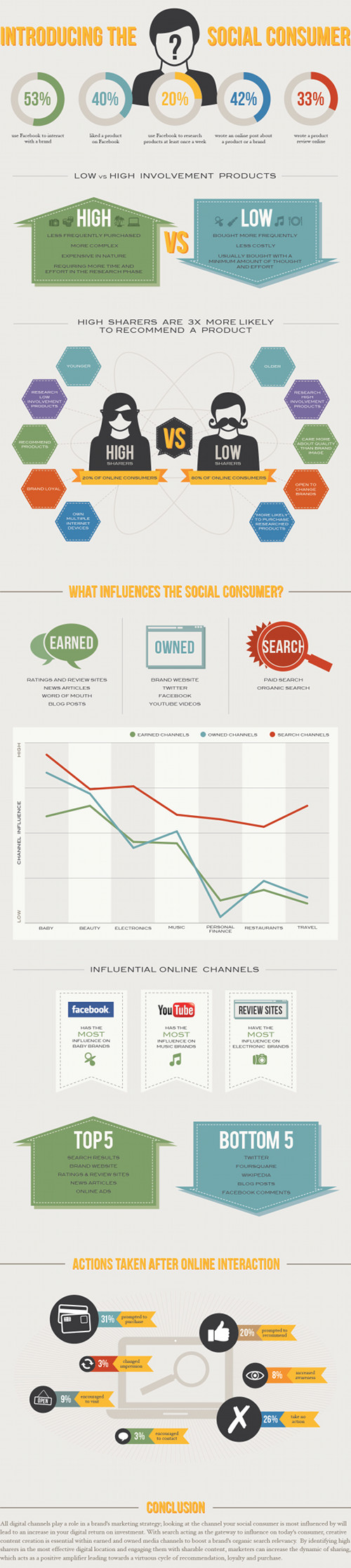
If marketers are looking to understand the profile of a social consumers, they need to have deep insights into their souls and needs. Beyond Digital has asked 3,000 US and UK consumers about the two products and services they had most recently researched online and which steps take them through the purchase process.

Apart from showing gender differences, sharing becomes the main element of strategy. The social consumer is a two-faced personality: First, they can either be categorized as a high or low sharer. A human being that utilizes differtent digital channels in a different manner, depending on whether he or she is researching and interacting with high or low involvement products. Those with a high sharer profile are the most valuable for brands. They recommend products 3x more often and influence others’ purchases…

Study: Mobile and TV – Users beloved combination…

Some weeks ago, I have written about ConnectedTV as the new hype. And we have acknowledged that mobile apps and TV have got TV primt time as the main usage time. Still, we don’t really know how much people use mobile and TV at the same time. A new study sheds some light here…

According to a new survey issued by Yahoo and Razorfish, 80% of web-enabled mobile device owners say they multitask while watching television. They rely on smartphones and tablets to communicate with friends and family. They look up content which is related to the program they’re watching. They might also access information which has no relationship with the TV program.

And the combined usage of mobile and TV is not low. The study shows that 70% of mobile multitaskers use both platforms at least once per week. 49% even report multitasking daily. Over 60% use their mobiles at least once or twice during a TV program. And 15% don’t leave the mobile web for the time of the show they are „watching“.

The main categories for multitaskers are: reality, news, comedy sports, and food. The statement “Using the Internet on my mobile or tablet device while watching TV enhances my viewing experience” was agreed by 38% of the respondents. Nevertheless, another 38% „find using mobile devices while watching TV to be distracting”. Text content leads all channels, beating talking, email, social networking and IM.

“This seems to be an opportunity for content producers and advertisers alike. Some people find multitasking to be a boon, and we have only begun to scratch the surface in terms of providing an engaging dual-screen experience. It’s like the early days of smartphones where it was remarkable that people were making purchases from sites that were not mobile-optimized. If folks were willing to go through that much effort, it stands to reason that making the experience easier and more streamlined will lead to even more passionate participants.” Jeremy Lockhorn, Vice President Emerging Media, Razorfish

Some more findings from the study…
• 94% of multitaskers engage in some kind of mobile communication
• 58% of men “fact-check” information on their mobile browser while attending a live sporting event, with 47% checking out scores of other games and player updates.
• 52% use their mobile device to escape awkward social situations
• 44% seek information unrelated to the current program – 38% searching for data related to it
• Apple’s iPhone 4S leads all mobile phone searches according to Yahoo Shopping data, followed by the Samsung Galaxy S2, the Samsung Galaxy Nexus, the Motorola Razr and the Nokia N9

Spot On!
Men seem to be more comfortable with mobile shopping processes. A former Performics study suggests that men are social shoppers and women the “Likers”. This study also finds that 70% of men under the age of 35 have made online purchases on their smartphones, compared to 64% of women in the same age demographic. And obviously the extention of TV to mobile starts to work: 36% say they go looking for more information related to a commercial they just viewed. Marketers need to start thinking multiscreen when planning their campaigns and ideally sync their mobile and TV campaigns immediately…

How students see the future workplace (infographic)

Foreseeing the future workplace might be a challenge. Especially, if you think of the digital native generation (millenials) some IT decision maker will get grey hair, in terms of policies and mobility aspects.

Most people in the UK (58%) say, the traditional office will be extinct by 2021. In their Technology Report Cisco was asking 2.800 college students how they see the future workplace and what they expect from it. 69% of students don’t see the necessity of an office in the future – an increase by 60% compared to last year.

Study: Men are social shoppers – Women the “Likers”?!

Jeanne Müller / pixelio.de

Sometimes studies find truths that don’t really match the expectations, or should we say the gender specific shopping prejudices? A recent report ROI Research illustrates some surprising facts which might eliminate these shopping behavior prejudices – at least from a social customer point if view.

The study we are talking about was conducted by Performics and analyzed the feedback of 1.000 social network users that use the Social Web “at least occasionally in the purchase process”. The results state that men are more likely to use social shopping and research sites before making a purchase.

According to the study men frequently research product information, compare products, read reviews, research availability and get store information via social networks, shopping and deal sites. Women are far more likely to search for deals, coupons and special promotions on social sites.

“Women are reported to control about 80% of household spending, so it may be surprising for some to see men play a more dominant role in the social shopping and research process. But given recent reports of ‘digital dads’ and increases in shared shopping activities across genders, this new data is intriguing.” Dana Todd, SVP, Marketing and Business Development, Performics

Some more key findings from the Performics’ 2011 Social Shopping study
- 63% of men use shopping sites vs. 52% of women.
- 62% of men compare products on shopping sites vs. 50% of women;
- 57% of men research products on deal sites vs. 40% of women.
- 54% of men use social networks to research products vs. 43% of women.
- 56% of men compare products on deal sites vs. 41% of women;
- Men are more likely to use their mobile device in-store to compare prices – 62% vs. 50%.
- Men are more likely to visit a company or brand’s social network page – 71% vs. 64%.

Spot On!
Although men are heavy social shoppers, women are bigger “Likers” and use Social Media and Mobile platforms and technologies differently. After visiting a page, women are more likely to press the admiration button (78% vs. 72%). Another research by Shoppercentric shows that online retail sites better support male’s needs. They also found that men tend to spend more money online than women (£391 vs. £131) – but only if they have a need to buy something. Some Jacobs Media study also reveals men are the new decision makers in the categories of car maintenance (82%), clothing (80%), sporting events (67%), electronics/media and DIY (64%) and investments (63%).

Now, I am interested to see what men and women are thinking about these findings. Wouldn’t it be cool if ebay or asos are doing such a research? Give us your thoughts please…

Study: Users „like“ brands for deals, discounts and coupons

Harald Wanetschka / pixelio.de

While Vitrue just found out how to get more “Likes” and engagement on mobiles, another new study by Nielsen/McKinsey’s NM Incite shows what the real value of “Likes” is. Although many brand marketers are working on the ROI, most companies still try to find some more value in the social engagement of consumers.

The Nielsen/McKinsey’s NM Incite global online consumers’ research states that the main reason for following or liking a brand or company on social networks is to receive discounts and special offers.
“While some may argue that consumers’ interest in discounts has faded, Nielsen data shows the desire for deals is still strong worldwide,” concluded NM Incite.

The results correspond with the study by ExactTarget and CoTweet from last year. The former study made clear that 40% of brand fans like a page predominantly for their doscounts and promotions.

The new NM Incite finds even higher figures. Almost 60% of US social media users visit social networks to receive coupons or promotions. And even more, 23% do this on a weekly basis. 45% of North American consumers had the strongest interest in using social media for deals, followed by consumers in Asia-Pacific (34%) and Latin America (33%).

Social deals hunters “Like” at home and at workplace
For most people it does not matter whether they are at home or at their workplace when using the benefits of the Social Web. A sample of ten major markets shows that nearly 40% of active Web users check coupons and rewards sites such as Groupon, Coupons.com and Living Social from home and work computers in September. However, there are respondents -under the age of 20 and 55- to-59-year-olds- who were less likely to follow brands for discounts. Here friends’ recommendations are the drivers for social engagement.

Spot On!
“Social deal hunters” are obviously also visitors of social networks and blogs. NM Incite found a strong overlap. In their test phase in September, 43% of visitors to social networks and blogs also visited a coupons or rewards site. And, 44% of Facebook’s audience and 63% of Twitter’s audience visited these deal sites. The study concludes that Facebook becomes a key source of traffic to Groupon and Living Social. Groupon’s and Living Social’s visitors came directly from Facebook. This also shows the link between deals and social networking sites, and how companies can motivate consumers to deals.

Inbound Marketing is the key to B2B Social Media

As I am doing many webinars and seminars on B2B Social Media, it is always good to get and share some of the information and data that will help marketers understand the opportunities of Social Media. The expensive outbound marketing tactics will lack behind to the cost-effective inbound marketing efforts that micro-blogging, blogs, videos and webinars could provide to prospects.

The challenge will be to enbable a cultural change inside the company where content, context and collaboration can grow. Where employees can create intelligent, educational, entertaining and remarkable input for their customers – and ideally they share it with the quantity and quality streams of their networks and social graphs.

The below infographic includes many of the B2B social media statistics. A clever approach from them to create an infographics which other people will be sharing, and thus spreading the word in favor of B2B Social Media blog, published by Kipp Bodnar and Jeffrey L. Cohen.

Nächste Seite »